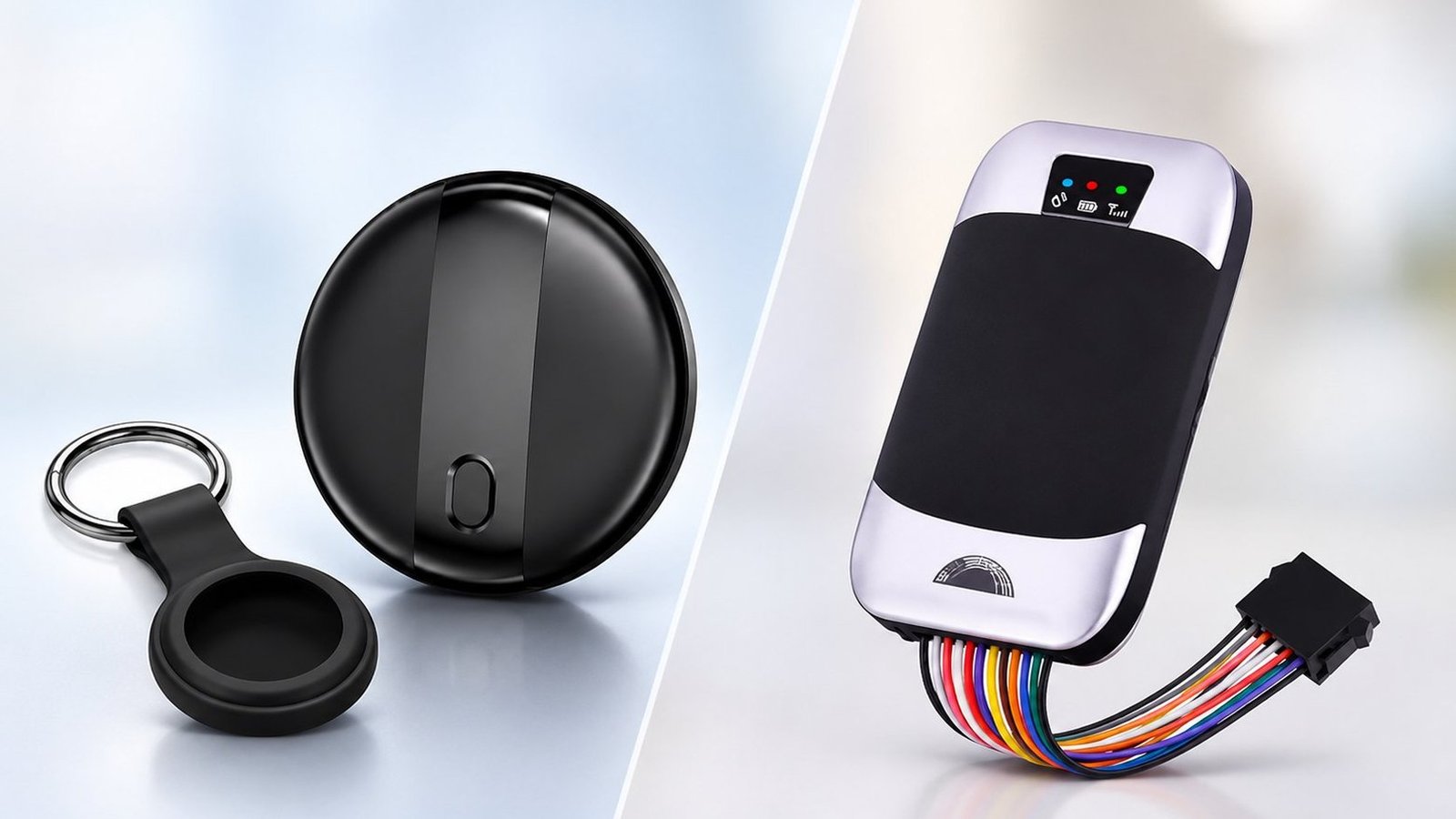
A tracker rated for a year that dies in three months usually is not faulty. In most cases the tag is fine and the coin cell inside it is the problem. The published standby figure assumes a good CR2032 and typical use. A weak cell, a freezing car, a buzzer that rings every time you walk away, or a coating that blocks the contact can cut that year down to a few months.
This guide walks through the six causes we see most often, the checks that sort them out, and what to ask for when you source trackers under your own brand. Every number below comes from a published cell datasheet or from a SUNDA product page, not from a rule of thumb.
Quick answer: fit a fresh CR2032 from a known brand, check the date code on the pack, and turn off separation alerts for tags you leave behind on purpose. Those are the first three things to try before you replace the tag.
Where the One-Year Figure Comes From
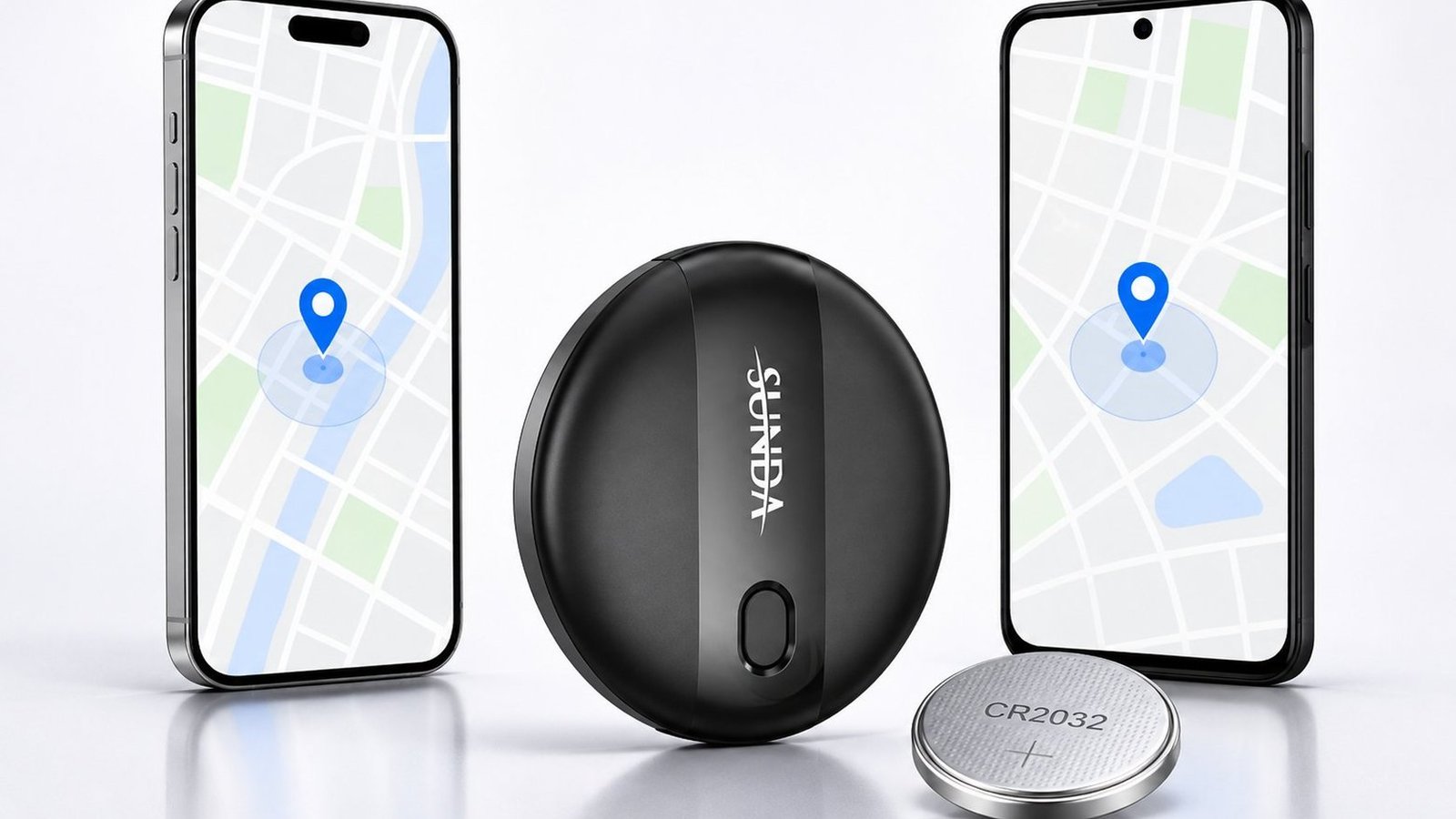
Most Bluetooth trackers run on a CR2032: a 3 V lithium coin cell, 20 mm across and 3.2 mm thick. Apple fits one in AirTag, and SUNDA’s FD2601 Bluetooth tracker uses a user-replaceable CR2032 behind a tool-free battery door.
SUNDA rates the FD2601 at more than 12 months standby under typical use. The same published specification lists Bluetooth 5.0 low energy, a built-in anti-loss buzzer, a working temperature of -10°C to 55°C, and a 31.75 mm by 7.62 mm ABS housing. That is a standby rating for a specific tag and a specific cell, not a promise about any replacement cell you buy later.

12+ months is the rating. Three months is the complaint. The gap is almost never the radio. It is the cell, the load pattern, the temperature or how often the buzzer fires.
Capacity is measured in a lab under conditions nothing like a tracker. Murata’s CR2032 specification sheet (SS-CR2032-2023-01) rates 220 mAh at 23°C through a steady 15.0 kΩ load down to a 2.0 V cut-off. The Energizer CR2032 product datasheet (Form 2032NA0618) quotes a typical 235 mAh to 2.0 V, rated at 15 kΩ at 21°C, and lists self-discharge at about 1% per year.
A tracker does not draw a steady 15 kΩ. It sleeps, wakes, sends a short Bluetooth burst and goes back to sleep. That difference is the whole problem.
Notice that both datasheets quote capacity against a gentle, continuous load. Neither one claims that figure describes a pulsed radio load. Keep that in mind when two cells with similar mAh labels behave differently in the same tag.
Reason 1: The Cell Cannot Handle Short Bursts
A tracker sleeps at a tiny background current. Then it wakes and transmits a short Bluetooth burst. Each burst asks the cell for a sudden spike of current, and the cell’s terminal voltage dips while it delivers it. How deep that dip goes depends on the cell’s internal resistance.
Cell makers know this, which is why their datasheets separate the steady rating from the pulse behaviour. The Energizer CR2032 datasheet publishes a pulse test with a 0.19 mA background drain through 15 kΩ and a ~6.8 mA pulse through 400 Ω for two seconds, twelve times a day. It prints internal-resistance curves beside the continuous-discharge curves. The same cell is characterised two ways because those two loads are not equivalent.
A high-resistance cell dips further on each burst. When a dip falls below the voltage the tag needs to run, the tracker shuts down with charge still left in the cell. Two CR2032s carrying the same printed mAh can therefore behave very differently inside the same tag. The label alone will not tell you which one sags under a pulse, so ask the supplier for the cell’s datasheet and pulse characteristic rather than just its capacity.
This also explains a confusing symptom: a tag that looks dead can sometimes report again after a rest or after you reseat the cell. The cell was never empty. It just could not deliver the last burst at that moment.
Reason 2: Cheap, Old or Unbranded Cells
An unbranded cell from a bulk pack often ships with no published datasheet at all. There is no load characteristic to check, no date code you can trust, and no record of how it was stored. Capacity and internal resistance can both be worse than the label suggests.
Coin cells do lose charge on the shelf. The Energizer datasheet lists self-discharge at about 1% per year, and the Murata specification recommends storage at 5 to 35°C and 45 to 85% RH. Murata also notes that high-temperature storage accelerates deterioration and shortens usable time. A pack that sat in a hot warehouse for years starts its life in your tracker partly used.
The fix is boring but effective: buy a known brand from a trusted retailer, read the date code, and avoid the cheapest bulk pack online. If you are buying cells at volume, ask the supplier for the datasheet and the production date before you place the order.
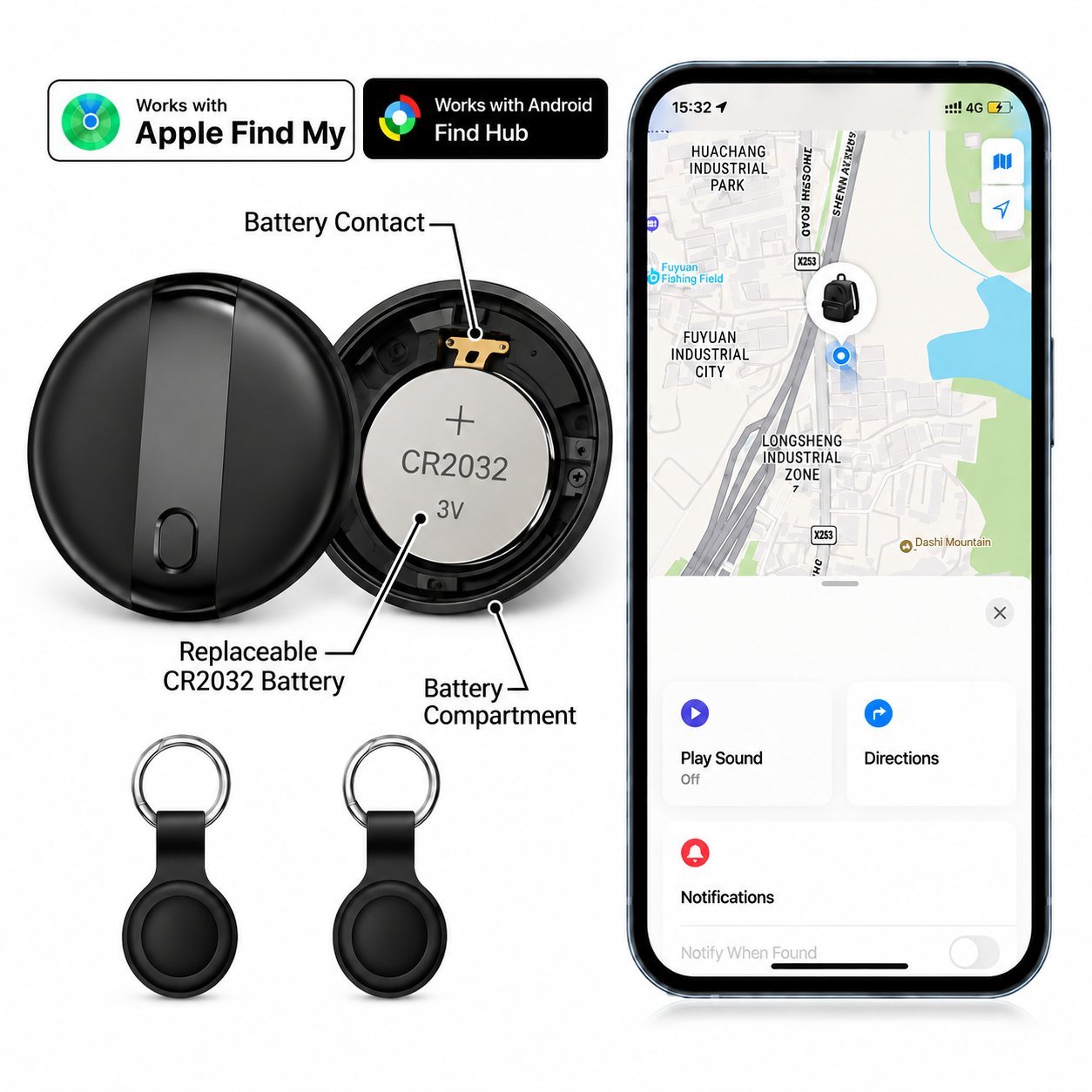

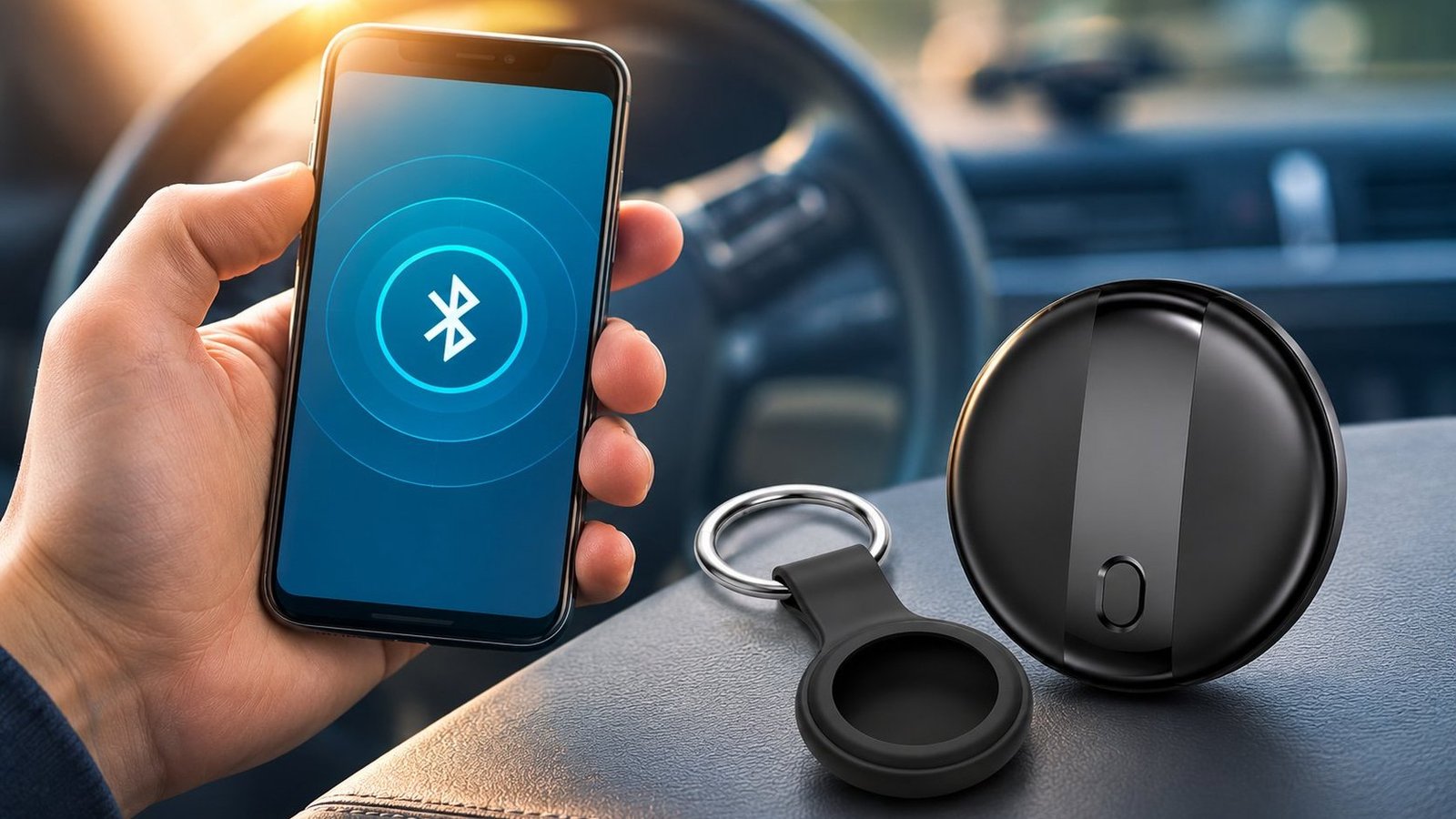
The two images above show what is actually inside the tag: a 3 V CR2032 in a user-replaceable compartment, and the Bluetooth connection and sound alert that the cell has to power.
Reason 3: The Buzzer Rings More Than You Think
Sound is the loudest load on a small tag, literally. A piezo buzzer draws far more current than a sleeping Bluetooth radio, and every ring costs the cell real charge.
You might ring your tag yourself once or twice in a typical week. Separation alerts ring without you. The FD2601’s built-in buzzer sounds when the tag moves out of Bluetooth range from the paired phone, as well as when the owner taps Play Sound in the app. A tag that lives in a parked car, a drawer or a suitcase you walk past will ring each time you leave it behind.
If your app allows it, switch separation alerts off for items you leave behind on purpose and keep Play Sound for when you are actually looking. SUNDA’s Bluetooth tracker series page also states that the standby rating differs by model, so ask for the figure that applies to the exact model you are quoting rather than assuming the year-long figure covers the whole range.
Reason 4: Cold Weather
Cold slows a lithium coin cell’s chemistry and raises its effective internal resistance, so the voltage dips from Reason 1 get deeper. Murata states this directly in its CR2032 specification: in low-temperature environments the discharge characteristics of the battery are deteriorated and the usable time becomes short. The same note says that high temperatures accelerate age-related deterioration.
Every tracker has a published working range. The FD2601 is rated -10°C to 55°C. Outside that window, expect shorter life or dropped connections. A key tag left in a freezing car can stop reporting and then work again once it warms up, which is why owners often assume the tag itself has failed.
Heat is slower but just as real. A tag left on a sunny dashboard ages its cell faster even if it never misses a connection that day.


Where a tag lives day to day matters as much as the cell you fit. A tracker clipped to a backpack in winter sees cold, movement and repeated separation events; one kept in an inside pocket sees none of them.
Reason 5: Bitter-Coated Cells That Do Not Connect
Some CR2032 cells now carry a bitterant coating to discourage children from swallowing them. It is a genuine safety measure. Apple’s AirTag battery replacement guide recommends a bitterant-coated CR2032 and warns that AirTag, its battery cover and the battery itself are a choking hazard that must be kept away from small children.
The catch is the contact. The same Apple guide warns that some CR2032 batteries with bitterant coatings might not work with AirTag or other battery-powered products, and advises looking for packaging that states “Compatible with Apple AirTag”. A coating that interferes with the cell’s contact can stop a tag powering up, or cause flaky behaviour that looks exactly like a dead battery.
The same contact logic applies to any tracker built around a CR2032. Choose a coated cell marked as compatible with your tracker, or a standard uncoated cell stored out of reach of children. If a fresh cell does nothing at all, wipe the contacts with a dry cloth and reseat it before you condemn the tag.
Reason 6: The Wrong Cell Type
A CR2032 and an LIR2032 look almost identical in the hand. They are not interchangeable. The CR2032 is a primary 3.0 V lithium manganese dioxide cell. The LIR2032 is a rechargeable lithium-ion coin cell with a 3.7 V nominal voltage and 40 mAh minimum capacity (45 mAh nominal) in the EEMB LIR2032 datasheet.
| Parameter | CR2032 | LIR2032 |
|---|---|---|
| Chemistry | Lithium manganese dioxide (primary, non-rechargeable) | Lithium-ion (rechargeable) |
| Nominal voltage | 3.0 V (Murata SS-CR2032-2023-01) | 3.7 V (EEMB LIR2032 datasheet) |
| Rated capacity | 220 mAh at 23°C, 15.0 kΩ, 2.0 V cut-off (Murata) | 40 mAh minimum, 45 mAh nominal (EEMB) |
| Rechargeable | No | Yes, with a dedicated charger |
| Use in a CR2032 tracker | Correct fit | Wrong voltage and far less charge. Do not fit it |
A tag designed for a 3 V cell is not built for 3.7 V, and the rechargeable cell holds a fraction of the charge even if the electronics tolerate it. Read the code printed on the cell before you fit it. It should say CR2032 exactly.
What Drains a Tracker Battery Early, at a Glance
Find your row, then make the matching change. None of these needs tools.
| Cause | What happens | What to do |
|---|---|---|
| Weak or high-resistance cell | Voltage dips on each Bluetooth burst cut power with charge left in the cell | Fit a known-brand CR2032 and ask for its pulse characteristic |
| Old or heat-stored stock | The cell starts partly discharged; high-temperature storage accelerates deterioration | Check the date code and buy from a retailer that stores cells correctly |
| Frequent ringing | The buzzer is a far heavier load than a sleeping radio; separation alerts add up | Turn off separation alerts for items you leave behind on purpose |
| Cold weather | Discharge characteristics deteriorate, so the tag can shut down early | Keep the tag inside its published working range, for example -10°C to 55°C on the FD2601 |
| Bitter-coated cell | A poor contact can stop the tag powering up or cause flaky behaviour | Choose a cell marked compatible with your tracker, or a standard uncoated cell kept safely |
| LIR2032 fitted | 3.7 V instead of 3.0 V, and roughly a fifth of the capacity | Use a CR2032 only |
How to Get a Full Year From Your Tracker
Work through this list before you buy a replacement tag.
- Fit a known-brand CR2032. Buy from a trusted retailer, not the cheapest bulk pack online. Ask for the datasheet if you are buying at volume.
- Check the date code. Fresher stock means more usable capacity. Coin cells self-discharge at about 1% per year under normal storage.
- Mind the coating. If the cell is bitter-coated, choose one marked compatible with your tracker, or use a standard uncoated cell kept out of reach of children.
- Cut needless ringing. Disable separation alerts for tags that stay home or in the car, and keep Play Sound for the moments you are actually searching.
- Stay inside the working range. A tag in an inside pocket in winter, and off a sunny dashboard in summer, ages far more slowly.
- Clean the contacts. Wipe the cell and the compartment contacts with a dry cloth before fitting, then make sure the door seats fully.
- Watch for the low-battery alert. Apple’s AirTag battery guide says the Find My app shows “Low Battery” under the item’s name when the charge is low, and that iPhone also sends a notification. Other tracker apps send their own warning. Replace the cell promptly, before the tag stops reporting.
Sourcing Trackers? Ask About the Cell Inside
If you sell trackers under your own brand, the first cell shapes your reviews. A tag that dies at three months earns a one-star rating, and the customer blames your brand rather than the coin cell.
Ask three questions before you place an order: which cell brand ships inside, what is its rated capacity and pulse characteristic, and can the user replace it? The last one matters for returns as much as for runtime.
On SUNDA’s published pages, the FD2601 is specified as follows:
| Parameter | Published value |
|---|---|
| Battery | Replaceable CR2032 button cell, tool-free door |
| Battery life | More than 12 months standby under typical use |
| Working temperature | -10°C to 55°C |
| Bluetooth | Bluetooth 5.0 low energy; Apple Find My (iOS) and Google Find My Device / Android Find Hub |
| Sound alert | Built-in anti-loss buzzer, rings on separation or from the app |
| Dimensions | 31.75 mm diameter by 7.62 mm thick, ABS housing |
| MOQ | 10 pcs stock / 500 pcs OEM |
The tracker series page adds two useful caveats for buyers: most models use a replaceable button cell, rechargeable versions exist for the wristband and some drop-shape models, and the standby rating differs by model. So ask for the figure that applies to the one you are quoting. You can compare the mini tag, the 2-pack and 4-pack options, the Apple Find My models and the rest of the Bluetooth tracker range side by side.
Commercial terms are published too. The private-label page quotes custom logo, custom housing colour and printed retail packaging from 500 pieces, with 5 to 20 pieces on catalogue models for sampling. The FD2601 page lists 10 pcs stock and 500 pcs OEM. Send your brief to the SUNDA OEM and ODM service team with:
- Which network you need: Apple Find My, Google Find My Device, or a dual-system tag.
- The form factor and pack quantity, and whether the cell must be user-replaceable.
- Your target market, because network licensing and certification differ by region.
- Estimated quantity, branding needs and the cell specification you want quoted.
Summary
A year-long tracker rating is measured with a good CR2032 under typical use. Murata rates its CR2032 at 220 mAh through a steady 15.0 kΩ load at 23°C; Energizer quotes 235 mAh at 15 kΩ and 21°C, with about 1% self-discharge per year. Neither figure describes the short Bluetooth bursts a tracker actually draws, which is why a high-resistance cell can quit with charge still in it.
The other five causes are easier to see: old or unbranded stock, a buzzer ringing on every separation, cold outside the tag’s working range, a bitterant coating that breaks the contact, and an LIR2032 fitted where a 3.0 V CR2032 belongs. A fresh, known-brand cell, a checked date code, clean contacts and fewer unnecessary rings address almost all of them.
If you are sourcing rather than repairing, ask for the cell brand, its datasheet and pulse characteristic, and the standby figure for that exact model. SUNDA publishes all of those for the FD2601, along with its -10°C to 55°C working range and its 10 pcs stock / 500 pcs OEM minimums.
Building a Tracker Line That Lasts?
SUNDA builds Bluetooth trackers for Apple Find My and Google Find My Device with user-replaceable CR2032 cells, built-in sound alerts and private-label runs from 500 pieces. Send your network, form factor, cell requirement and quantity to get a spec sheet and a sample plan back.
FAQ
How long should a Bluetooth tracker battery last?
With a quality CR2032 and typical use, about a year. SUNDA rates the FD2601 at more than 12 months standby. A weak cell, frequent ringing, cold outside the -10°C to 55°C working range or a poor contact can cut that to a few months.
Why did my new tracker battery die in a few weeks?
Start with the cell. Old stock or a cheap unbranded CR2032 can fail early under burst loads, and a bitterant-coated cell with a poor contact can look completely dead. Try a fresh, known-brand CR2032, wipe the contacts with a dry cloth, and check the date code on the pack.
Which CR2032 brand lasts longest in a tracker?
We would not name a winner without a controlled comparison on the same tag. What the datasheets do show is that capacity is quoted under a gentle continuous load, while a tracker draws pulses. Buy a known brand from a trusted seller, check the date code, and ask the supplier for the cell’s pulse and internal-resistance characteristics.
Do bitter-coated batteries work in trackers?
Not always. Apple’s AirTag battery guide warns that some CR2032 batteries with bitterant coatings might not work with AirTag or other battery-powered products, and advises looking for packaging marked “Compatible with Apple AirTag”. Choose a coated cell marked compatible with your tracker, or a standard uncoated cell stored out of reach of children.
Can I use a rechargeable LIR2032 instead?
No. The EEMB LIR2032 datasheet gives a 3.7 V nominal voltage and 40 mAh minimum capacity, against 3.0 V and 220 mAh for the Murata CR2032. A tag designed for a CR2032 should only use a CR2032. Check the code printed on the cell before fitting it.
Does cold weather drain a tracker battery?
Cold does not empty the cell, but it weakens its output. Murata’s CR2032 specification says low temperatures degrade the discharge characteristics and shorten usable time, and SUNDA rates the FD2601 from -10°C to 55°C. A tag often works again once it warms up. Keep winter tags in an inside pocket.
Does ringing my tracker use a lot of battery?
Yes. A piezo buzzer is a far heavier load than a sleeping Bluetooth radio. Separation alerts that ring every time you walk away add up quickly. The FD2601 rings when the tag moves out of Bluetooth range from the paired phone, so turn that alert off for items you leave behind on purpose if your app allows it.
How do I know when my tracker battery is low?
Your app warns you. Apple’s AirTag battery guide says the Find My app shows “Low Battery” under the item’s name when the charge is low, and that iPhone also sends a low-battery notification. Other tracker apps send their own alert. Replace the cell soon after, before the tag stops reporting.
Can I specify the cell when I order trackers under my own brand?
Ask for it explicitly. SUNDA’s FD2601 page publishes a replaceable CR2032, more than 12 months standby and a -10°C to 55°C working range, with 10 pcs stock / 500 pcs OEM minimums. The private-label page quotes custom logo, colour and retail packaging from 500 pieces. Send the cell brand, capacity and pulse requirement with your enquiry.