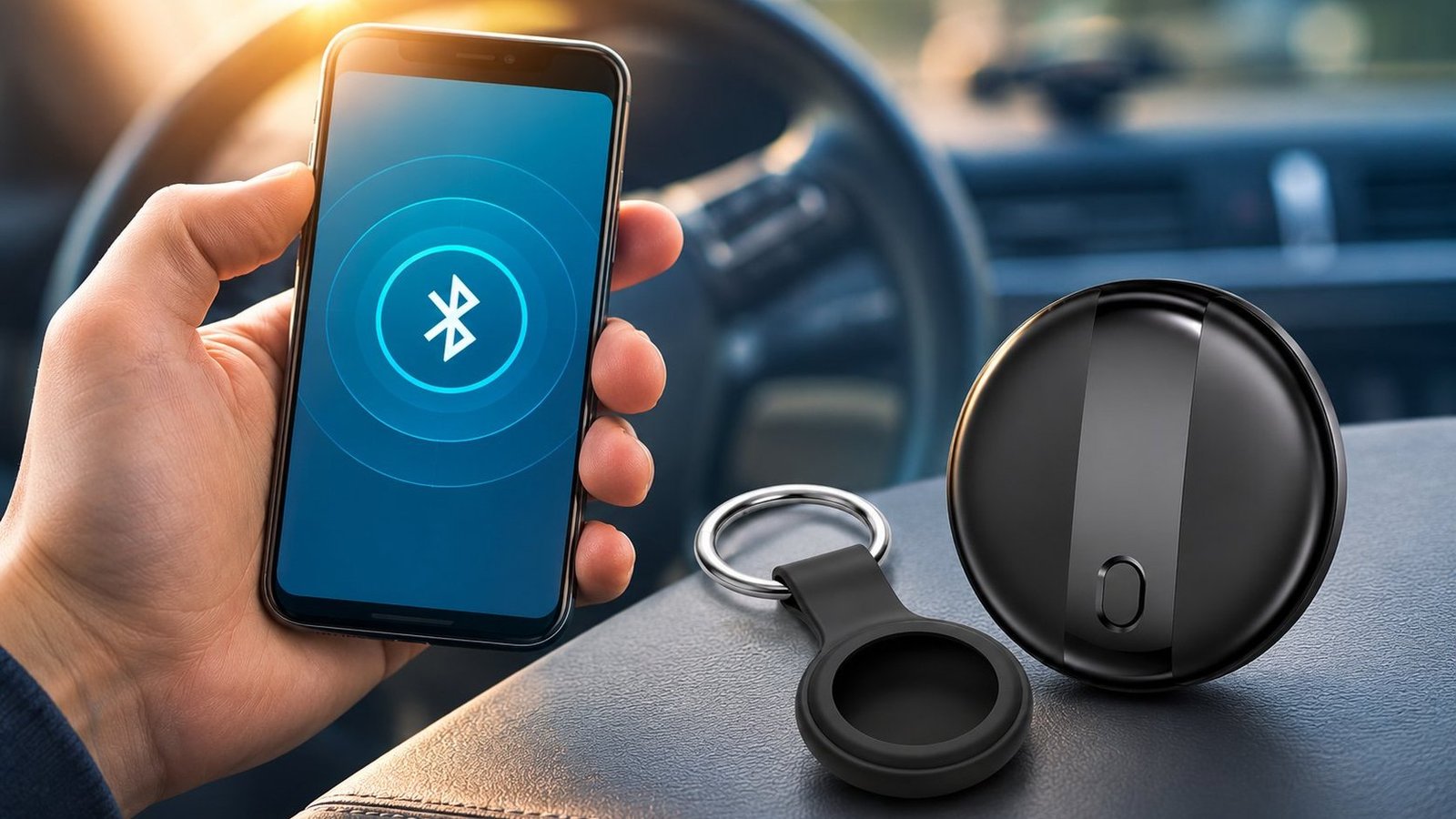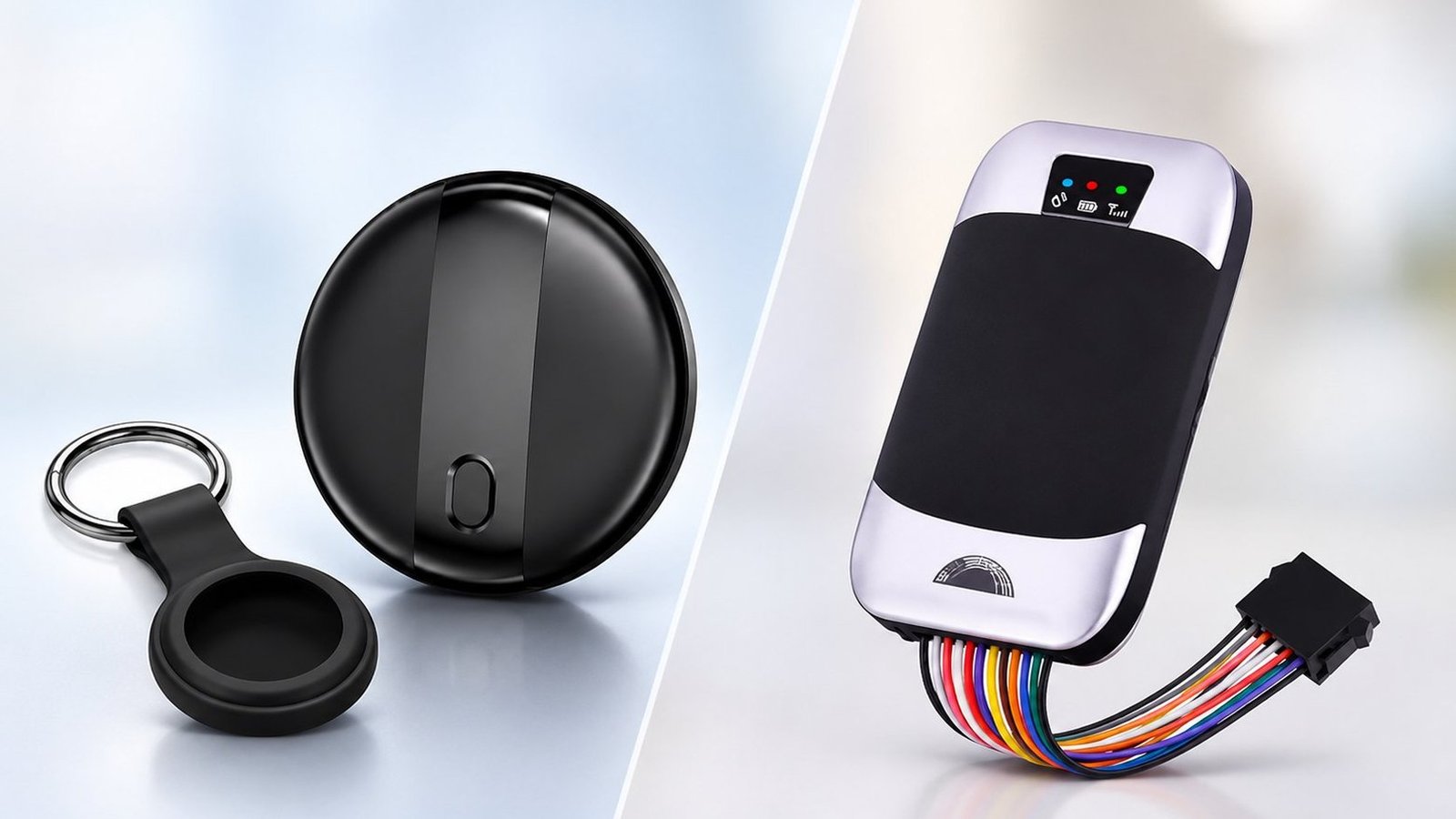
A GPS tracker works out its own position from satellites, then sends that position to you over a mobile network. A Bluetooth tracker has no GPS receiver at all. It broadcasts a short-range signal, and passing phones report where they heard it.
That one design choice changes everything downstream: cost, battery life, how often you see an update, and where the tracker goes quiet. SUNDA’s FD2601 Bluetooth tracker is specified as “Bluetooth proximity (no GPS, no SIM, no subscription)”. That single line is the whole difference between the two categories.
So the real question is not which tracker is better. It is what you need to find, and how fast it moves. The comparison below uses published network specifications, GPS.gov and SUNDA’s own product pages rather than rule-of-thumb numbers.
Quick answer: for keys, bags, wallets and luggage that sit still, use a Bluetooth tag. For a vehicle, a fleet or a roaming animal that keeps moving, use a GPS unit. If you run both, each covers the other’s blind spot.
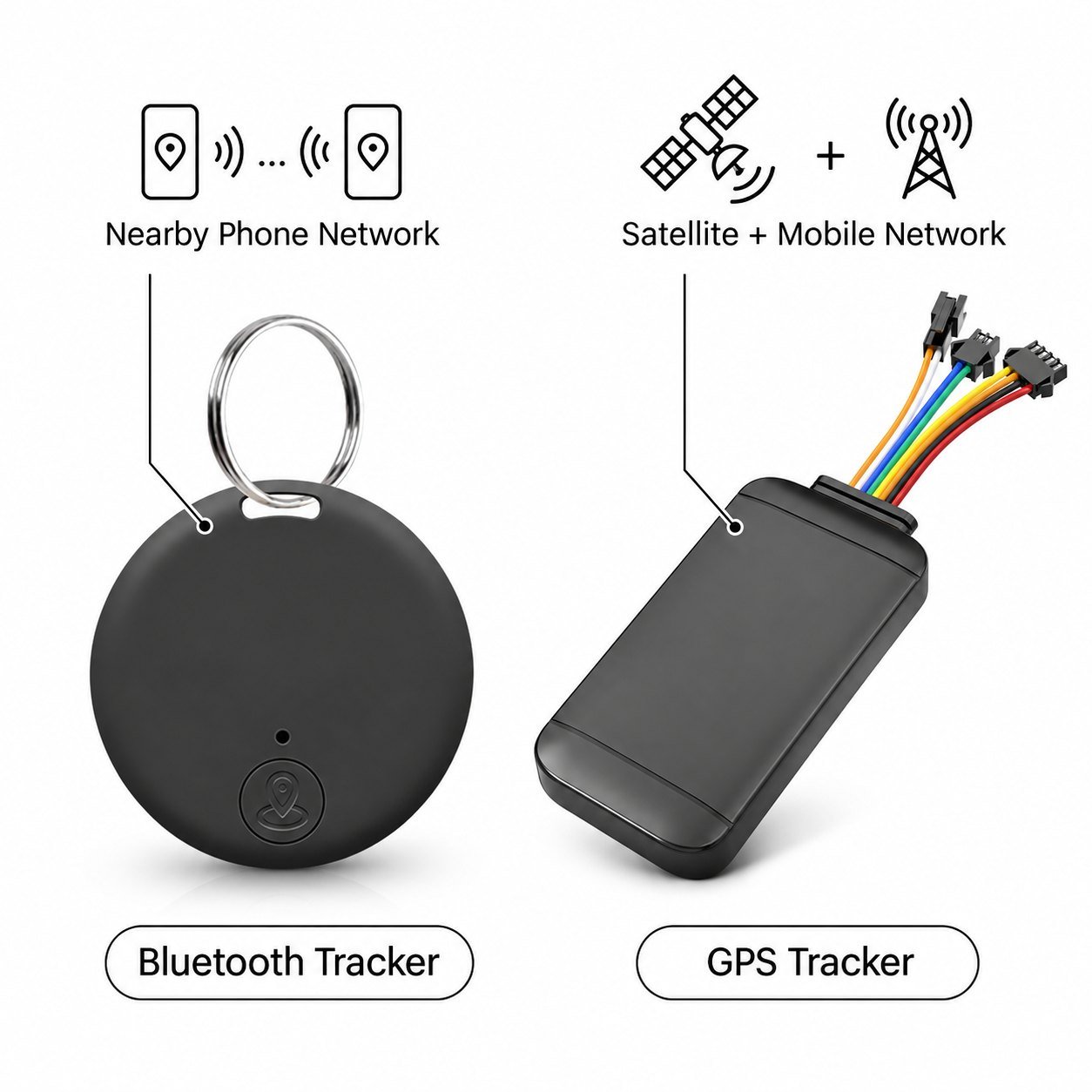
Two radios, two very different jobs. The Bluetooth side waits for a nearby phone to relay an encrypted location. The GPS side computes its own position and needs a modem to send it.
Neither design is a substitute for the other. One trades live movement for a coin cell that lasts a year; the other trades a rechargeable battery and a monthly plan for a live map.
How a Bluetooth Tracker Finds Its Location
A Bluetooth tracker is a small tag with a low-energy radio and a coin cell. It has no idea where it is, and it does not need to know. It just keeps announcing that it exists, using a rotating identifier.
Your own phone hears that signal directly. SUNDA’s mini tag and multi-pack pages both publish a connection distance of Up to 10 m. Beyond that, the tag depends on a crowd: a compatible phone passing nearby hears the broadcast, attaches its own location and relays it to the network.
On Apple’s side, the Find My network is described as using “hundreds of millions of Apple devices around the world” with “advanced end-to-end encryption” to locate belongings in the Find My app. Third-party accessories join it through the MFi Program.
Google’s equivalent is the Find Hub Network. Its accessory specification defines “an end-to-end encrypted approach for tracking beaconing Bluetooth Low Energy (BLE) devices” and says the Find Hub Network frame carries a public key used to encrypt location reports by any supporting client that contributes to the crowdsourcing network. The same document still uses the older name Find My Device Network (FMDN) in places, so do not be surprised to see both.
Neither network adds a subscription to the tag. SUNDA’s Bluetooth tracker series page puts it plainly: “There is no SIM, no data plan and no monthly fee”. The network is the phones already around you, not a cellular contract you have to buy.
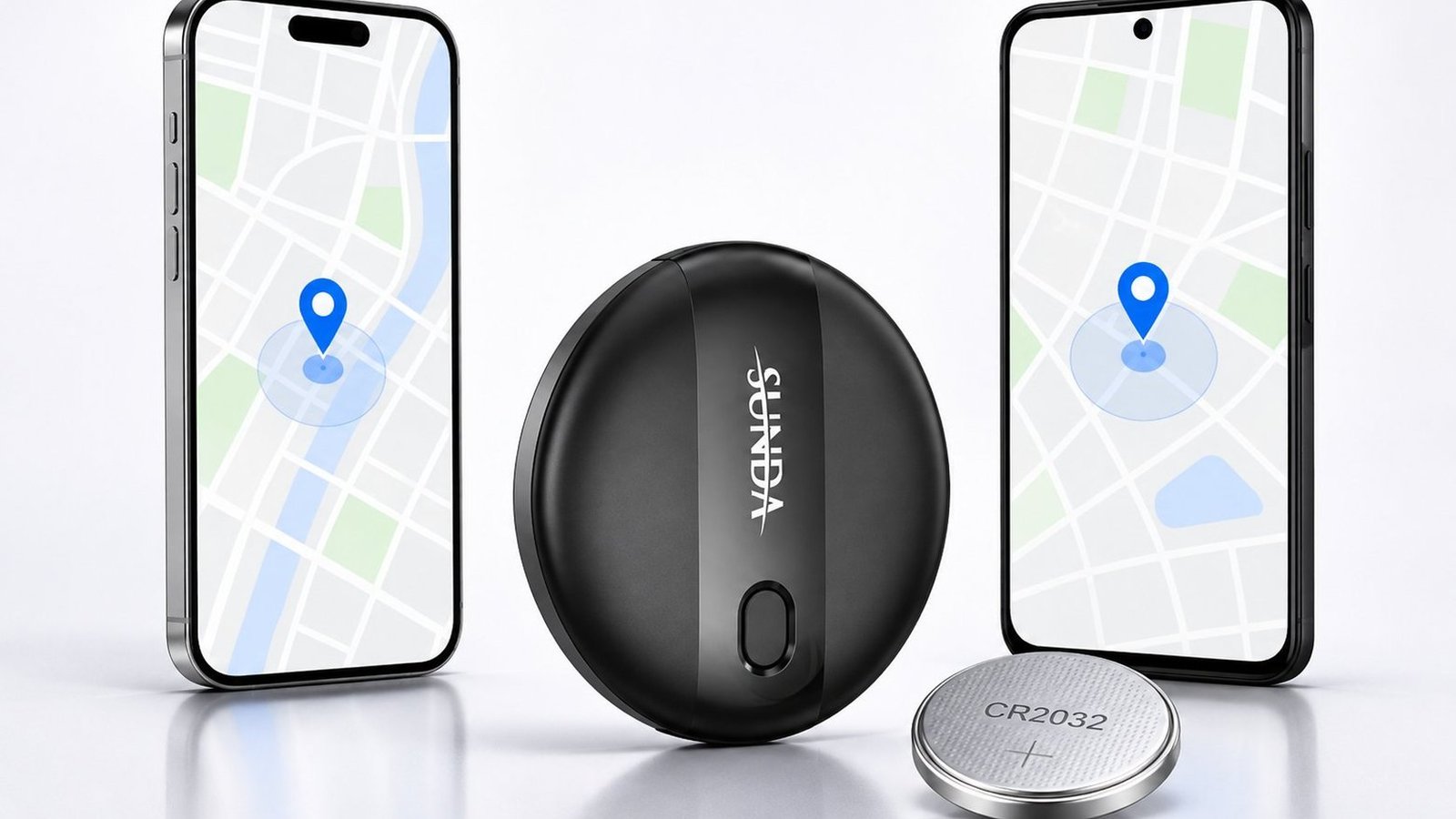
Because the tag only broadcasts, it sips power. The FD2601 uses a replaceable CR2032 coin cell and is rated for more than 12 months standby. Its published sheet also lists Bluetooth 5.0 low energy, a 31.75 mm by 7.62 mm housing, a working range of -10°C to 55°C and CE, FCC and ROHS certification.

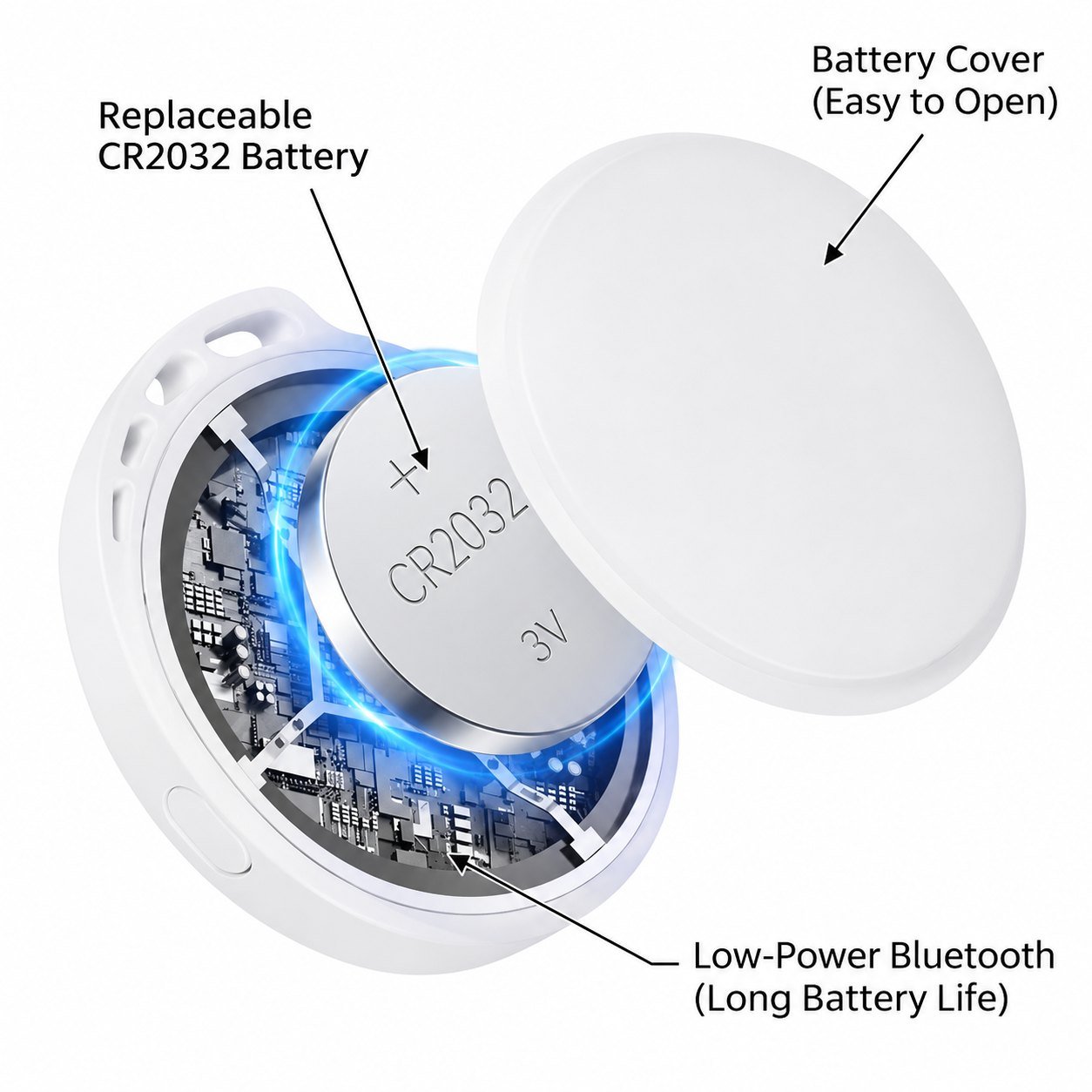
The two images above show the mechanism and the hardware: a Bluetooth signal detected by a nearby phone produces a location update, and inside the tag there is nothing but a low-power board, a buzzer and a replaceable CR2032 cell. No GPS receiver, no SIM slot, no modem.
How a GPS Tracker Finds Its Location
A GPS tracker does the positioning work itself. Its receiver listens to satellites and calculates a position. No strangers’ phones are involved, which is why the device still works on an empty road or in a field.
Knowing a position is not the same as telling you about it. Most GPS trackers therefore carry a cellular modem and a SIM card. Each position travels over a mobile network to a server, and from there to your app. That is why a monthly fee is usual for the category: it covers the SIM, the data and the server. GPS satellite signals themselves are free to receive.
A few GPS loggers skip the modem entirely. They store a route in memory and you download it once the device is back in your hands. Those are trip recorders, not live trackers — worth checking before you buy one for recovery.
A receiver, a modem and a SIM draw far more current than a coin cell, so GPS units normally use rechargeable batteries and their runtime is counted in days or weeks rather than months. How often you get depends on the reporting rate, so ask for the figure that applies to the exact model you are quoting instead of assuming a category-wide number.
Bluetooth Tracker vs GPS Tracker at a Glance
Find your row first, then read the section that explains it. Figures in the Bluetooth column are the published FD2601 values, not generic estimates.
| Bluetooth tracker | GPS tracker | |
|---|---|---|
| How it gets a location | Passing phones report it | Its own GPS receiver |
| How it sends the location | Through nearby phones on the network | Its own SIM and mobile network |
| Live, moving updates | No — only when a compatible phone passes | Yes, with sky view and mobile coverage |
| Works in remote areas | Only if a phone passes | Yes, with sky view and mobile coverage |
| Works indoors | Yes, near phones | Weakly — GPS needs open sky |
| Monthly fee | None on SUNDA tags: no SIM, no data plan, no fee | Usually yes |
| Power | Replaceable CR2032, more than 12 months standby on the FD2601 | Rechargeable, days to weeks |
| Close-range finding | Bluetooth plus a built-in buzzer, Up to 10 m | GPS fix plus the app map |
| Size | 31.75 mm by 7.62 mm on the FD2601 | Larger, to fit the modem and battery |
| Best for | Keys, bags, luggage, wallets | Vehicles, fleets, live movement |
Where a Bluetooth Tracker Is the Better Choice
Here is the thing: most of the items people lose are not moving anywhere. They are sitting still somewhere you have already been. That is exactly the job a Bluetooth tag was built for.
- Keys and wallets. Ring the tag and follow the sound. No subscription, no charging, no setup beyond pairing.
- Checked luggage. Airports are packed with phones, so updates arrive often. A tag in a suitcase shows whether it made your connecting flight.
- Bags and backpacks. A tag slips into an inner pocket and stays there for a year on one coin cell.
- Remotes, cameras, tool cases. Anything you set down and forget rather than something that drives away.
Size matters too. A coin-sized tag hides inside a wallet or bag lining. A GPS unit is bulkier and needs a cable every week or two. And after you buy it, the running cost stays near zero: your only expense is a fresh coin cell roughly once a year.
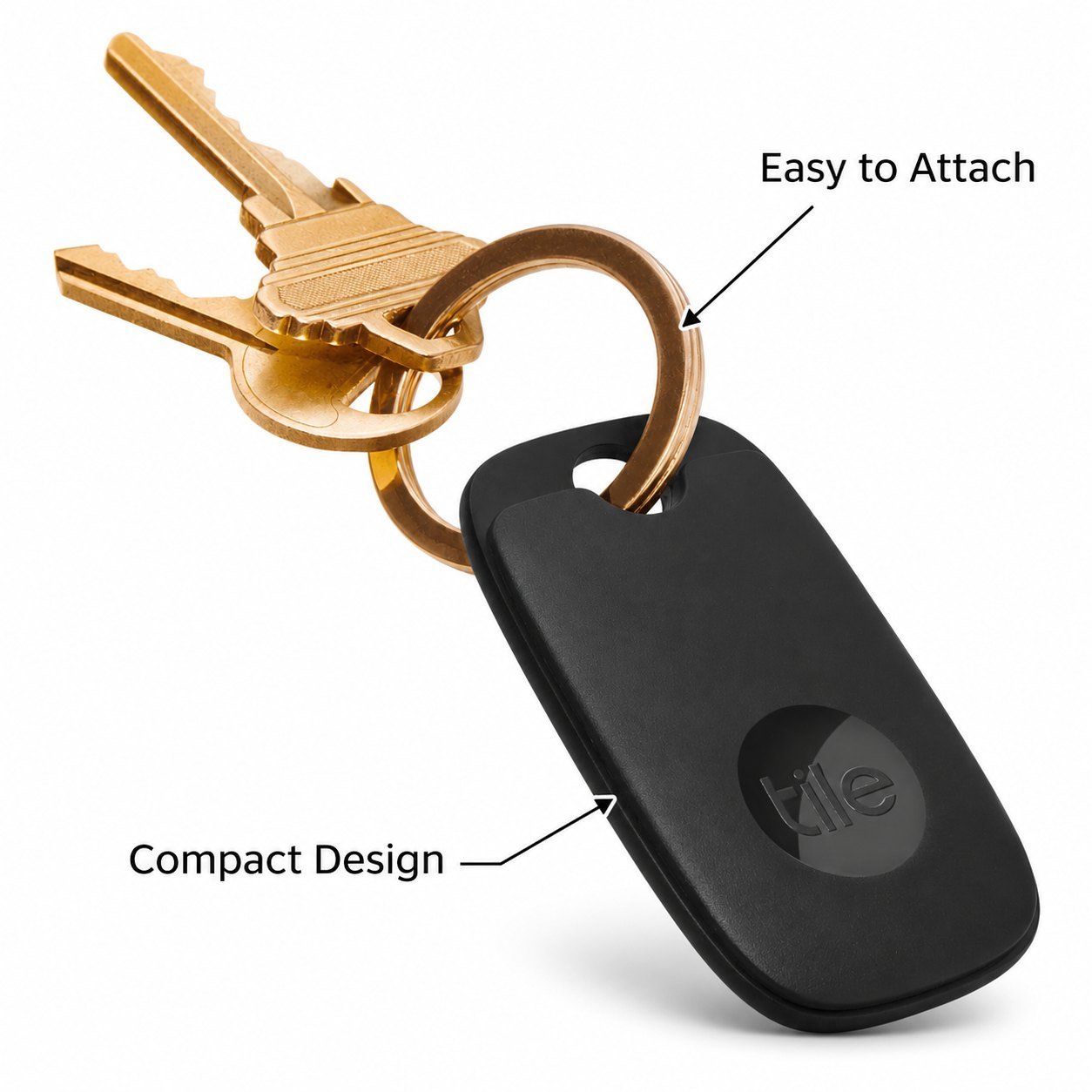

That is also what the app experience looks like. You get a last seen dot and a Play Sound button, not a live route. For a stationary item, that is all you need.
Where a GPS Tracker Is the Better Choice
GPS earns its fee when the thing you are tracking keeps moving, especially through places with few people around to relay anything.
- Vehicles and fleets. You see each vehicle’s route as it drives, often with speed and stop history.
- Remote work sites. A trailer or machine in an empty yard will not meet passing phones. GPS does not need them.
- Live geofence alerts. Many GPS services warn you the moment an asset leaves a set zone.
- Animals that roam open land. A dot from an hour ago will not help you find something that is still running.
One limit, though: GPS needs a clear view of the sky. GPS.gov’s accuracy page says GPS-enabled smartphones are “typically accurate to within a 4.9 m (16 ft.) radius under open sky”, but that “their accuracy worsens near buildings, bridges, and trees”. It lists “Satellite signal blockage due to buildings, bridges, trees, etc.” and “Indoor or underground use” among the common causes of a wrong position. Inside a concrete building or a car park, a GPS fix weakens or vanishes.
How Accurate Is Each One?
Most comparisons skip this, yet it changes how you read the map. A Bluetooth tracker’s map dot is not the tag’s own position. It is the location of the phone that heard the broadcast, plus the Bluetooth range at that moment. On a busy street that is close enough to walk over and ring the tag. In a quiet suburb, the dot can be older and less exact.
Up close, some tags add Ultra Wideband (UWB), a radio built for positioning that can give an arrow and an exact distance on screen. Apple’s AirTag (2nd generation) Tech Specs list “Bluetooth for proximity finding” alongside an “Apple-designed, second-generation Ultra Wideband chip and expanded Precision Finding connectivity” (year introduced 2026). That is a feature of a specific Apple product, not of every Bluetooth tag. Tags without UWB finish the last few metres by ear: Google’s FHN specification even states “It is mandatory for the device to include a sound maker and support the ringing function.”
GPS accuracy, by contrast, depends on its own receiver and its view of the sky. Under open sky it puts a moving car on the right street. Indoors, GPS.gov lists signal blockage and reflected “multipath” signals as reasons it can drift or lose the fix entirely. Neither technology gives you a perfect pin in every situation.
Privacy and Anti-Stalking Rules
Both kinds of tracker can be misused. The Bluetooth finding networks address that at the specification level rather than leaving it to each app.
In May 2023 Apple and Google jointly submitted a proposed industry specification to help combat the misuse of Bluetooth location-tracking devices for unwanted tracking. The announcement says the “first-of-its-kind specification will allow Bluetooth location-tracking devices to be compatible with unauthorized tracking detection and alerts across iOS and Android platforms”. It went to the IETF as the Detecting Unwanted Location Trackers draft, with Samsung, Tile, Chipolo, eufy Security and Pebblebee expressing support.
On Google’s side that is now a certification requirement. The FHN accessory specification states: “Unwanted tracking prevention is a core element of FMDN, requiring devices to adhere to the Detecting Unwanted Location Trackers (DULT) specification.” It also requires a way for a user to temporarily stop a tag advertising without a factory reset.
A standalone GPS tracker usually sits outside those alert systems, which is one reason it is common in fleet management where the business owns every vehicle. Whatever you choose, track only property you own, or people who have agreed. Covert tracking of another person is illegal in many countries.
Can You Use Both Together?
Yes. Plenty of fleets and families do exactly that, because each covers the other’s weak spot.
A company van might carry a GPS unit for live routing while the driver’s keys and tool bag carry Bluetooth tags. A family might use a GPS collar on an animal that roams, and Bluetooth tags in every suitcase for holidays. One system answers “where is it right now”; the other answers “where did I leave it”.
GPS is the live map. Bluetooth is the everyday finder that lives on your keys. Buying one does not oblige you to give up the other.
Which One Should You Buy?
Match the tracker to the item, and to how that item actually moves day to day.
| What you are tracking | Pick | Why |
|---|---|---|
| Keys, wallet, remote | Bluetooth | Small, buzzer, no fee, about a year per cell |
| Suitcase or carry-on | Bluetooth | Airports are full of reporting phones |
| Bike or scooter in a city | Bluetooth | Hidden tag, steady updates in busy streets |
| Car, van or truck fleet | GPS | Live routes, speed, geofence alerts |
| Equipment at a remote site | GPS | No passing phones needed |
| Animal roaming open land | GPS | Live updates as it moves |
Is your item in the top half? Then a Bluetooth tag does the job at a fraction of the running cost. SUNDA’s range covers several shapes: the mini key tag, Apple Find My models, a magnetic anti-theft tag, a pet and luggage tag and a bicycle tracker. Browse the full Bluetooth tracker range to compare them side by side.
What to Ask for When You Source Trackers
If you buy under your own brand, the network is a production decision. SUNDA’s OEM page lists the network as “Chosen before production; cannot be changed afterwards”. Get that right before tooling starts.
| Published term | SUNDA value |
|---|---|
| FD2601 positioning | Bluetooth proximity (no GPS, no SIM, no subscription) |
| FD2601 networks | Apple Find My (iOS) and Google Find My Device / Android Find Hub |
| FD2601 battery | Replaceable CR2032, more than 12 months standby |
| FD2601 working temperature | -10°C to 55°C |
| FD2601 MOQ | 10 pcs stock / 500 pcs OEM |
| Catalogue models | MOQ 5 to 20 pieces, enough to sample any configuration |
| Private label | From 500 pieces for custom logo, colour or packaging |
One trap for buyers: SUNDA’s published pages describe two different dual-network behaviours, so check the exact spec sheet before you write a listing. The dual-system tag “registers on Apple Find My and on Google Find My Device at the same time”, and the page adds that the two networks do not share data with each other — the tag simply speaks both. The mini tag pairs to one system at a time, chosen at setup, so one SKU covers an iPhone household and an Android household. Neither behaviour is a switch you flip by resetting the tag, and neither adds GPS: the dual-system page says “There is no cellular or GPS module and no subscription”.
Send your enquiry to the SUNDA OEM and ODM service team with:
- Which network you need: Apple Find My, Google Find My Device, or dual system.
- The form factor, pack quantity, and whether the cell must be user-replaceable.
- Your target market, because network licensing and certification differ by region.
- Estimated quantity and branding needs, so the MOQ can be quoted against the right tier.
Summary
A Bluetooth tracker has no GPS receiver. It broadcasts a short-range signal and passing phones on the Find My network or the Find Hub Network relay an encrypted location. That keeps it small, cheap to run and alive for more than 12 months on a replaceable CR2032, but it only updates when a phone passes and it cannot show live movement.
A GPS tracker calculates its own position from satellites and sends it over a mobile network. That gives live routes in places with no passing phones, at the cost of a SIM, a monthly fee, a rechargeable battery and — as GPS.gov notes — a clear view of the sky. Under open sky a smartphone-class receiver is typically accurate within a 4.9 m (16 ft.) radius; near buildings, bridges and trees it gets worse.
So the choice is about movement, not about which technology is newer. Items that sit still belong on a Bluetooth tag. Assets that keep moving belong on GPS. If you are sourcing rather than buying one, settle the network before production: SUNDA publishes the model spec, the -10°C to 55°C working range and the 10 pcs stock / 500 pcs OEM minimums for the FD2601, with private-label runs from 500 pieces.
Building a Tracker Line?
SUNDA builds Bluetooth trackers for Apple Find My and Google Find My Device with user-replaceable CR2032 cells, built-in sound alerts and private-label runs from 500 pieces. Send your network, form factor, quantity and target market to get a spec sheet and a sample plan back.
FAQ
Does a Bluetooth tracker have GPS?
No. A Bluetooth tracker has no GPS receiver and no SIM card. It broadcasts a short-range Bluetooth signal, and passing phones on Apple’s Find My network or Google’s Find Hub Network relay its location. SUNDA lists the FD2601 as “Bluetooth proximity (no GPS, no SIM, no subscription)” and rates its replaceable CR2032 at more than 12 months standby.
Do Bluetooth trackers need a subscription?
Not on SUNDA’s tags. The series page states “There is no SIM, no data plan and no monthly fee”. The location reports travel through phones already in the crowd network, so your only running cost is a replacement coin cell.
Why do GPS trackers usually need a monthly fee?
Because a live GPS tracker has to send its position to you. That normally means a cellular modem, a SIM card, mobile data and a server to store the locations. The fee covers those; GPS satellite signals themselves are free to receive. A logger that only records a route for later download is the exception, and it is not a live tracker.
Which is better for finding a stolen bike?
In a city, a hidden Bluetooth tag works well because phones pass it often. In quiet suburbs or rural areas, GPS shows live movement with no passer-by needed. A magnetic or concealed mount, like the ones in SUNDA’s anti-theft range, helps either one stay on the bike.
Can a Bluetooth tracker track a car in real time?
No. It updates only when a compatible phone passes the car. On a busy road that happens often; in a remote car park it may not happen for hours. For live vehicle tracking, use a GPS unit with its own modem.
Which lasts longer on one battery?
Bluetooth, easily. The FD2601 is rated for more than 12 months standby on a user-replaceable CR2032. A live GPS tracker draws far more current through its receiver and modem and is normally rechargeable, with runtime counted in days or weeks depending on how often it reports.
Is a Bluetooth tracker good for pets?
Only for finding a pet nearby. A tag gives you a last seen dot and a sound alert, not live movement; SUNDA publishes a pet and luggage tag for that kind of use. An animal that roams open land is better served by a GPS collar. Check the model sheet before you fit anything to a collar.
Can one tracker work with both iPhone and Android?
Yes, but check which dual-network configuration you are buying. SUNDA’s dual-system tag “registers on Apple Find My and on Google Find My Device at the same time”, while its mini tag pairs to one system at a time, chosen at setup. The two networks do not share data with each other. The network is also fixed before production on OEM orders, so it cannot be changed afterwards.
Does a GPS tracker work indoors?
Poorly. GPS.gov lists “Satellite signal blockage due to buildings, bridges, trees, etc.” and “Indoor or underground use” among the common causes of a wrong position, along with signals reflected off walls (“multipath”). A Bluetooth tag, by contrast, works indoors as long as a compatible phone is nearby.