
A USB car charger left in a live 12V socket does draw a little current with the engine off. On a well-designed charger that standby draw is a few milliamps, and a healthy battery would need months of parking to notice it. Flat batteries usually come from somewhere else: a charger wired to an always-on circuit, a damaged unit, an old battery, or a long airport stay that finished off a battery already on its way out.
Two things decide whether you need to care. First, whether your 12V socket stays live with the key out, because many switch off and the question then disappears. Second, how long the car sits between drives.
Quick answer: a few milliamps against a 60Ah battery is roughly 100 days of parking before you use 20% of it. If the socket dies with the ignition, the drain is zero. If it stays live and the car sits for weeks at a time, unplug the charger.
Find Your Situation
Start with what you are actually seeing. The fix differs for each row.
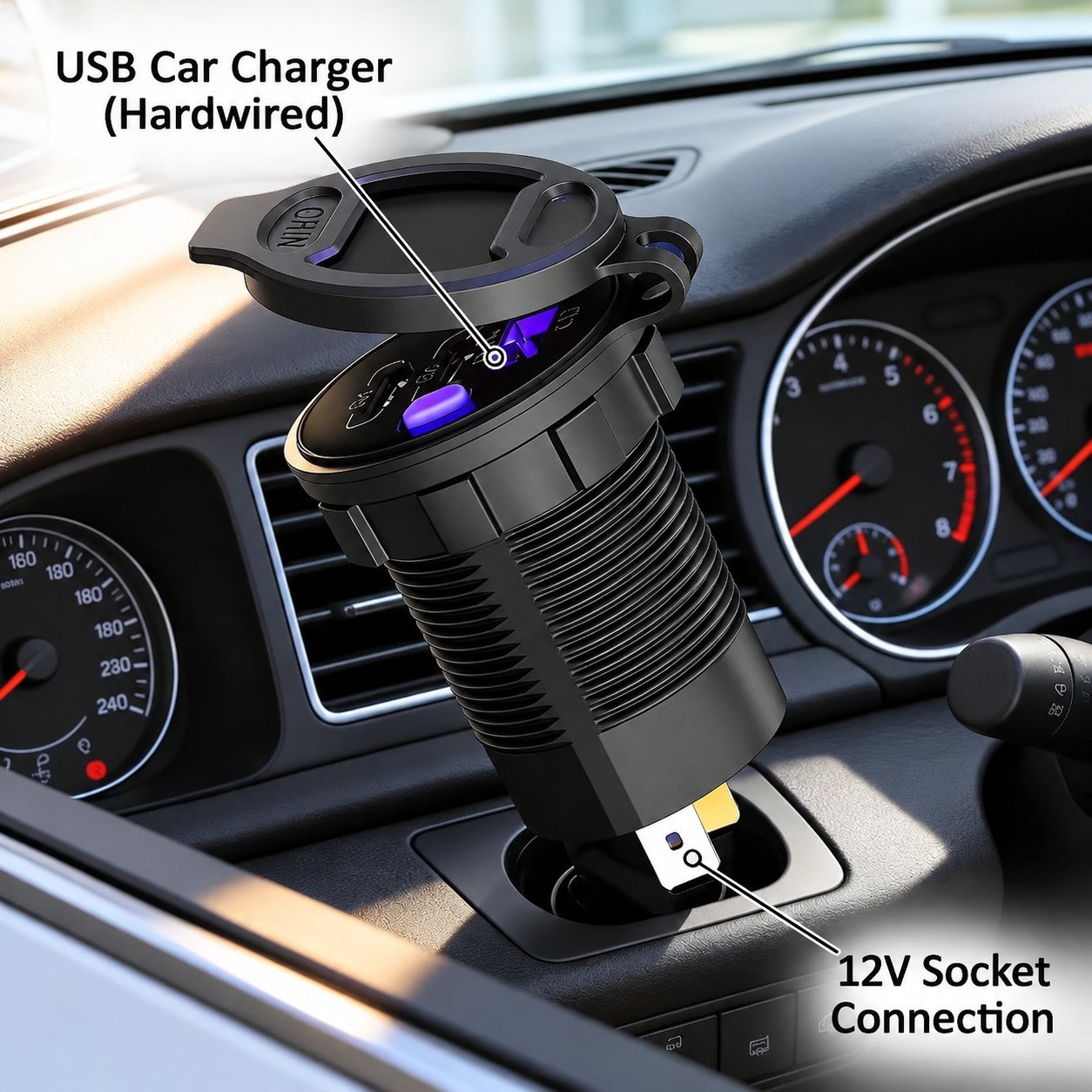
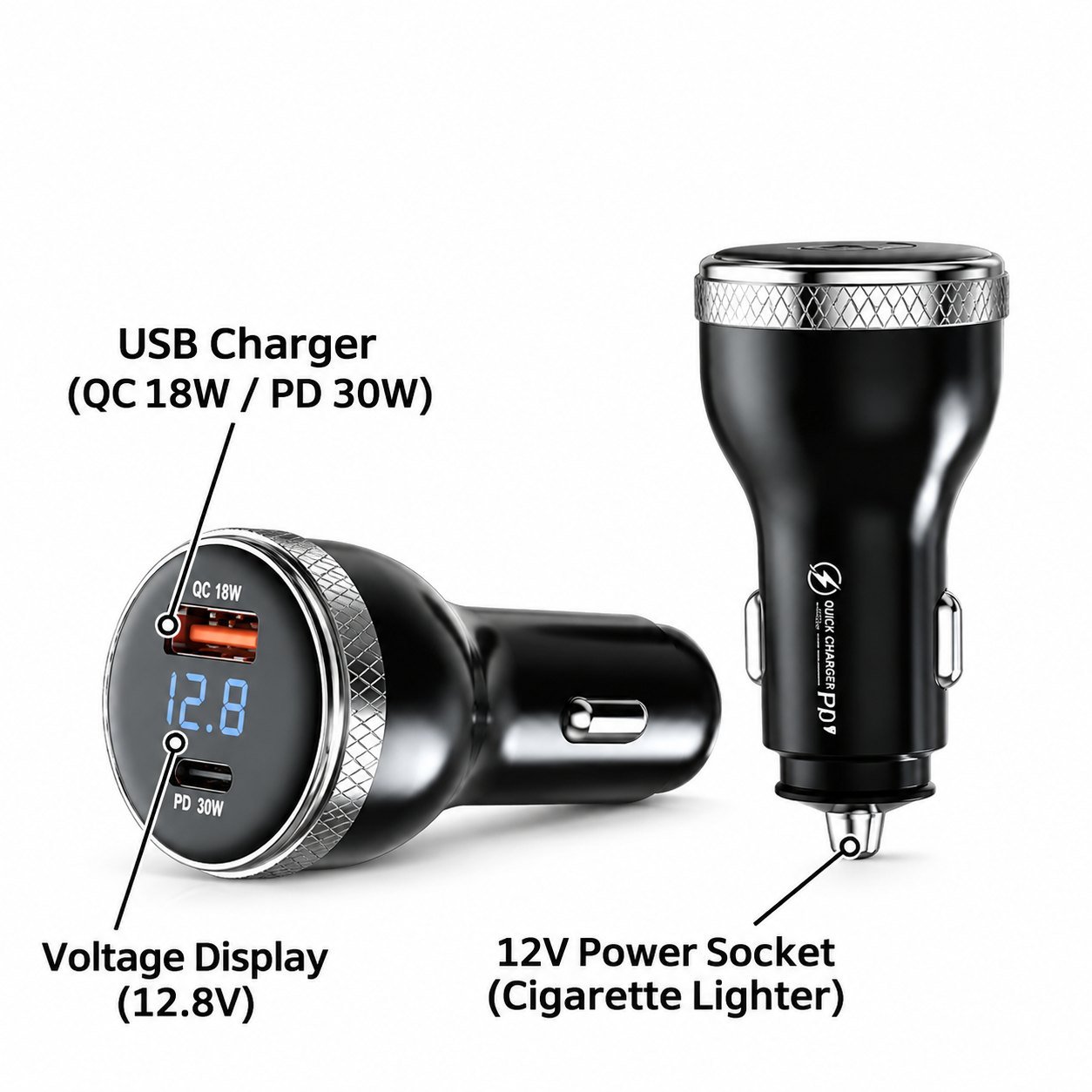
The socket decides, not the charger. Whether a plug-in unit draws anything at all with the engine off depends on the socket it sits in. Many cars cut the 12V socket with the ignition, and on those the standby draw is irrelevant because the charger has no supply.
To find out which you have, check the fuse map in the owner’s manual, or leave a charger with a visible LED in overnight and look at it in the morning. If the socket stays live, treat the charger as a permanent load. If you are fitting a module rather than plugging one in, our hardwire guide covers the switched-versus-constant circuit decision before you cut anything.
| What you see | Likely cause | Safe first check | When to go further |
|---|---|---|---|
| Charger LED stays lit with the key out | The socket is live when the car is off | Note how long the car usually sits parked | Unplug it before parking for more than a week or two |
| Battery flat after a few days, charger plugged in | A damaged charger, a weak battery, or another fault in the car | Unplug the charger, then see if the problem stops | If it continues, have an auto electrician run a parasitic draw test |
| Battery flat after weeks of parking | The car’s own standby load plus any accessories | Check your manual for long-term parking advice | Consider a battery maintainer for long stays |
| Charger feels warm with nothing connected | An internal fault | Unplug it and stop using it | Replace it |
The Math: Standby Current vs Battery Capacity
You can estimate the drain yourself. Multiply the charger’s standby current by the hours parked, then compare that with your battery’s amp-hour (Ah) rating, printed on the battery label.
Say a charger idles at 5mA. Over 24 hours, that uses 120mAh, or 0.12Ah. On a 60Ah battery, losing 20% means using 12Ah. At 0.12Ah a day, that takes about 100 days.
Here is the same arithmetic across a range of draws.
| Standby draw | Used per day | Days to use 20% of a 60Ah battery |
|---|---|---|
| 1mA | 0.024Ah | About 500 |
| 5mA | 0.12Ah | About 100 |
| 25mA | 0.6Ah | About 20 |
| 50mA | 1.2Ah | About 10 |
| 200mA | 4.8Ah | About 2.5 |
This is a calculation, not a test result. It assumes a fully charged, healthy 60Ah battery and no other load. A real car also has its own standby draw, and cold weather and battery age both cut the usable capacity.
Why use 20% as the line? A car’s starter battery is designed for short, heavy bursts of current, not for being drained deep and often. The further it runs down, the less margin you have to start the engine, especially in cold weather. A 20% loss is a sensible point to start paying attention.
When a Charger Really Can Drain the Battery
The charger is rarely the whole story. These four situations are where it matters.
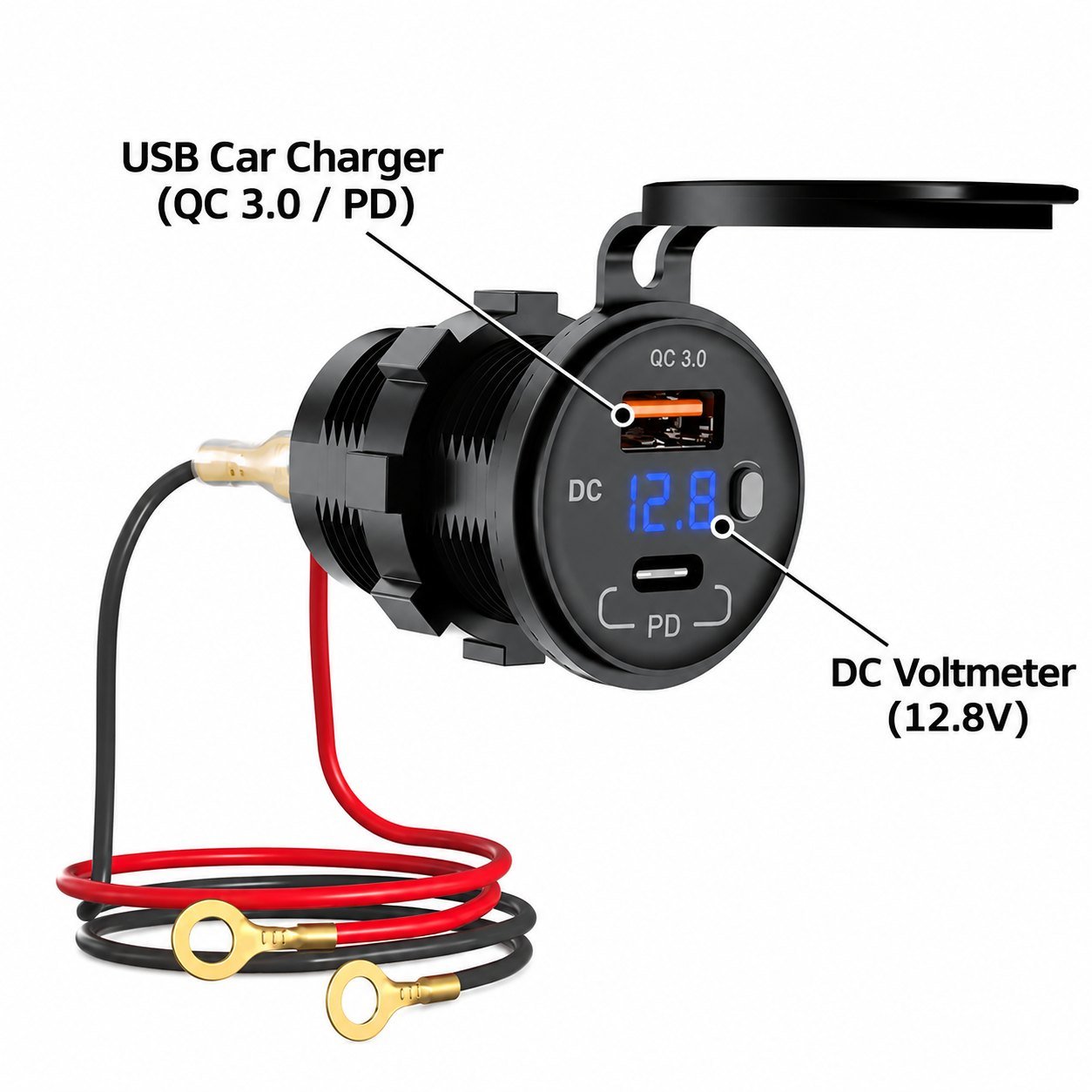
A module on a constant circuit. A hardwired charger tapped into a fuse that stays live with the key out never switches off. Add a voltmeter display or a bright LED, and its standby draw can be several times that of a plain plug-in unit. If you are having one fitted, ask the installer to use an ignition-switched circuit. Our hardwire installation guide explains the difference, and the wiring itself is covered in the step-by-step install guide.
A damaged charger. Chargers get crushed, soaked, or hit by voltage spikes. A unit damaged that way can leak far more current than it should. A charger that is warm with nothing plugged in is the warning sign.
An aging battery. A battery’s usable capacity falls as it ages. Every figure in the table above shrinks with it, so a draw that is harmless on a new battery can matter on an old one.
Long parking. Your car’s clock, alarm, and sleeping control modules draw current on their own. The exact figure depends on the vehicle. Over several weeks at an airport, that base load can use a meaningful share of the battery before the charger adds anything.
Heat, sunlight, and the wider question of whether to leave a charger in at all are covered in is it safe to leave a USB car charger plugged in.
How to Check Your Own Car
The simplest check needs no tools. Unplug the charger whenever you park for more than a week, and see whether starting problems stop.
For an exact number, a parasitic draw test measures the current your car pulls while it is off. An auto electrician can run it quickly and safely. If you are experienced with a multimeter and your vehicle manual allows disconnecting the battery, the basic method looks like this.
- Switch everything off, lock the car, and close the doors so the interior lights stay off.
- Disconnect the negative battery cable. Radio presets, the clock, or other settings may reset.
- Set the meter to its 10A DC range, then connect it between the negative battery post and the cable clamp, so the current flows through the meter.
- Wait for the car’s modules to go to sleep. In many modern vehicles this takes 30 minutes or longer, and readings stay high until it happens.
- Switch to the milliamp range and note the baseline.
- Plug in the charger and note how much the reading rises. That rise is the charger’s own standby draw.
Do not crank the engine or switch on the headlights while the meter is connected. The surge will blow the meter’s fuse. Some vehicles need a specific procedure before the battery is disconnected, so check the manual first.
A DC clamp meter also works, as long as it can resolve milliamps. A standard AC clamp meter cannot measure these currents.
What to Look for When You Buy
Whether you are buying one charger or sourcing thousands, three things tell you how it will behave when the car is off.
A stated standby current. A real supplier gives you a number, measured at a stated input voltage with no load connected. “Low standby” printed on a box tells you nothing. SUNDA publishes the figure for the CC-96 retractable charger: under 50mA, held by its smart IC while the unit sits idle. Against the table above, that is roughly ten days of parking to use 20% of a 60Ah battery.
Certification that matches the model. Ask which marks apply to the exact model you are buying, and for which markets. A factory’s management certificates, such as ISO 9001, cover the factory, not each product. The SUNDA certification page separates the two.
Clear shutdown behavior. Ask what the charger does when the socket stays live and nothing is connected. Does the LED switch off? Does the converter drop into a low-power sleep mode? The CC-97 digital display charger answers this with a push-button power switch that cuts the output completely when you are parked, and the CC82 panel-mount module switches its USB-C outputs off rather than leaving them on standby.


You can compare plug-in models across SUNDA’s car charger range, and a unit with a voltage display such as the 12V USB charger with voltmeter shows you the battery falling before it strands you.
Sourcing Low-Standby Chargers for Retail or a Fleet
If you are specifying chargers for a product line or a vehicle fleet, make standby current a written requirement. It is easy to test at incoming inspection, and it heads off the “your charger killed my battery” complaints before they start.
SUNDA builds car chargers to order through its OEM and ODM service. Stock ODM models start at 500 units per SKU, and new-tooling OEM projects typically start at 3,000 units. Samples take 3 to 7 days after artwork approval. Stock-model production runs 7 to 15 days, and new ODM development takes 45 to 60 days, including tooling.
CE, CCC, RoHS, and E-Mark are standard. UL, FCC, PSE, KC, and BIS are available for specific markets. Coverage varies by product model and destination, so request the certificate or test report for the exact model and market.
To get a useful first reply, send:
- Target standby current, and the input voltage it should be measured at.
- Wattage, number and type of ports, and protocols (PD, QC 3.0, PPS).
- Whether the charger is plug-in or hardwired, and whether it will sit on a constant or switched circuit.
- Target markets, estimated quantity, branding needs, and timing.
Send your brief to the SUNDA team. They usually reply within 2 hours with pricing, MOQ, and lead time, then follow up with a model recommendation, spec sheet, and sample plan.
Summary
A working charger in a live socket draws a few milliamps, which is about 100 days of parking on a 60Ah battery before you use 20% of it. That is not what flattens batteries. A hardwired module on a constant circuit, a damaged unit leaking current, an aging battery, and a car that sits for weeks are the real causes. Check whether your socket is live, unplug the charger for long stays, and when you buy, ask for a standby current figure in milliamps at a stated input voltage rather than a claim on the box.
Specifying Standby Current Into a Charger Order?
The CC-96 publishes a sub-50mA standby figure, the CC-97 cuts its output with a push-button, and the rest of the car charger range covers 38W to 140W across plug-in and panel-mount builds. Send your target current, port layout and volume to get pricing and lead time back.
FAQ
Do chargers with LED lights drain more?
Slightly. An indicator LED adds some current to the charger’s standby draw, and a bright voltmeter display adds more. On a healthy battery and a normal driving pattern, a small LED rarely matters. On a live socket, a car parked for weeks, or an older battery, a plain charger without a display is the safer choice.
Does cold weather make a charger’s drain matter more?
Yes. Cold reduces a lead-acid battery’s usable capacity and its cranking power, so the same small draw leaves you with less margin. The charger itself does not draw more. If the car will sit for more than a week or two in a hard freeze, unplug accessories from any socket that stays live.
Does the 12V socket stay live when the car is off?
It depends on the car. Many vehicles cut the socket with the ignition, which makes the whole question disappear. Others keep one or all sockets live for parking mode or accessories. Check the fuse map in the owner’s manual, or leave a charger with a visible LED in overnight and look at it in the morning.
How long can a car sit with a charger plugged in?
Work it out from the table above. A 5mA charger on a healthy 60Ah battery takes about 100 days to use 20% of the capacity, and a 50mA unit about 10 days. The charger is only one of the loads, though: the clock, alarm and sleeping modules draw current too, so the real limit is lower than the charger’s own figure suggests.
Can a car charger drain a battery overnight?
Not a working one. At 5mA, a full night uses about 0.04Ah, which is nothing against a 60Ah battery. An overnight flat points at a damaged charger leaking far more than its rating, a socket wired to a constant circuit with a high-draw module on it, or a battery that was already failing.
What standby current should I specify when sourcing chargers?
Give the supplier a maximum figure, measured at a stated input voltage such as 12.6V with nothing connected. Ask for test data from production units, not a single hand-picked sample. Pair the requirement with the certifications your target market needs, confirmed for the exact model you are ordering.