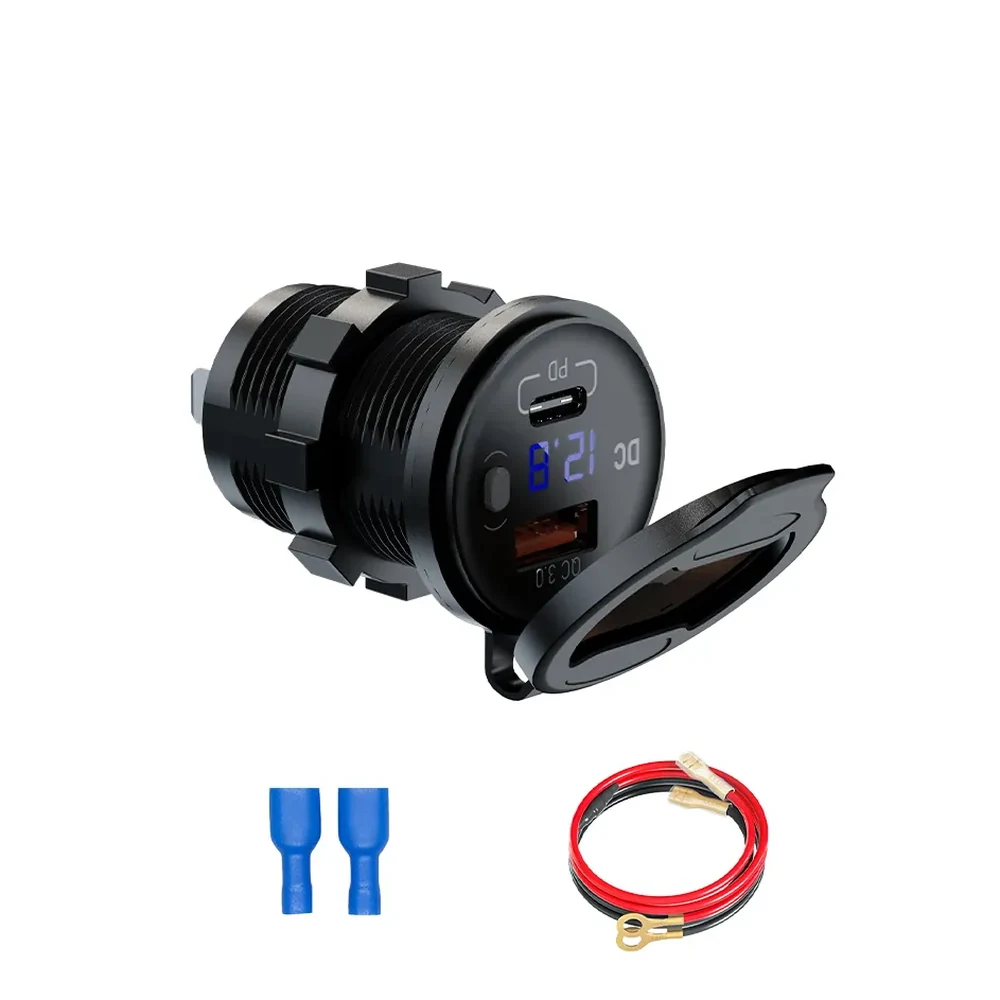
A charger with a voltmeter, so the battery is never a surprise
This is the CC82 panel-mount charger with a blue digital voltmeter built into the face. The display takes its reading from the same 12-24V supply the charger is wired to, so with the ignition off it shows the battery’s resting voltage, and with the engine running it shows what the alternator is putting into it. On a motorcycle, a quad, a boat or a motorhome there is often no gauge at all, and this is the cheapest place to add one — the hole is being drilled for the charger anyway.
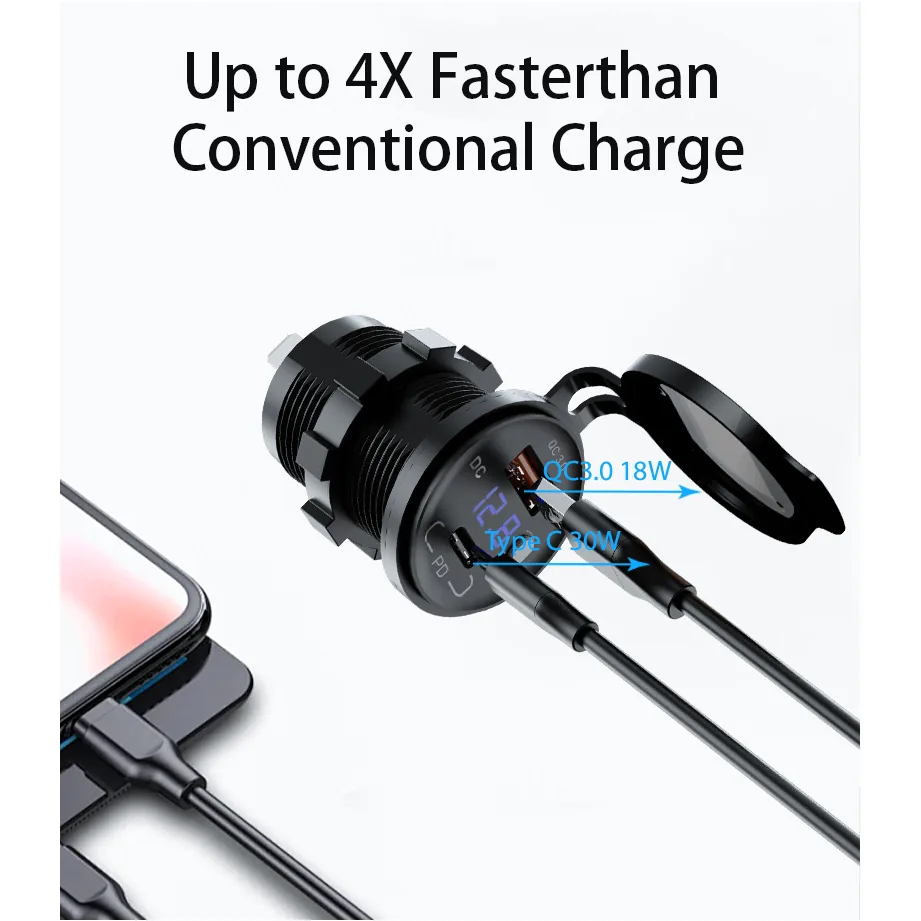
Everything else about the unit is the same as the rest of the CC82 range: a 30 mm hole, a threaded barrel locked from behind the panel, a hinged splash cap, and a fused harness that runs to the battery. It charges one USB-C device at PD 30W with PPS 33W and one USB-A device at QC 3.0 18W, which the factory quotes as 51W across the pair.
What the display is actually for
- Battery state at a glance. A rested lead-acid battery reports its state of charge by voltage alone, which is what the table below turns into a decision.
- Charging system check. With the engine running, a healthy alternator lifts the reading into the 13.7-14.7V band on a 12V system. A reading that stays down at battery level means the alternator is not charging — worth knowing before a long ride or a launch.
- Parasitic drain. Leave the vehicle for a week and compare the reading with where you left it. A battery that has dropped a long way is being drained by something.
- Before switching a load on. Fridges, winches, inverters and bilge pumps punish a weak battery. The readout tells you where you stand before you draw on it.
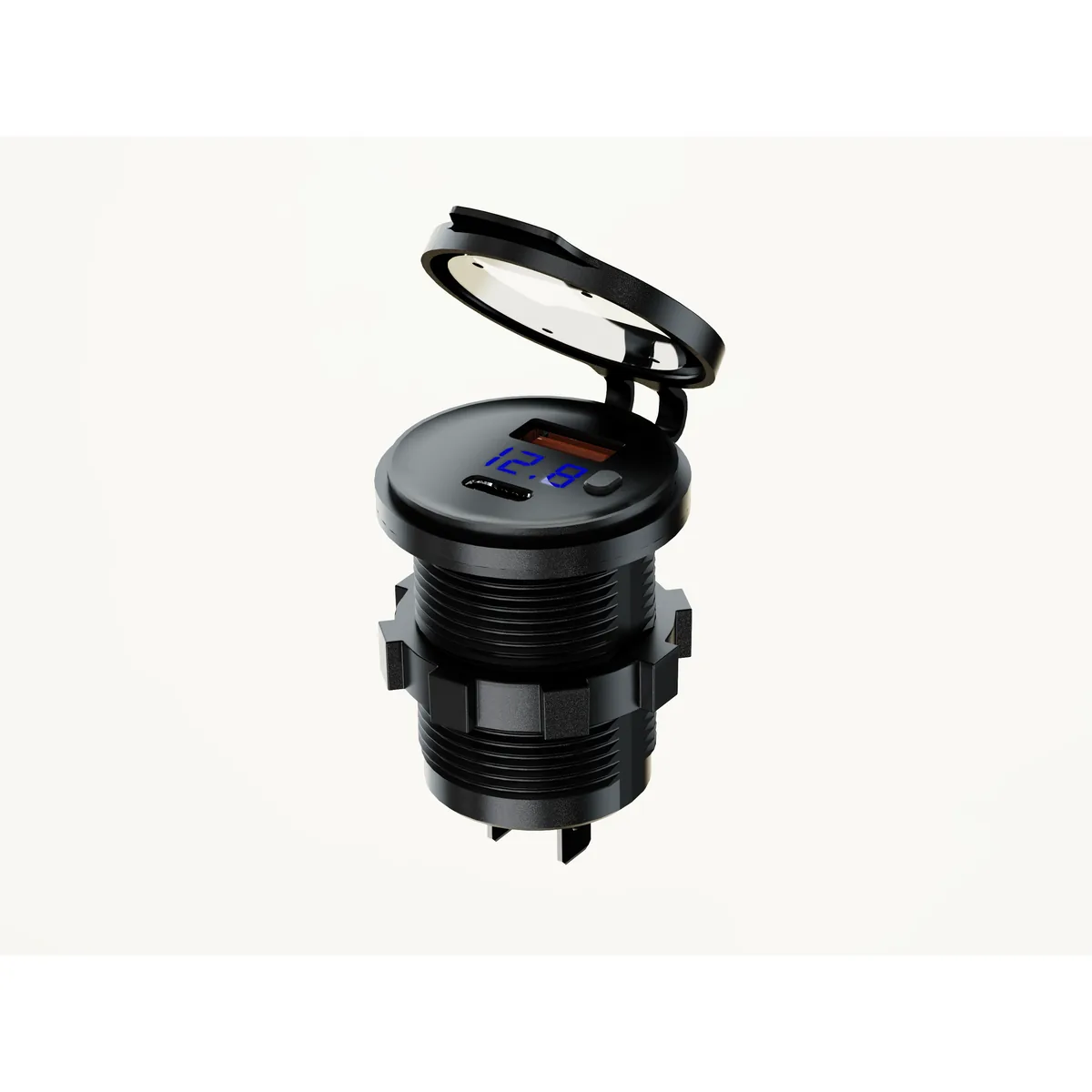
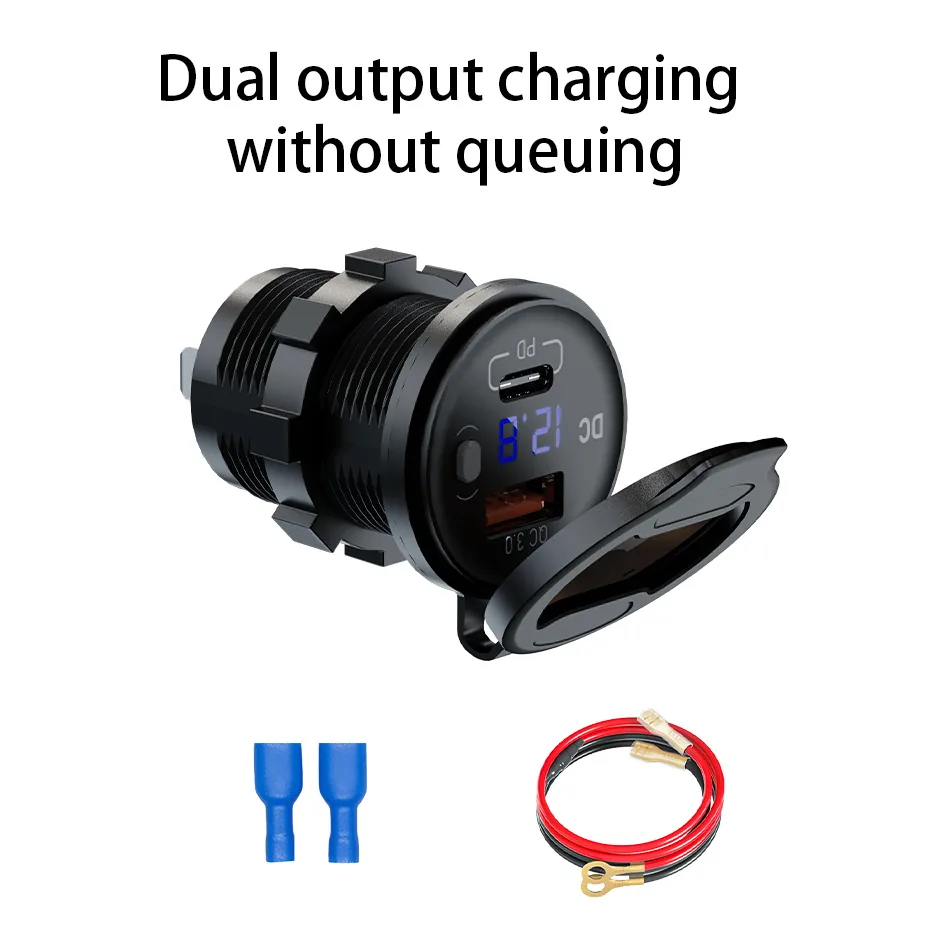
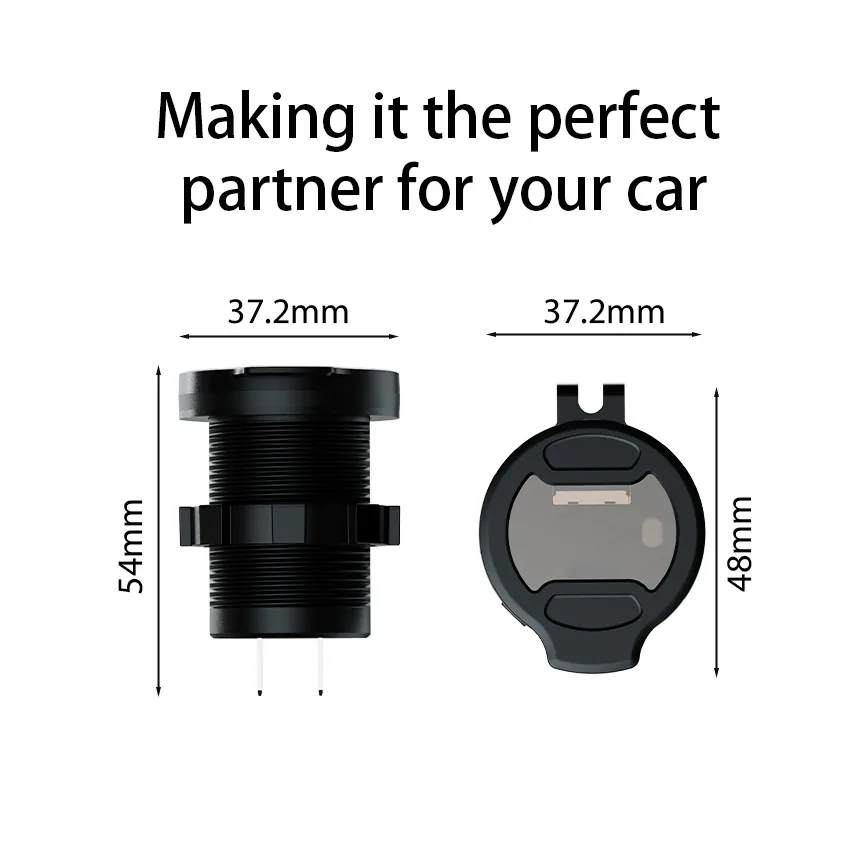
The voltmeter face reading 12.8V, the accessories that come in the box — a fused harness with ring terminals and two spade connectors — and the dimensioned drawing: 48 mm face, 37.2 mm barrel, 54 mm body depth.
What the reading means on a 12V battery
| Reading (battery at rest) | State of charge | What it means |
|---|---|---|
| 12.6V and above | 100% | Fully charged; nothing to do. |
| 12.4V | About 75% | Serviceable. Charge before a long trip or a cold night. |
| 12.2V | About 50% | Half discharged. Recharge soon — leaving a battery here shortens its life. |
| 12.0V | About 25% | Discharged. Recharge before the next use. |
| 11.8V and below | Flat | Recharge immediately. A battery left flat sulfates and loses capacity. |
| 13.7-14.7V, engine running | Charging | Alternator output on a 12V system. On a 24V system the equivalent bands are double. |
These are open-circuit readings on a lead-acid battery at around 25 °C, taken roughly an hour after charging stops. They are a guide to state of charge, not a substitute for a load test: an AGM or gel battery reads slightly higher, and any battery reads lower while it is under load.
A second mounting: the CC81 square panel insert
The charger on this page is the barrel type: drill a 30 mm hole, push the barrel through and tighten the lock nut behind the panel. The CC81 does the same job where the vehicle already has a square switch-panel cut-out. There is no drilling at all — the blank accessory comes out, the charger block pushes into the same opening, the positive and negative leads go to the supply and the face clips down over it. The factory’s fitting sheet shows those four steps, and the same unit is offered for boats, UTVs and golf carts as well as cars.
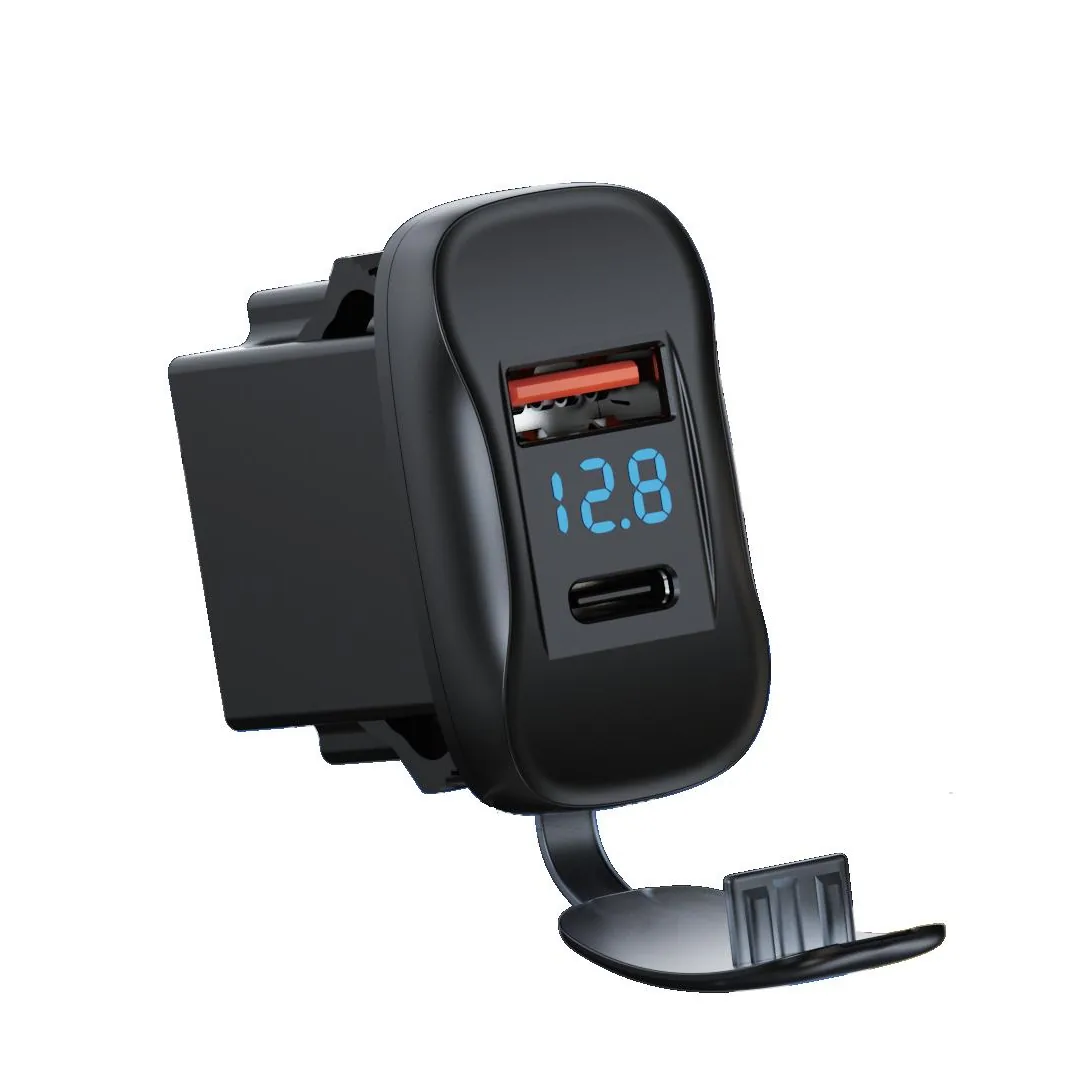

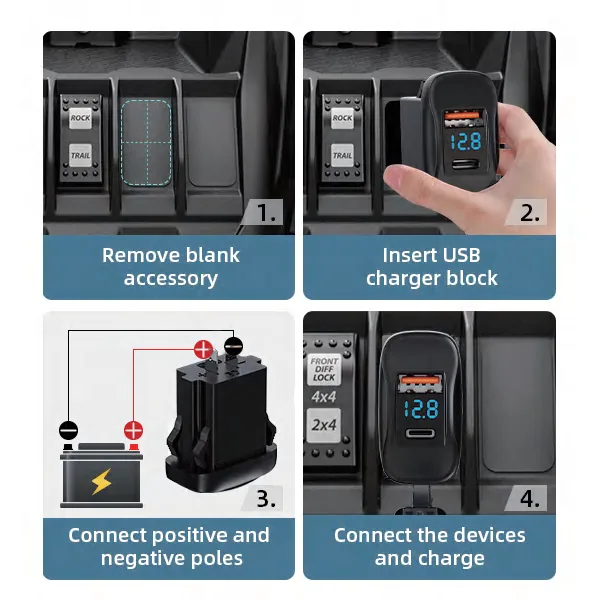
The electrical side is the same as the barrel version: a blue digital voltmeter in the face reading the 12-24V supply (the product images read 12.8V), one USB-C port at PD 30W / PPS 33W and one USB-A port at QC 18W, giving the 51W series figure. A rubber protection cap is listed as waterproof, anti-cracking and anti-electric shock, which is what makes the square insert practical on an open boat or a buggy rather than only behind a car dashboard.
The two mountings are quoted from the same sheet because they differ only in the fitting: the barrel for a drilled hole, the square insert for an existing switch-panel slot. If your vehicle has neither, the CC82 panel mount third-port version and the CC77 digital display car charger cover the lighter-socket fitments instead.
Specifications
| Item | Specification |
|---|---|
| Model | CC82 / catalog reference CC-82 (voltmeter version) |
| Type | Panel mount (flush mount) USB car charger with DC voltmeter |
| Input | DC 12-24V |
| Display | Blue digital DC voltmeter; the product images show a 12.8V reading |
| USB-C output | 1 × PD 30W, PPS 33W |
| USB-A output | 1 × QC 3.0 18W |
| Total output | 51W (PD 30W / PPS 33W + QC 18W) |
| Protocols | PD 3.0, QC 3.0, PPS |
| Ports | 2 (1 USB-A + 1 USB-C) |
| Mounting | 30 mm drill hole, lock nut from behind |
| Dimensions | 48 mm face, 37.2 mm barrel, 54 mm body depth |
| Supplied with | Fused wiring harness, ring terminals and 2 spade connectors |
| Sealing | IP66 with hinged splash-proof cover |
| Housing material | PC fireproof material (+ ABS) |
| Colour | Black; custom colour on OEM runs |
| Weight | 80 g |
| Certificates | CE, RoHS, FCC |
| MOQ | 10 pcs; OEM/ODM branding from 500 pcs |
| Price | Quote on request |
| Warranty | 12 months |
| Payment | TT / Western Union / PayPal / secure payment |
| Shipping | EMS, TNT, UPS, FedEx, DHL or your forwarder |
| Place of origin | Guangdong, China |
Protection and sealing
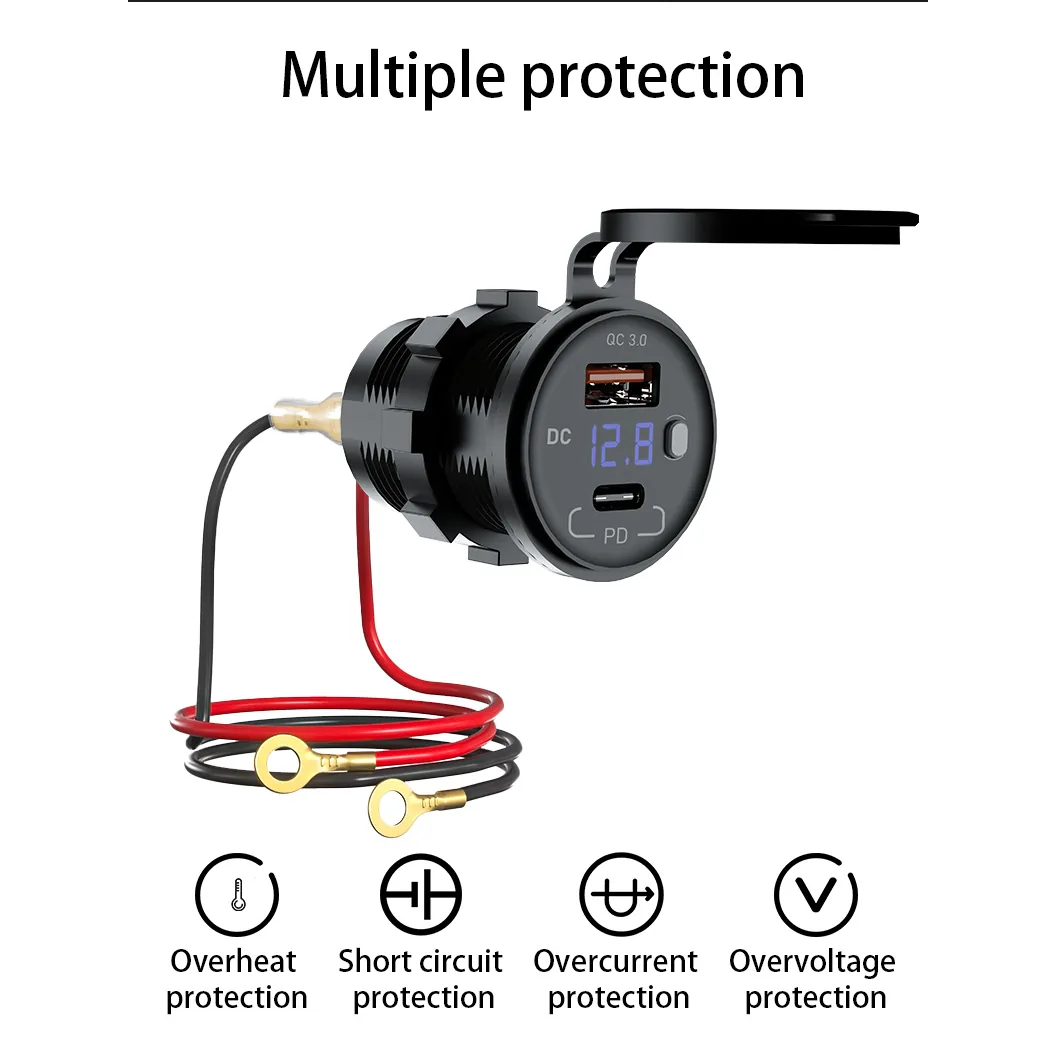
- Overheating, over-current and over-voltage protection, all four cut-outs built onto the board.
- Short-circuit protection on both outputs.
- IP66 with a hinged splash-proof cover, which is what makes the same unit usable on a boat panel and on a motorcycle fairing rather than only inside a cabin.
- The harness carries an inline fuse between the charger and the battery.
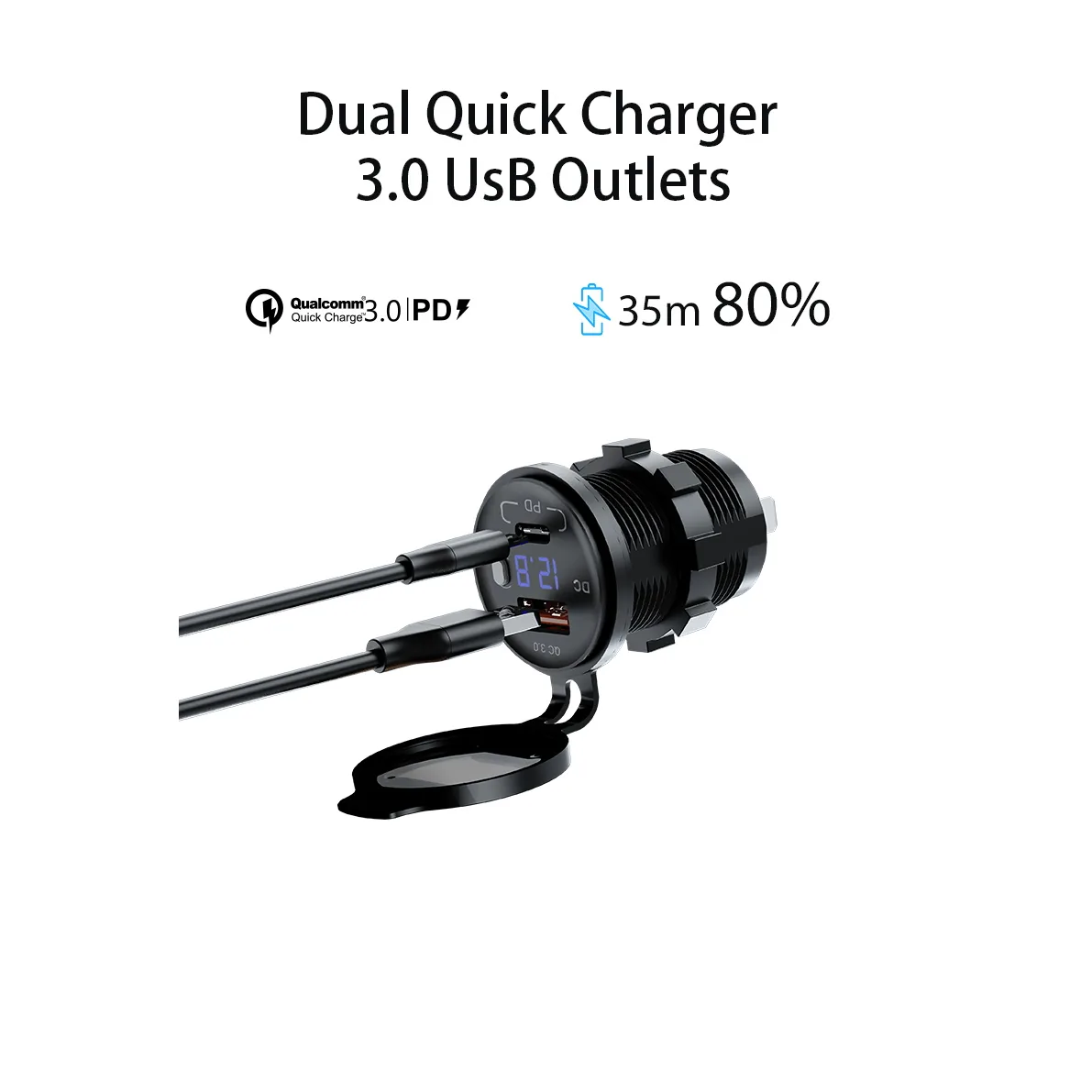
Both ports run independent circuits, so charging a phone on the USB-C side does not halve what the USB-A side can deliver. The USB-C port is rated at PD 30W with a PPS profile up to 33W, which is the profile Samsung and Pixel handsets negotiate for their fastest charge; the port charges a phone to roughly 80% in about 35 minutes, quoted by the factory at up to four times the speed of a conventional charger.
OEM and ODM options
The housing is the factory’s own tool, so a branded order is a production run rather than a moulding project. Body colour, logo, the marking on the cap, the print on the face and the retail packaging are all produced to your artwork, and the manual can be printed in the language your market reads. Send the version, the destination market and the quantity per run, and the sales team will confirm unit pricing, the output table, the certification documents for that market and the production schedule.
Frequently asked questions about the SUNDA CC82 voltmeter car charger
What does the voltmeter show?
It shows the DC voltage of the supply the charger is wired to, on a blue digital readout in the face. With the ignition off that is the battery’s resting voltage; with the engine running it is the alternator output. The unit in the product images reads 12.8V.
Will it work on a 24V truck or a boat, and what will the display show?
The input covers 12V to 24V, so a 24V truck, bus or boat runs on the same part number. On a 24V system the readout shows the 24V figures — a rested pair of batteries sits around 25.2V and the alternator lifts it to roughly 27.4-29.4V, so the bands in the table above are doubled.
What is the difference between this and the 3-port CC82?
The 3-port version adds a second USB-C port and a touch switch that isolates the USB-C outputs. This 2-port version trades that port for the digital readout. The barrel, the lock nut, the 30 mm cut-out and the harness are the same on both, so the two can be quoted on one sheet.
Will the display itself drain the battery?
The readout draws a very small current, and the charger is fed through the inline fuse on the harness. On a vehicle that is stored for long periods, wire it to a switched accessory circuit rather than straight to the battery.
How accurate is the reading?
It is a panel readout for monitoring, not a calibrated bench meter — use it to see whether a battery is holding charge and whether the alternator is working, not as a substitute for a load test.
Can we have our own logo, colour and packaging?
Yes. Body colour, logo, cap marking and retail packaging are produced to your artwork, and the manual can be printed in your market’s language. OEM and ODM branding runs start at 500 pcs per version, against a stock MOQ of 10 pcs.
Related models. This unit is one face style of the CC82 panel mount car charger range, which also covers the 3-port version and the plain 2-port version. For cigarette-lighter fittings, the CC76 dual-port car charger runs from 20W to 51W, the CC68 series covers the four-port 30W-to-126W platform, and the CC-53 series runs from 48W to 140W. The CC-62 series covers retractable and coiled-cable models, and the full range sits under car chargers.
Get a wholesale quote
The SUNDA CC82 12V car charger with voltmeter is built on our own tooling, so the housing colour, the logo print and the retail packaging can all be set to your brief. Stock models start from 10 pcs; OEM and ODM branding runs start at 500 pcs. Tell us the power version you want, the market you are selling into and the quantity per run, and we will come back with unit pricing, the full output table, the certification documents for that market, packing options and the current production schedule. Contact the SUNDA sales team for samples and lead time.