.lsunda-article-wrap{color:#1e293b;font-family:inherit;line-height:1.72;max-width:100%;text-align:left!important}.lsunda-article-wrap *{box-sizing:border-box}.lsunda-article-wrap h2{color:#334155!important;font-family:inherit;font-weight:700;font-size:clamp(1.45rem,2.2vw,1.9rem);line-height:1.32;margin:2.55em 0 .75em;text-align:left!important}.lsunda-article-wrap h3{color:#334155!important;font-family:inherit;font-weight:700;font-size:clamp(1.12rem,1.7vw,1.35rem);line-height:1.38;margin:1.85em 0 .65em;text-align:left!important}.lsunda-article-wrap p{color:#1e293b!important;margin:0 0 1.05em;font-size:1rem;text-align:left!important}.lsunda-article-wrap a{color:#046bd2;text-decoration:none;font-weight:500}.lsunda-article-wrap a:hover{color:#045cb4;text-decoration:underline}.lsunda-list{margin:1.1em 0 1.9em;padding:0;list-style:none;display:grid;gap:.65em}.lsunda-list li{position:relative;padding:.78em 1em .78em 2.25em;border:1px solid #ECEFF3;border-radius:8px;background:#fff;text-align:left!important}.lsunda-list li::before{content:””;position:absolute;left:.95em;top:1.32em;width:.42em;height:.42em;border-radius:50%;background:#046bd2}.lsunda-imgrow{display:grid;grid-template-columns:repeat(2,minmax(0,1fr));gap:1.15em;margin:1.8em 0 2.1em;align-items:stretch}.lsunda-imgcol{min-width:0;overflow:hidden;border-radius:8px;background:#fff}.lsunda-figure{margin:0;overflow:hidden;border-radius:8px;background:#fff;height:100%}.lsunda-figure img,.lsunda-article-img{width:100%;aspect-ratio:1/1;height:100%;display:block;border-radius:8px;border:1px solid #ECEFF3;object-fit:cover;transition:transform .22s ease;transform-origin:center center}.lsunda-figure:hover img,.lsunda-article-img:hover{transform:scale(1.018)}.lsunda-tablewrap{width:100%;max-width:100%;overflow-x:auto;-webkit-overflow-scrolling:touch;margin:1.55em 0 2em;border:1px solid #D1D5DB;border-radius:8px;background:#fff}.lsunda-table{width:100%;min-width:860px;border-collapse:collapse;table-layout:auto;font-size:.95rem;color:#1e293b;background:#fff}.lsunda-table tr:first-child{background:#F0F5FA}.lsunda-table th,.lsunda-table td{text-align:left!important;padding:.85em 1em;border:1px solid #ECEFF3;vertical-align:top;line-height:1.55;overflow-wrap:anywhere}.lsunda-table th,.lsunda-table td:first-child{font-weight:700;color:#334155}.lsunda-table tr:not(:first-child):hover{background:#F9FAFB}.lsunda-faq{margin:1.15em 0 2.1em;border-top:1px solid #ECEFF3;text-align:left!important}.lsunda-faq-item{border-bottom:1px solid #ECEFF3;padding:0;margin:0;background:#fff}.lsunda-faq-q{cursor:pointer;list-style:none;color:#334155;font-weight:700;font-size:1.03rem;padding:1.05em 2.3em 1.05em .15em;position:relative;line-height:1.5;text-align:left!important}.lsunda-faq-q::-webkit-details-marker{display:none}.lsunda-faq-q::after{content:”+”;position:absolute;right:.35em;top:50%;transform:translateY(-50%);color:#046bd2;font-size:1.35rem;font-weight:500}.lsunda-faq-item[open] .lsunda-faq-q::after{content:”-“}.lsunda-faq-q:hover{color:#046bd2}.lsunda-faq-a{padding:0 .15em 1.15em;color:#1e293b;text-align:left!important}.lsunda-final-cta{margin:2.4em 0 2.2em;padding:1.45em 1.55em;border:1px solid #D1D5DB;border-left:4px solid #046bd2;border-radius:8px;background:#F9FAFB;text-align:left!important}.lsunda-final-cta h2{margin-top:0;text-align:left!important}.lsunda-cta-button{display:inline-flex;align-items:center;justify-content:center;min-height:44px;padding:.76em 1.15em;border-radius:4px;background:#046bd2;color:#fff!important;font-weight:700;line-height:1.2;text-decoration:none!important;transition:background-color .2s ease,transform .2s ease}.lsunda-cta-button:hover{background:#045cb4;color:#fff!important;transform:translateY(-1px)}@media(max-width:768px){.lsunda-article-wrap h2{margin-top:2.15em}.lsunda-imgrow{grid-template-columns:1fr;gap:1em}.lsunda-figure img,.lsunda-article-img{height:auto;aspect-ratio:auto;object-fit:contain}.lsunda-final-cta{padding:1.2em}}@media(max-width:640px){.lsunda-table{min-width:760px;font-size:.9rem}.lsunda-table th,.lsunda-table td{padding:.7em .78em}}
.lsunda-pick{display:grid;grid-template-columns:minmax(220px,34%) minmax(0,1fr);gap:1.3em;align-items:start;margin:1.2em 0 2em}.lsunda-pick-media img{width:100%;aspect-ratio:1/1;height:auto;display:block;object-fit:cover;border:1px solid #ECEFF3;border-radius:8px}.lsunda-pick-copy{min-width:0}.lsunda-pick-copy>p:first-child{margin-top:0}.lsunda-pick-copy>p:last-child{margin-bottom:0}@media(max-width:768px){.lsunda-pick{grid-template-columns:1fr}.lsunda-pick-media{max-width:520px}}
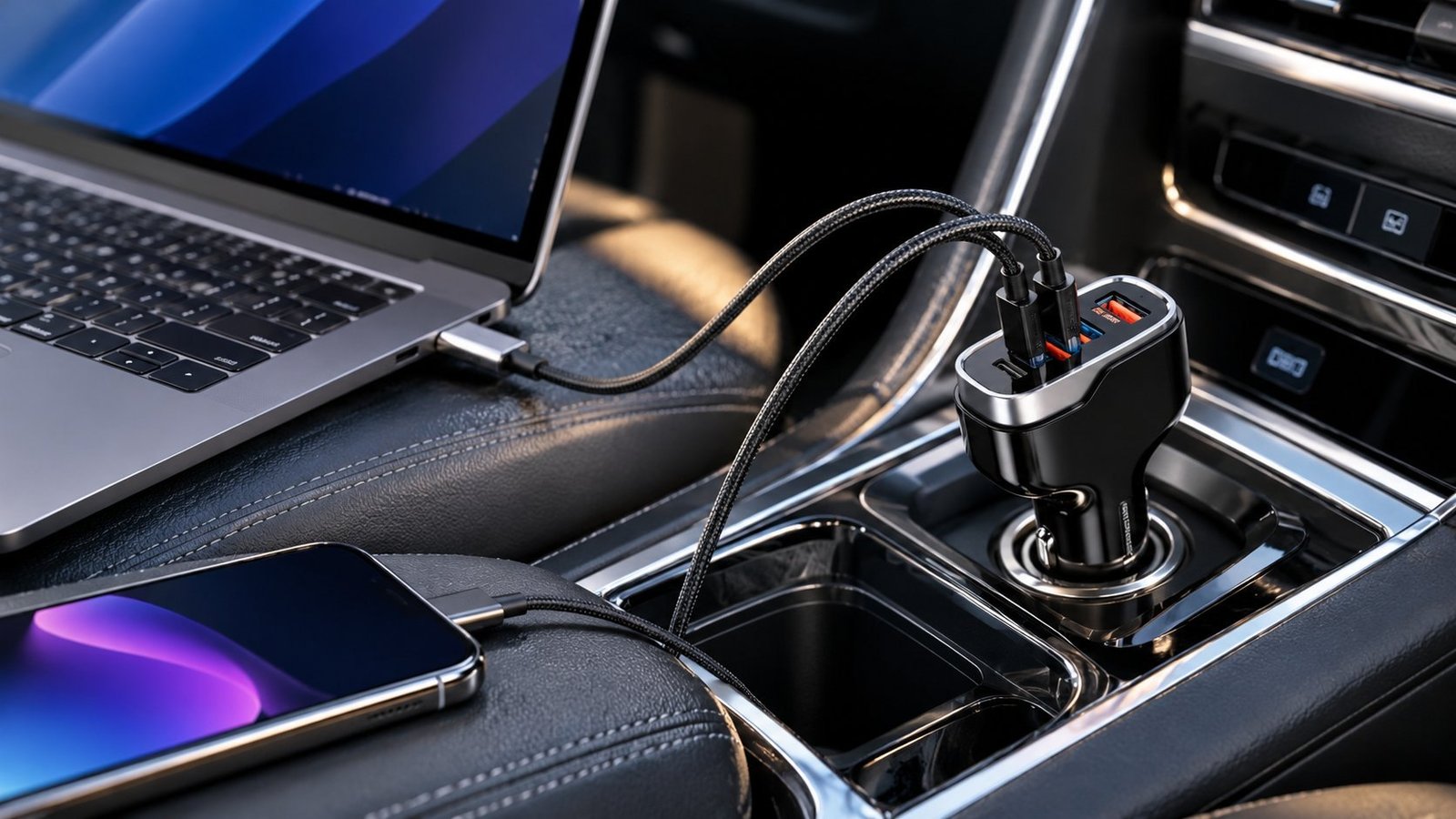
The mobile office is real, and so is the moment your laptop hits 3% somewhere on the motorway. A phone charger will not save you here. Charging a laptop in a car needs a 65W or higher USB-C PD charger with a genuine boost stage, plus an E-marked 5A cable.
Here is the catch most buyers hit in 2026: many chargers labelled 100W cannot actually sustain 100W from a 12V socket. They hit the number for a few seconds, then throttle. This guide explains the physics, shows what the wattage labels really deliver, and picks the units that hold their rating.
Quick answer: for an ultrabook, 65W is enough. For a 15 or 16-inch laptop, you want a charger that sustains 100W, not just peaks there, paired with an E-marked 5A cable.
Can You Really Charge a Laptop from a 12V Socket?
Yes, but the physics make it harder than charging a phone, and this is where cheap chargers fall short. Your car socket supplies 12V. A laptop over USB-C PD wants 20V. The charger has to boost 12V up to 20V internally, and that conversion is the whole challenge. If you want the basics first, our guide to how USB-C Power Delivery works in a car covers the handshake before the maths.
Here is the current math. To deliver 100W at 20V out, the charger pushes 5A to the laptop. Pulling that from a 12V input means drawing roughly 9A to 10A once you account for conversion losses. Most 12V sockets are fused at 10A to 15A. So a sustained 100W laptop charge sits right near the socket’s hard ceiling, with little room left over. Our breakdown of watts, amps and volts in car charging puts the same arithmetic in plain terms.
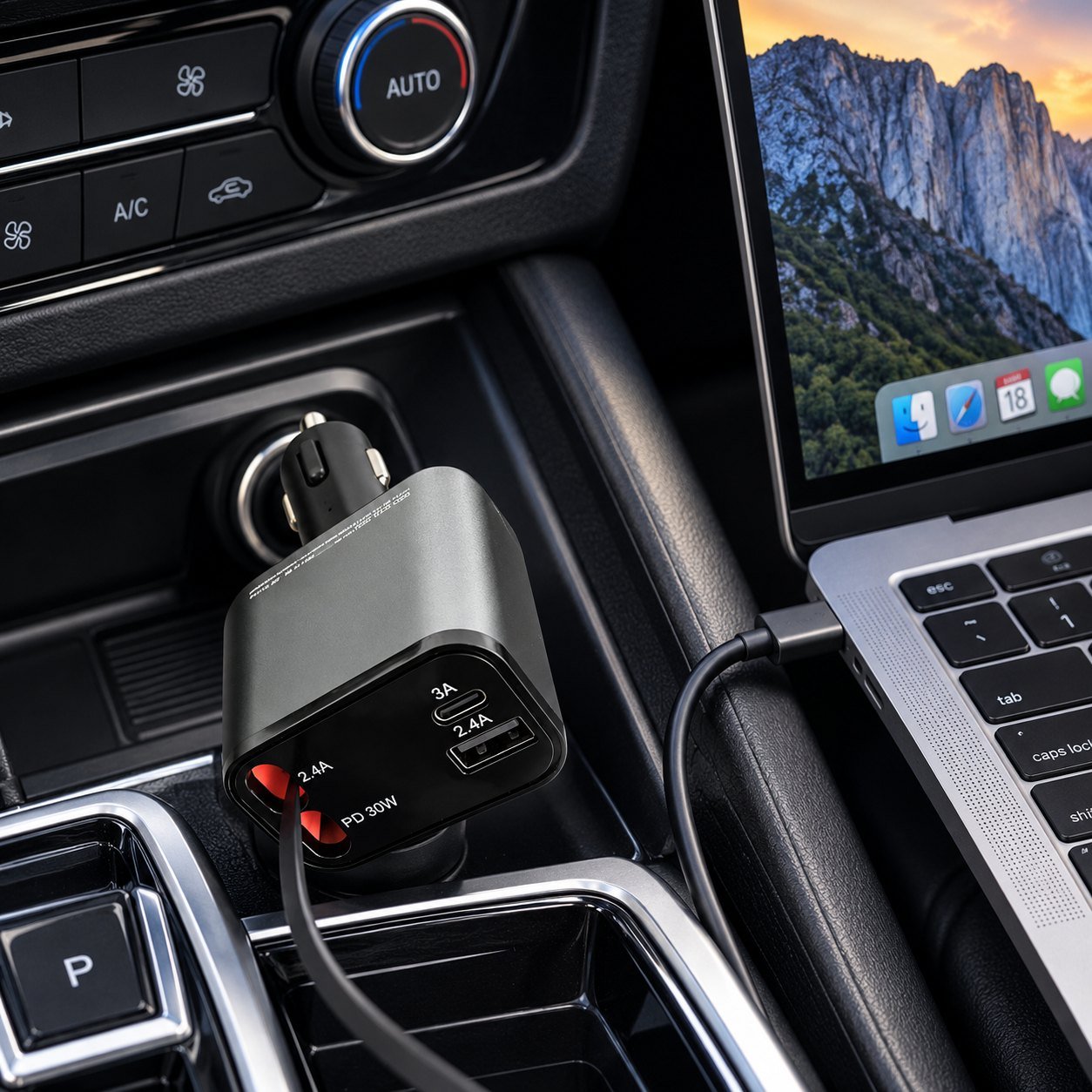
That ceiling is why sustained high wattage is an engineering problem, not a marketing one. A unit needs a real boost topology and enough thermal mass to shed the heat that conversion generates.
On the SUNDA bench, a 100W module is validated at a sustained 100W output at 30°C ambient, not just a peak reading. A charger that only quotes peak wattage is hiding the number that matters.
What 45W, 65W and 100W Labels Actually Deliver
A wattage label is a ceiling, not a promise. What the charger sustains under real load, and how it splits power across ports, is what counts.
| Label | Sustains in a real car | Charges |
|---|---|---|
| 45W | 45W single port | MacBook Air, ultrabooks at full speed |
| 65W | 65W single port | 13 to 14-inch laptops, MacBook Pro 14 at light load |
| 100W | 100W if boost-staged, else throttles to ~65W | 15 to 16-inch laptops under load |
| 140W (PD 3.1 EPR) | 140W with an EPR charger and EPR cable | MacBook Pro 16 at full speed |
Sustained figures assume a single port under load. Add a second device and the budget splits.
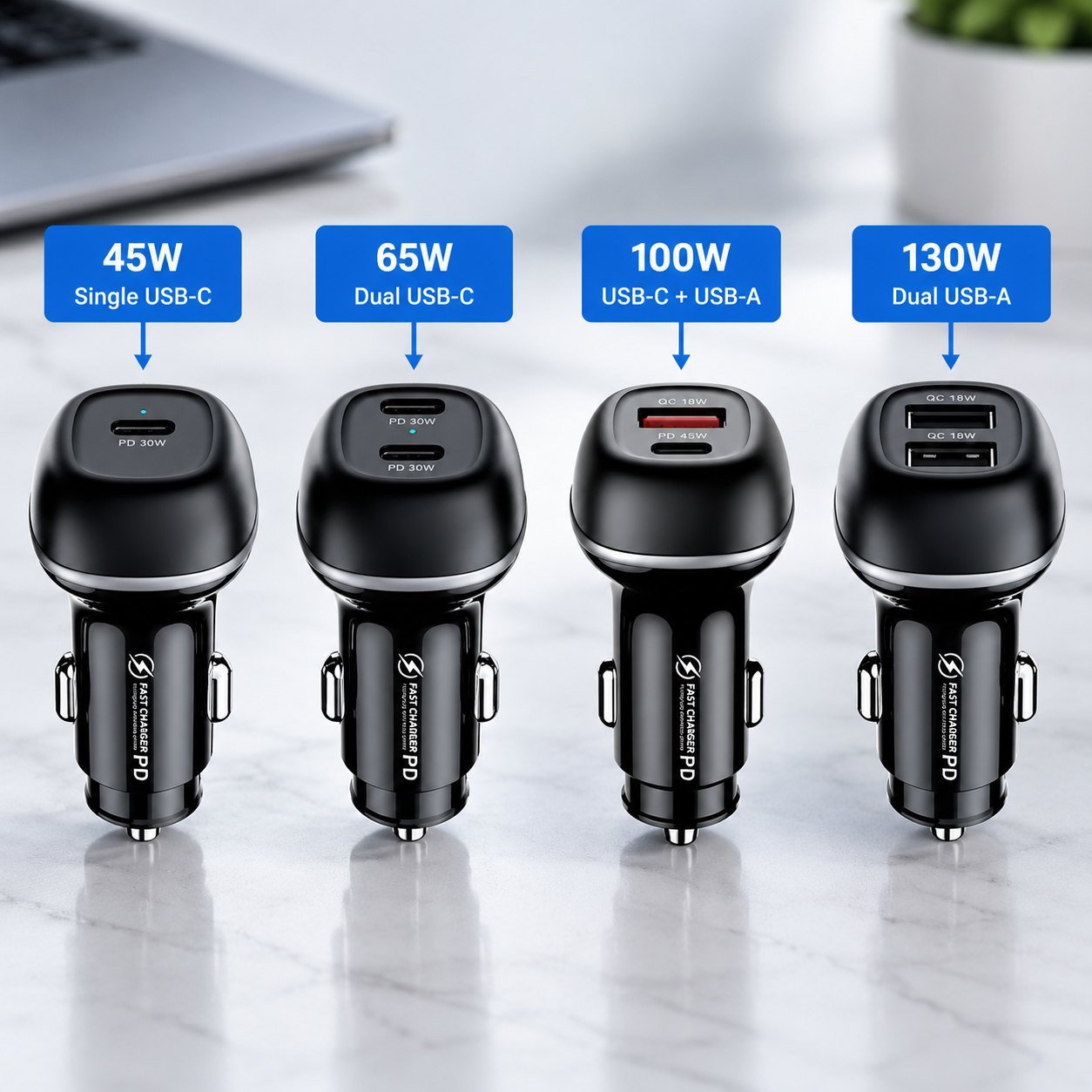
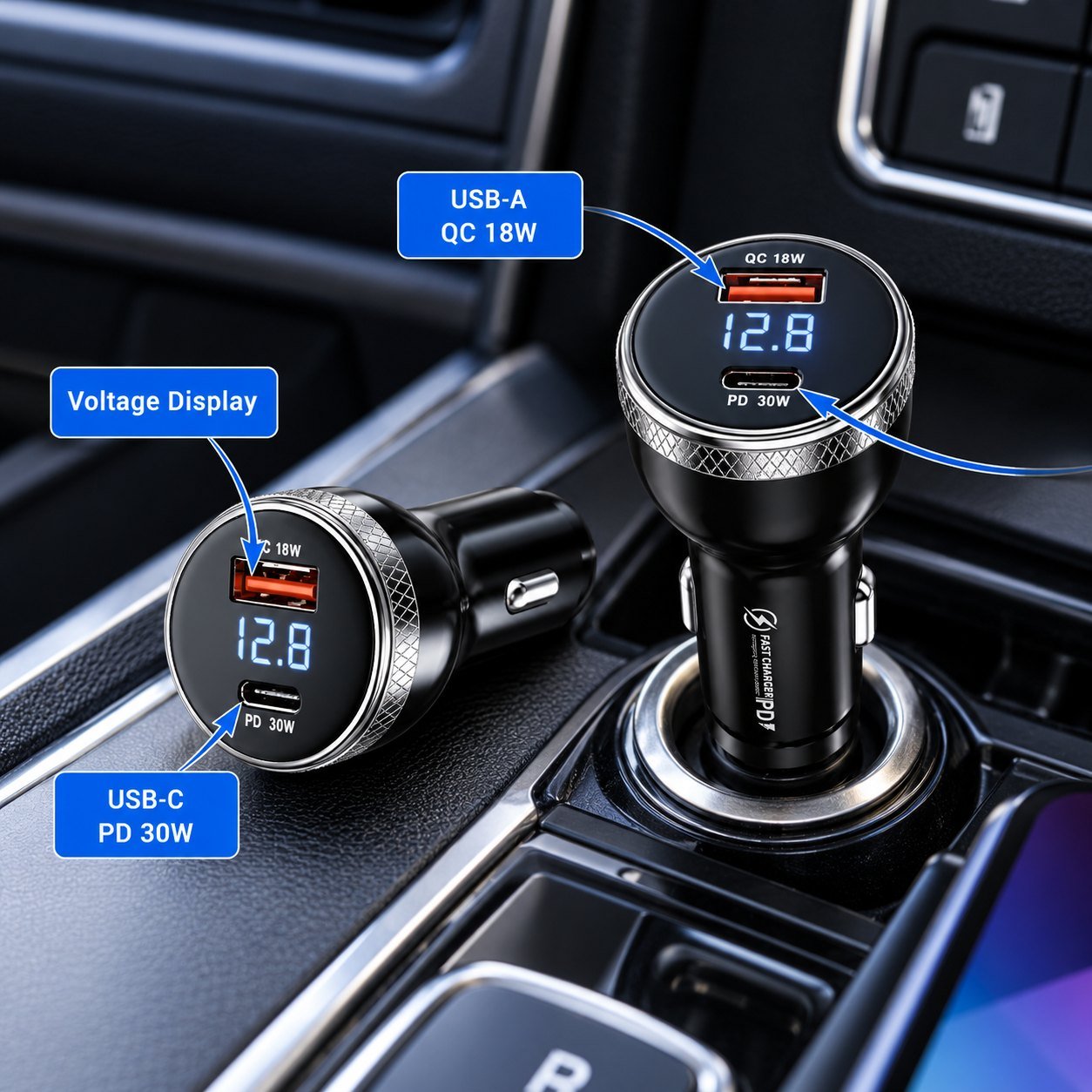
Two label red flags. A “100W” charger with no sustained-output spec, only a peak figure, usually throttles hard once it warms up. And “100W total” on a dual-port unit means the 100W splits across both ports, so your laptop might see only 65W while a phone charges on the second port. Read the per-port sustained number, not the headline.
SUNDA’s own range shows why the distinction bites. The CC-90 four-port unit is rated 102W total, but each USB-C port delivers PD 30W with PPS 33W. That total is real. It just is not a laptop figure. Nothing on the box lies, and plenty of buyers still read it wrong.
The Picks, by Laptop Size
Match the charger to your laptop’s real draw. Paying for 100W when a 65W unit covers your machine is wasted money, and the reverse leaves you charging slowly.
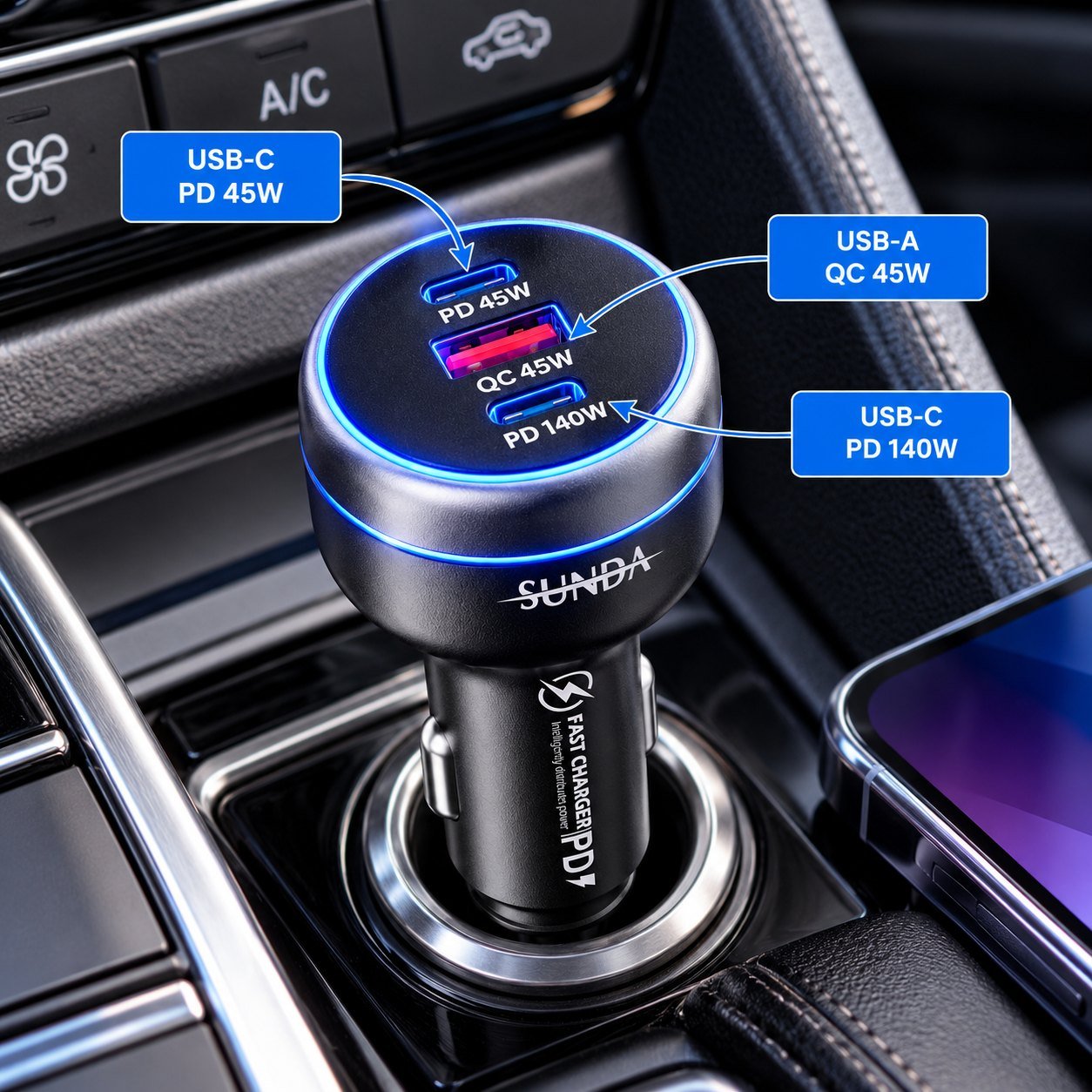
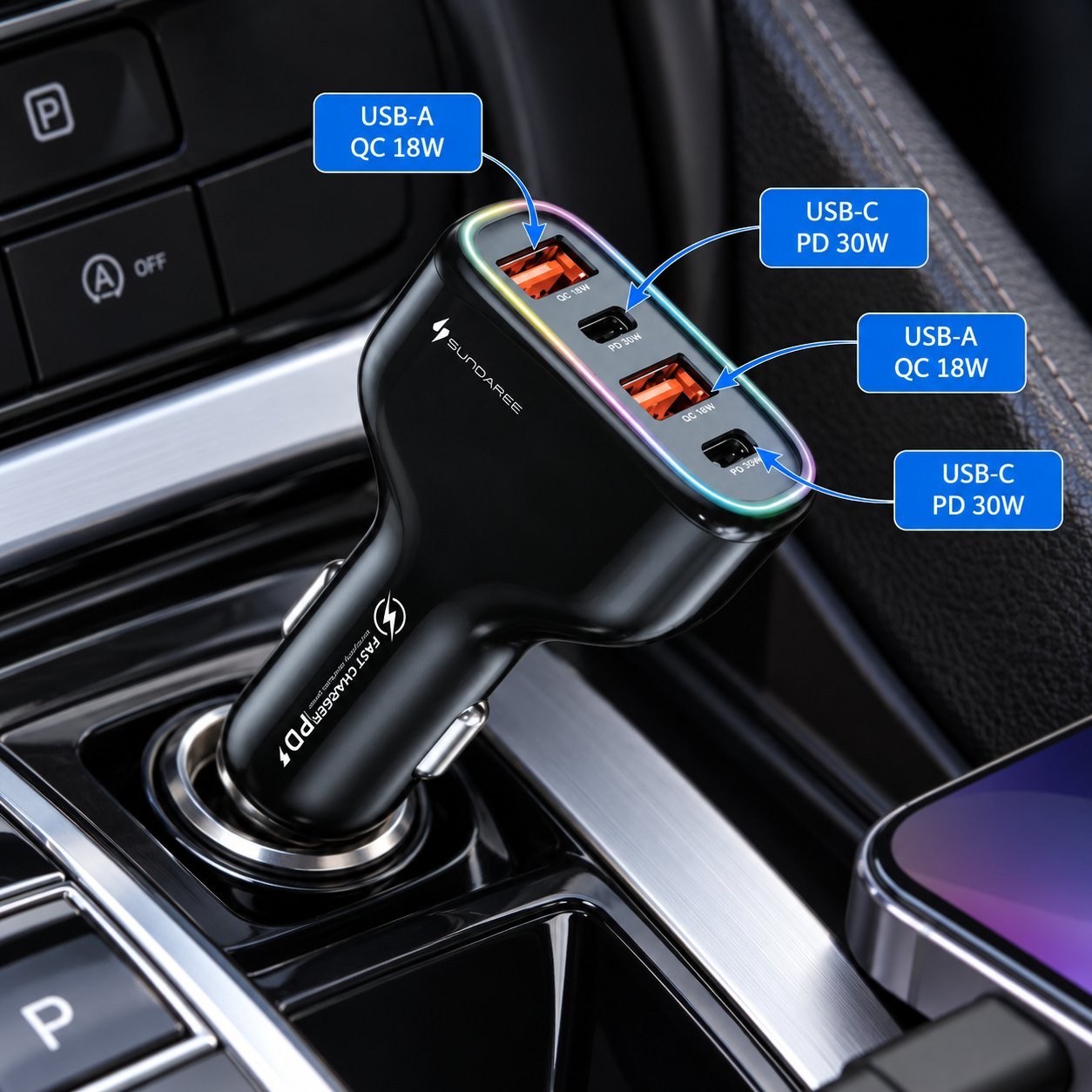
Port count is where most sourcing decisions go wrong. A three-port unit with one high-wattage USB-C, like the 45W / 45W / 140W layout above, gives the laptop the big port and leaves the other two for phones. A four-port unit splits a smaller budget four ways, which is right for a family car and wrong for a work laptop.
| SUNDA model | Ports | Laptop port | Second device | Total |
|---|---|---|---|---|
| CC53 140W | 2 x USB-C + 1 x USB-A | 100W PD 3.0 | 18W QC 3.0 | 140W |
| CC68 120W | 2 x USB-C + 2 x USB-A | 60W PD, PPS 63W | 30W QC per USB-A | 120W, 126W PPS peak |
| CC-90 102W | 2 x USB-C + 2 x USB-A | 30W PD, PPS 33W | 18W QC per USB-A | 102W |
Read that table as a ladder. Only the top row holds a large laptop at full speed. The middle row suits two medium laptops or a laptop plus a tablet. The bottom row is a phone charger that happens to carry a big total number.
65W Single USB-C: Best for Ultrabooks
A 65W single-port unit fast-charges a MacBook Air M3, a Dell XPS 13, and most 13 to 14-inch laptops at full speed. It is the sweet spot for the mobile worker carrying a thin-and-light machine. A quality 65W unit sustains its rating without throttling, which a cheap one often cannot.
Inside the CC53 car charger series the 60W and 75W models cover this tier, in 2-port, 3-port and 4-port layouts. Every model runs 12 to 24V input, so the same SKU works in a 12V car and a 24V truck.
100W Single USB-C: Best for Large Laptops
A 100W unit with a real boost stage covers 15 and 16-inch laptops, including the MacBook Pro 14 under heavy processor load. The spec to confirm here is sustained output, not peak. Ask whether the 100W figure is validated at a warm ambient, because that is the condition a summer car cabin creates.
Two SUNDA models reach 100W on a single port. The CC53 140W carries up to 100W on USB-C PD 3.0 plus 18W QC 3.0 on USB-A, with OVP, OCP, OTP and short-circuit protection. The CC-92 goes further: PD 100W at 20V/5A on PD 3.1, IP67, and bidirectional charging so the same module can feed a battery instead of drawing from one.
100W+ Multi-Port: Best for Laptop Plus Phone
For charging a laptop and a phone at once, you need total headroom above 100W so the laptop keeps its full speed while the phone pulls its share.
The CC53 140W does exactly that: 100W to the laptop, 18W to a phone, from a 140W total. If you need two laptops instead, the CC68 120W four-port unit splits into 2 x PD 60W with PPS 63W peak plus 2 x QC 30W, on a 12 to 24V / 12A input. SUNDA’s high-wattage platform runs from 38W up to 140W across the range, with PD 3.1 on the 100W CC-92 module. See the full car charger range for the current lineup.
Cables and E-Markers: The Silent Failure Point
This is the mistake that generates the most “my 100W charger only does 60W” complaints. The cause is almost never the charger. It is the cable.
Any USB-C cable carrying more than 3A has to include an E-marker chip, a tiny controller that tells the charger the cable can safely handle higher current. A 100W charge at 20V needs 5A, so it needs an E-marked 5A cable. Plug in an old 3A cable with no E-marker and the charger caps itself at 60W to stay safe, no matter what it is rated for.
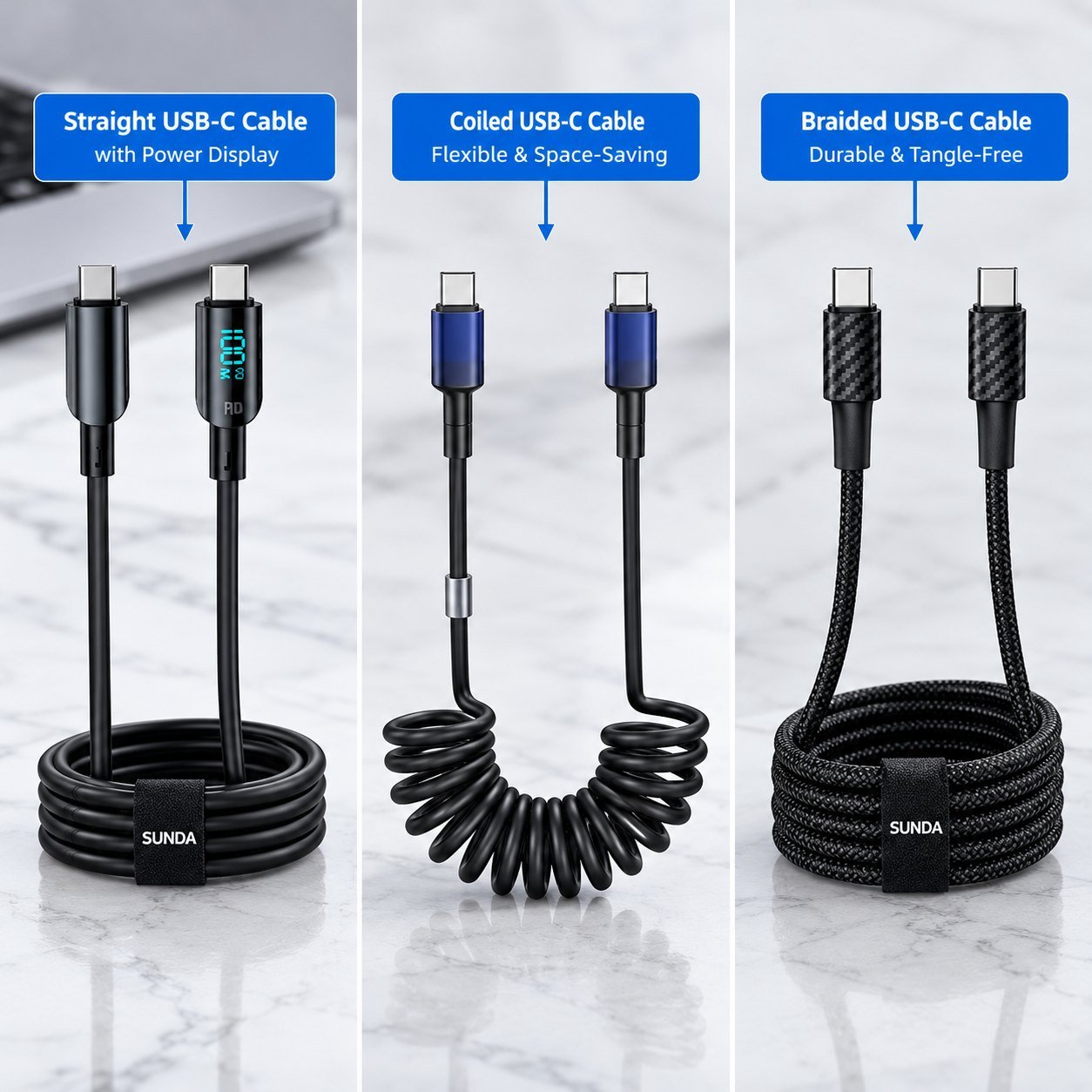

For 140W PD 3.1 EPR charging, you need an EPR-rated cable, which is built to an even higher spec. Match the cable to the charger.
SUNDA’s YD-TP01 USB-C cable carries the 5A chip and a real-time wattage display, so the buyer can see the negotiation happen instead of trusting a label. The YD-TP02 coiled cable is rated 60W, which is the honest number for a 3A-class build and the right pairing for a 65W unit, not a 100W one. The full USB-C cable range covers 3A and 5A builds in straight, coiled and braided constructions.
High Wattage as a Margin Play for Resellers
For distributors and private-label brands, the high-wattage tier is where the margin lives. A 100W laptop car charger commands two to three times the price of a basic phone charger, and the buyer is a less price-sensitive professional. The catch is that this tier is unforgiving of corner-cutting. A unit that throttles under load generates returns and kills a brand’s reviews.
Sourcing against sustained-output data, not peak claims, is what protects the margin. The CC53 series is built for exactly that conversation: eight models from 38W to 140W, PC or PC+ABS fire-retardant housings, CE, RoHS and FCC on the model pages. The wider SUNDA certification stack covers E-Mark, ETL, UL, ISO 9001, amfori BSCI and SMETA, so you can match the paperwork to your market.
Custom logo, housing and packaging run from 500 pcs per SKU, and stock orders start at 10 pcs depending on model. Lead time is around 30 working days. Request sustained-output test data and a quote and the SUNDA team will respond within two business days.
Summary
Charging a laptop in a car is a boost-conversion problem, not just a wattage number. Your 12V socket caps sustained output near its fuse limit, so a real 100W charge needs genuine boost engineering and heat dissipation. Match the charger to your laptop size, confirm sustained output rather than peak, and always pair a 100W unit with an E-marked 5A cable. Skip any charger that quotes only a peak figure.
Need a Charger That Holds 100W?
Compare the eight CC53 models, then send your laptop model, target volume and market to the SUNDA team. You get sustained-output test data and pricing back within two business days.
FAQ
Can I charge a laptop in my car with USB-C?
Yes, with a 65W or higher USB-C PD car charger. An ultrabook like a MacBook Air charges fully from 65W. A 15 or 16-inch laptop needs a charger that sustains 100W. The charger boosts your car’s 12V up to the 20V the laptop needs, so a quality boost stage is what makes it work.
How many watts does a laptop need from a car charger?
It depends on size. Ultrabooks and 13-inch laptops charge fully at 45W to 65W. A 14-inch MacBook Pro wants 65W to 96W. A 16-inch laptop under load needs 100W, and the MacBook Pro 16 can take 140W over PD 3.1 EPR. Match the charger’s sustained output to your machine’s rated input.
Why does my laptop charge slowly in the car?
The most common cause is the cable. A USB-C cable without an E-marker chip caps charging at 60W even on a 100W charger. The second cause is a charger that throttles because it cannot sustain its peak wattage from 12V. Check the cable first, then confirm the charger’s sustained output rating.
Do I need a special cable for 100W charging?
Yes. You need an E-marked 5A USB-C cable. The E-marker is a chip that tells the charger the cable can safely carry 5A, which 100W at 20V requires. A standard 3A cable with no E-marker limits the charge to 60W. For 140W EPR charging, you need an even higher-rated EPR cable.
Is a 100W car charger safe for my car’s electrics?
Yes, on a healthy 12V socket. A 100W output draws around 9A to 10A at the input, which sits inside the 10A to 15A fuse rating of most sockets. A quality charger includes overcurrent protection that keeps it within that limit. The socket’s own fuse is the backstop if anything exceeds it.
Do you supply high-wattage chargers for retail brands?
Yes. SUNDA manufactures 65W to 140W USB-C PD car chargers for distributors and private-label programs, validated for sustained output rather than peak claims. Custom logo, housing and packaging are available from 500 pcs per SKU, with CE, RoHS and FCC on the model pages and E-Mark, ETL and UL available by target market. Lead time is around 30 working days.