The numbers on a car charger label (5V, 2.4A, 30W) determine how fast your phone charges. Most buyers ignore them. Then they wonder why a "30W charger" barely moves the battery needle in a 30-minute commute. This guide breaks the formula down in under five minutes, shows what the specs mean in real charge time, and tells you which wattage tier fits which device in 2026.
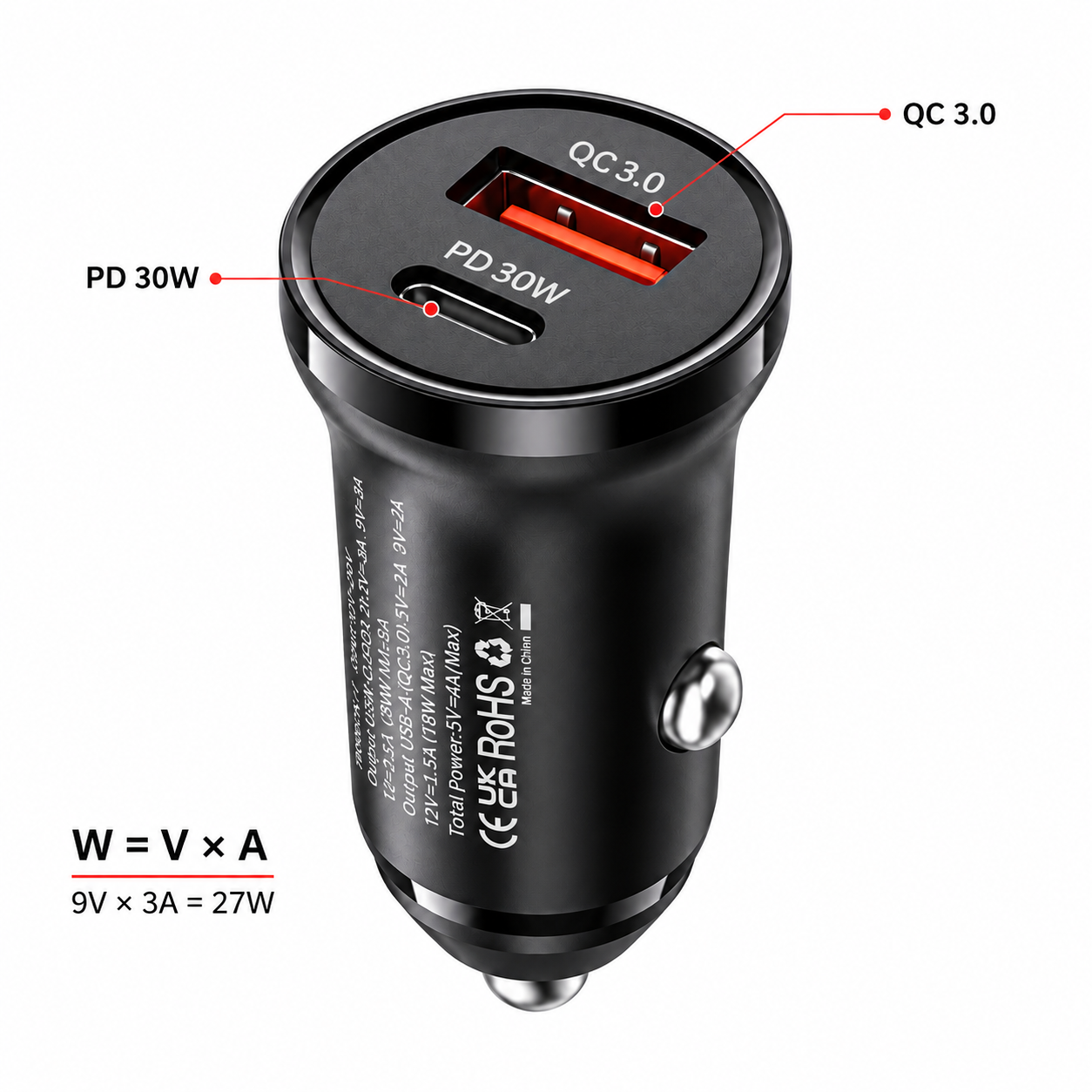
The short answer: Watts = Volts × Amps. A 5V/2A charger delivers 10W, which is fine for a slow top-up but far too slow for modern phones. A 9V/3A charger delivers 27W, which is today's baseline for fast charging. Samsung Galaxy S-series phones need 25W to 45W with PPS support to hit their rated fast-charge speed.
W = V × A: The Only Formula You Need
Watts, volts, and amps measure three different things. Volts (V) is the electrical pressure pushing current through the circuit. Amps (A) is the rate at which that current flows. Watts (W) is the actual power reaching your battery, which you get by multiplying the two.
Four examples:
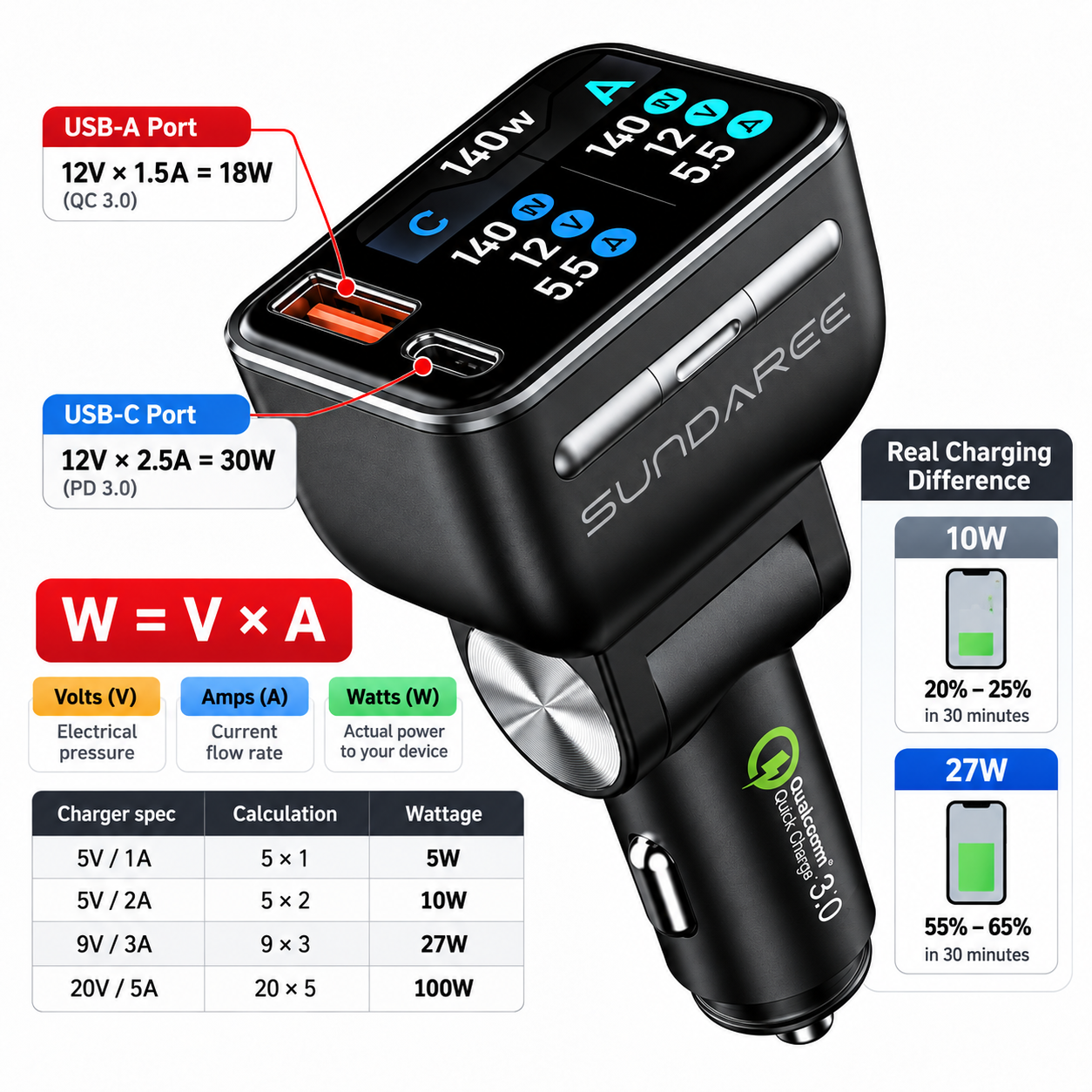
| Charger spec | Calculation | Wattage |
|---|---|---|
| 5V / 1A | 5 × 1 | 5W |
| 5V / 2A | 5 × 2 | 10W |
| 9V / 3A | 9 × 3 | 27W |
| 20V / 5A | 20 × 5 | 100W |
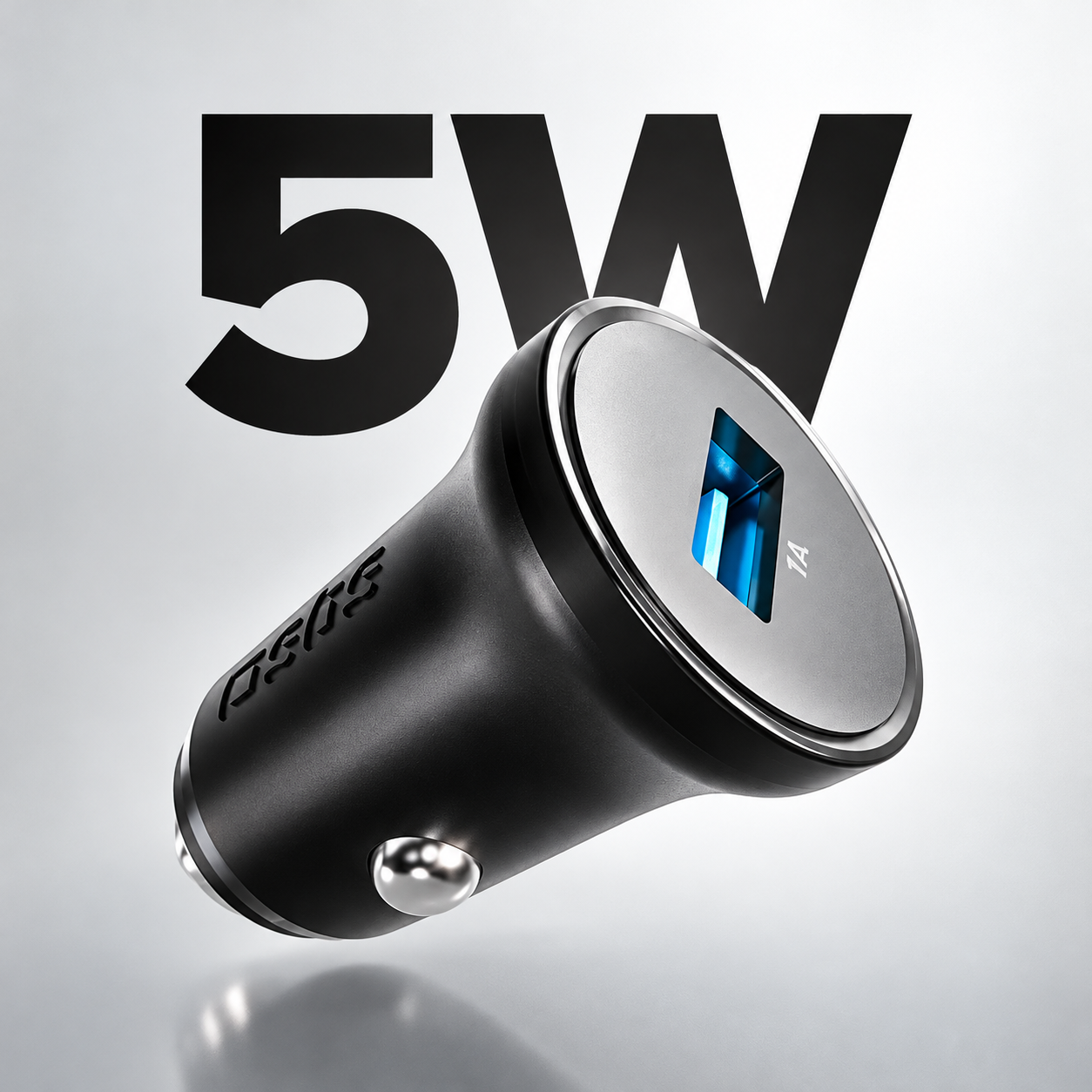
A 2 amp 5 volt charger outputs 10W. That's where most generic "USB car adapters" sit. They charge. Just slowly. A 1 amp 5 volt charger at 5W is the original USB spec from 2005, still showing up on cheap dashboard USB ports in older vehicles.
The numbers matter because charge time scales with wattage. At 10W, a 3,000 mAh phone battery gains roughly 20% to 25% in 30 minutes. At 27W, that same phone gains 55% to 65% in the same window. The math is why buying a higher-wattage charger with the right protocol pays off on every commute.
5V/2.4A vs 9V/3A: The Charge Speed Gap Is Bigger Than It Looks
Here is where amperage as a marketing number causes real confusion. Packaging often puts "2.4A" in bold because 2.4 looks more impressive than "12W." At 5V, 2.4A is 12W. Fast charging starts at 18W. The phone does not care how many amps the charger claims at 5V.
At 9V, the math flips. A 9V/3A port is 27W, which is more than twice the output of a 5V/3A port. That difference shows up clearly in a half-hour drive.
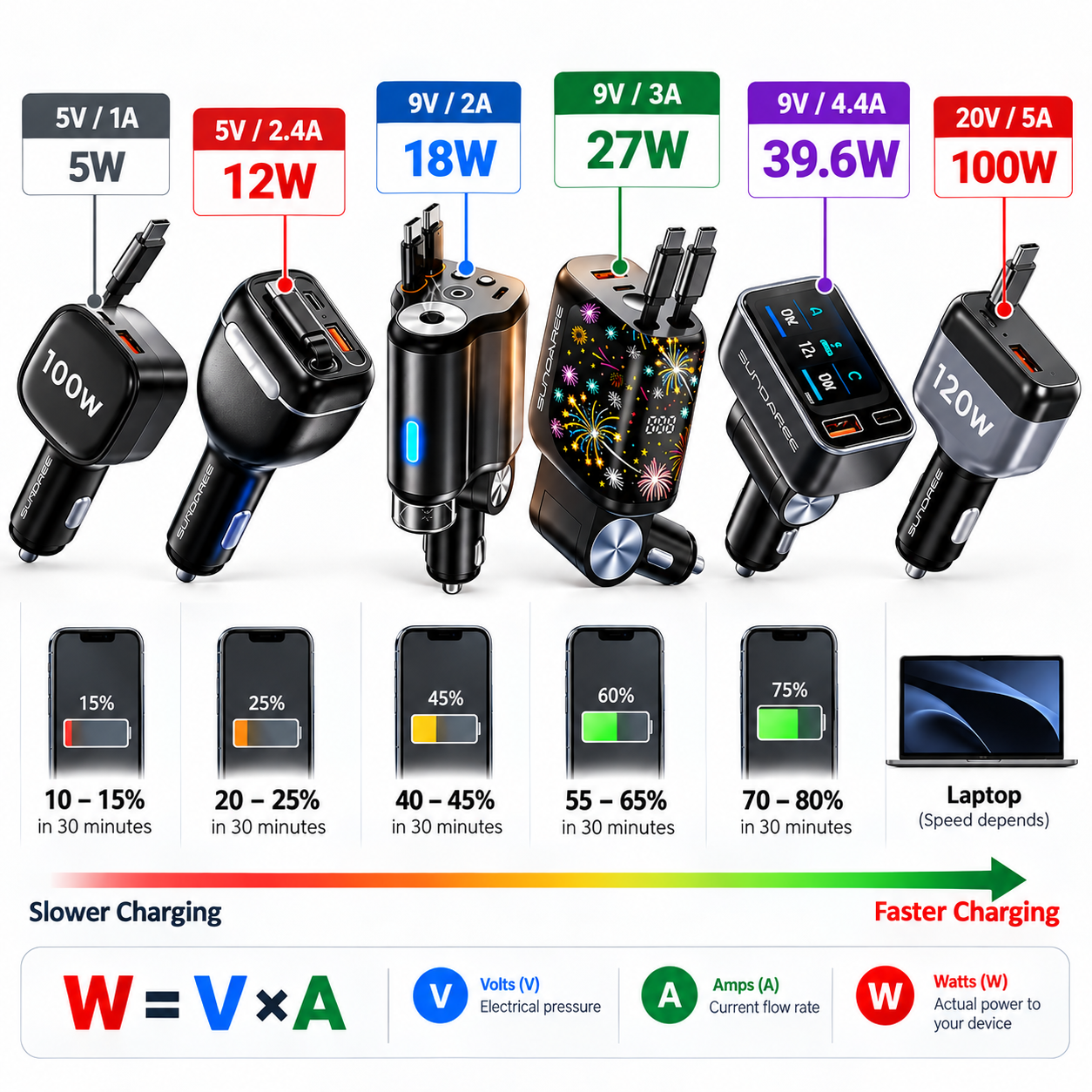
| Charger spec | Wattage | Approximate battery gain in 30 min |
|---|---|---|
| 5V / 1A | 5W | 10 to 15% |
| 5V / 2A | 10W | 20 to 25% |
| 5V / 2.4A | 12W | 25 to 30% |
| 9V / 2A | 18W | 40 to 45% |
| 9V / 3A | 27W | 55 to 65% |
| 9V / 4.4A | 39.6W | 70 to 80% |
| 20V / 5A | 100W | laptop-dependent |
Approximate benchmarks at rated wattage against a 3,000 mAh battery at room temperature. Actual results vary with cable quality, phone temperature, and state of charge.
The jump from 5V to 9V is what triggers fast charging. That jump happens through a short negotiation protocol called PD (Power Delivery) or QC (Quick Charge). The phone sends a request over the USB-C CC pin or USB-A D+/D- lines, the charger responds with a higher voltage, and fast charging starts.
If the charger does not support PD or QC, the phone stays at 5V even if the label says 30W. The protocol is not optional. It is the gate. And the cable is the second gate: a charge-only USB-C cable without data lines blocks the entire negotiation, so the phone falls back to 5V regardless of what charger you plugged in.
Picking the Right Wattage Tier Before You Order
Different devices have different ceilings. Matching the charger to the device means you get the rated charge speed without overpaying for wattage the phone cannot use.
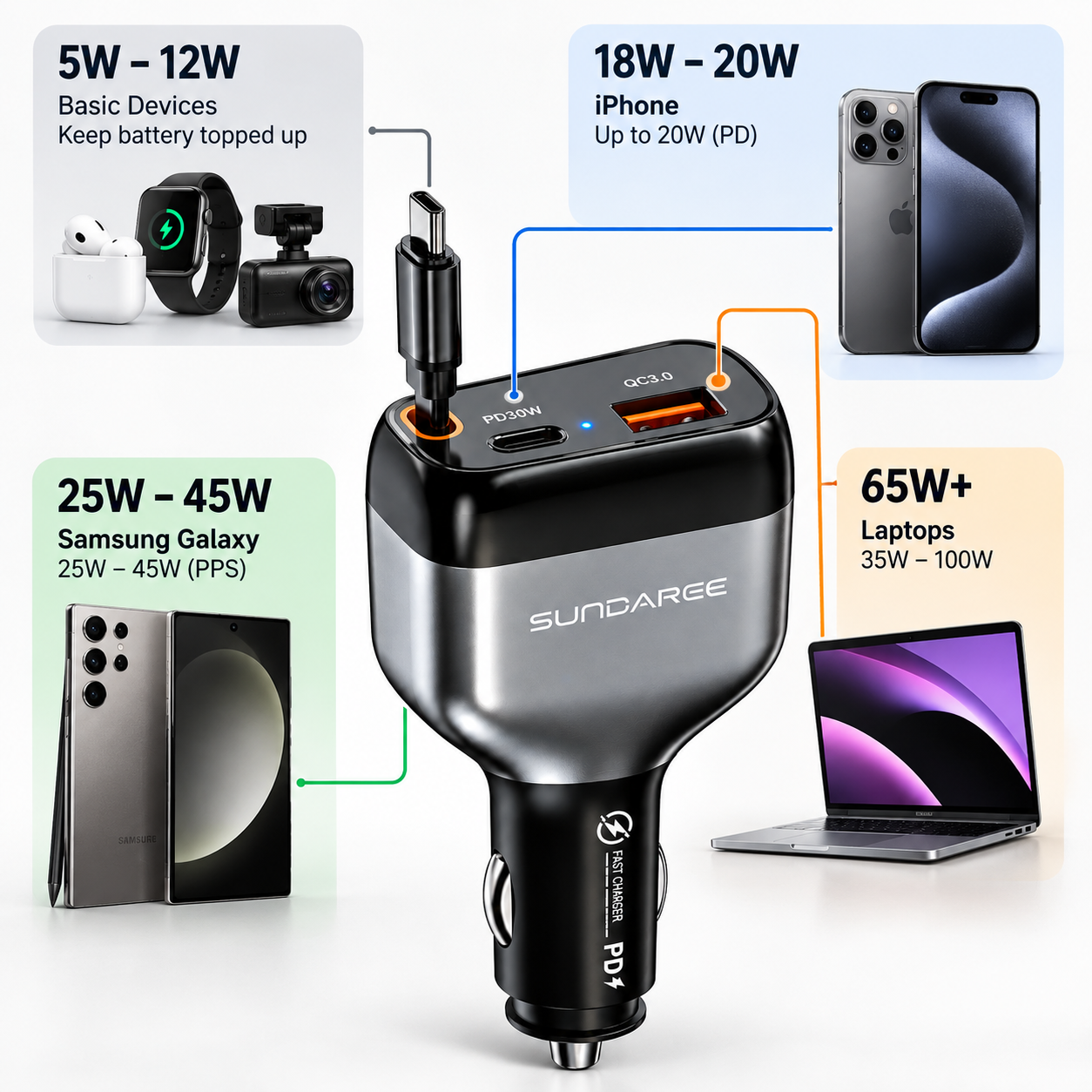
5W to 12W covers devices with no fast-charge support, basic USB-A ports on older vehicles, and secondary devices where you only need to keep the battery from draining.
18W to 20W is the iPhone tier. Apple rates iPhone 15 and all current models at 20W via USB-C PD. A 20W PD port delivers exactly that. Going to 30W or 40W does not charge the iPhone faster. The phone will not accept more than its own rated input.
25W to 45W is where Samsung Galaxy S-series phones land. The S24 charges at 25W via standard PD. The S24+ and S25 Ultra hit 45W, but only with PPS (Programmable Power Supply) support on the charger. Without PPS, a Samsung Galaxy flagship charges at around 25W regardless of the charger's headline wattage. This is the most common sourcing mistake in the Android segment.
65W and above is the laptop tier. A MacBook Air M3 needs around 35W under active use. A MacBook Pro 14-inch needs 67W to keep up with the processor under load. A 100W car charger covers both, with the laptop charging at its rated speed and a phone charging simultaneously from a second port.
For importers building a catalog that covers multiple markets, a 65W dual-port unit with PPS handles Samsung at 45W, iPhone at 20W, and Pixel at 21W from a single SKU. SUNDA's car charger range runs from 40W single-port up to 230W multi-port, with PDO documentation on every model.
Reading a Spec Sheet Without Getting Fooled
"Total output" is not per-port output. A 65W charger with two USB-C ports shares that 65W budget across both. When both ports run simultaneously, the typical split is 45W on one port and 20W on the other. Some units use dynamic allocation. The headline number tells you the ceiling for the unit, not what each port delivers under load.
PDO tables are what you actually need. PDO stands for Power Delivery Object. Each PDO is a specific voltage and current pair the port can supply: 5V/3A, 9V/3A, 12V/3A, 15V/3A, 20V/3.25A. A spec sheet listing these tells you the exact staircase of outputs the charger supports. A sheet that only says "65W PD" tells you almost nothing verifiable about per-port delivery.
Three red flags to spot immediately:
- A charger that lists "total output" without a per-port breakdown. You cannot determine what each port actually delivers under load.
- A high amp number at 5V only. "5V/6A" sounds strong. It is 30W. No current phone runs fast-charge negotiation at 5V. The protocol steps voltage up first, so a high amp count at 5V adds nothing.
- No protocol listed at all. If the spec sheet does not say PD, PPS, or QC3.0, the charger outputs flat 5V only, regardless of wattage claims.
USB car charger amperage is only a useful number when the voltage is also stated. Amps without volts is a marketing figure. The CC53 car charger series ships with full per-port PDO documentation on request so you can verify the output staircase before placing an order.
Charger Specs at a Glance
| Device | Protocol required | Minimum charger spec | PPS needed? |
|---|---|---|---|
| iPhone 15 / 15 Pro | PD 3.0 | 20W | No |
| iPhone 16 Pro Max | PD 3.0 | 30W | No |
| Samsung Galaxy S24 | PD 3.0 | 25W | No |
| Samsung Galaxy S24+ / S25 Ultra | PPS | 45W | Yes |
| Samsung Galaxy A55 | PD 3.0 | 25W | No |
| Google Pixel 9 Pro | PD 3.0 | 21W | No |
| MacBook Air M3 | PD 3.0 | 30W to 35W | No |
| MacBook Pro 14-inch | PD 3.0 | 67W | No |
For a matched home-and-car charging set, SUNDA's wall charger range covers the same PD and PPS tiers, useful for bundle SKUs targeting buyers who want the same protocol coverage at home and in the vehicle.
Summary
Watts = Volts × Amps. That formula is everything. A 2A/5V charger outputs 10W, which was the USB standard two decades ago and charges phones today at roughly a third the speed of a fast-charge port. A 9V/3A port at 27W is today's baseline. Samsung Galaxy S-series at 45W needs PPS on top of PD. Laptops in the car need 65W or higher to charge under active use.
Source Car Chargers With Verified Specs
Request a spec sheet or send your sourcing requirements to the SUNDA team. OEM programs run from 500 units per SKU, with CE, FCC, RoHS, E-Mark, and UL available by target market. Standard production lead time is 7 to 15 working days.
FAQ
Is 2.4A enough to charge a phone in the car?
At 5V, 2.4A delivers 12W. That charges a phone but slowly by current standards. A 9V/3A charger at 27W puts roughly twice the power in over the same time. On a 30-minute commute, the gap between 12W and 27W is roughly 20 to 30 percentage points of battery gained. For a quick stop, 2.4A at 5V is noticeable.
What does 5V 2A mean on a car charger?
5V is the voltage. 2A is the current. Multiply them to get 10W of actual power delivered. A 5V/2A charger runs the original USB standard from before fast charging existed. It works on any USB device but charges at a fraction of the speed a current phone accepts from a fast-charge port.
How do I convert amps to watts for a car charger?
Multiply the voltage by the amps. At 5V, a 2A charger is 10W and a 3A charger is 15W. At 9V, a 3A charger is 27W. At 20V, a 5A charger is 100W. Without knowing the voltage, the amp number alone gives you no reliable information about actual charge speed.
Why does my '30W' charger only charge at 15W?
Most likely causes: the cable has no data lines and blocks the PD voltage negotiation, so the charger stays at 5V. Or the "30W" figure is total output split across two ports, giving each port 15W under load. Or the charger lists PD without a proper PDO staircase and only outputs fixed voltages that do not match your device's request.
How many watts do two phones need at once?
Budget 20W per phone as a floor for standard fast charging. A 45W dual-port charger covers both, though the split typically gives one port 25W to 30W and the second port 15W to 20W. For two phones where both need peak fast-charge speed, a 65W dual-port unit gives each port more headroom under shared load.
Does higher wattage wear out my battery?
No, when the phone's own battery management is functioning correctly. Every current smartphone regulates its charge intake. The phone requests only as much power as its controller allows. A 100W charger connected to a phone rated at 20W delivers 20W. The phone sets the limit, not the charger.