The USB-C car charger market shifted permanently when iPhone 15 dropped the Lightning port. Every flagship phone now ships USB-C, and every buyer searching for the best USB-C car charger in 2026 hits the same trap: wattage figures on packaging are often marketing math, not what the port actually delivers under load. This guide covers six picks from 20W budget to 100W laptop-ready, with the spec checks that tell you whether a charger actually fast-charges your device before you order it.
The best USB-C car charger for 2026 delivers 30W or higher PD from a certified controller. For two devices simultaneously, you need 45W or higher total output. The six picks below cover every budget.
| Pick | Best for | Max output | Protocol |
|---|---|---|---|
| 40W single USB-C | One phone, daily commute | 40W PD | PD 3.0 |
| 65W dual USB-C | Phone and tablet at the same time | 65W total, 45W single port | PD 3.0 + PPS |
| 100W USB-C + USB-A | Laptop and phone simultaneously | 100W PD + 18W QC3.0 | PD 3.0 + PPS + QC3.0 |
| 30W mini flush | Compact, stays installed permanently | 30W PD | PD 3.0 |
| 20W budget | One phone, light use | 20W PD | PD 3.0 |
| Custom OEM / private label | Wholesale programs, custom branding | Configurable | Configurable |
All six tiers are available through SUNDA’s car charger manufacturing line, with CE, FCC, RoHS, and E-Mark certification and private-label programs from 500 units per SKU.
What ‘PD Fast Charge’ Actually Requires
PD stands for Power Delivery. It is the USB-IF standard that lets a charger and device negotiate a higher voltage and current than the 5V/0.9A USB default. The negotiation happens over the CC pin on the USB-C connector in the first few seconds of connection.
Three things determine whether a charger actually fast-charges your phone:
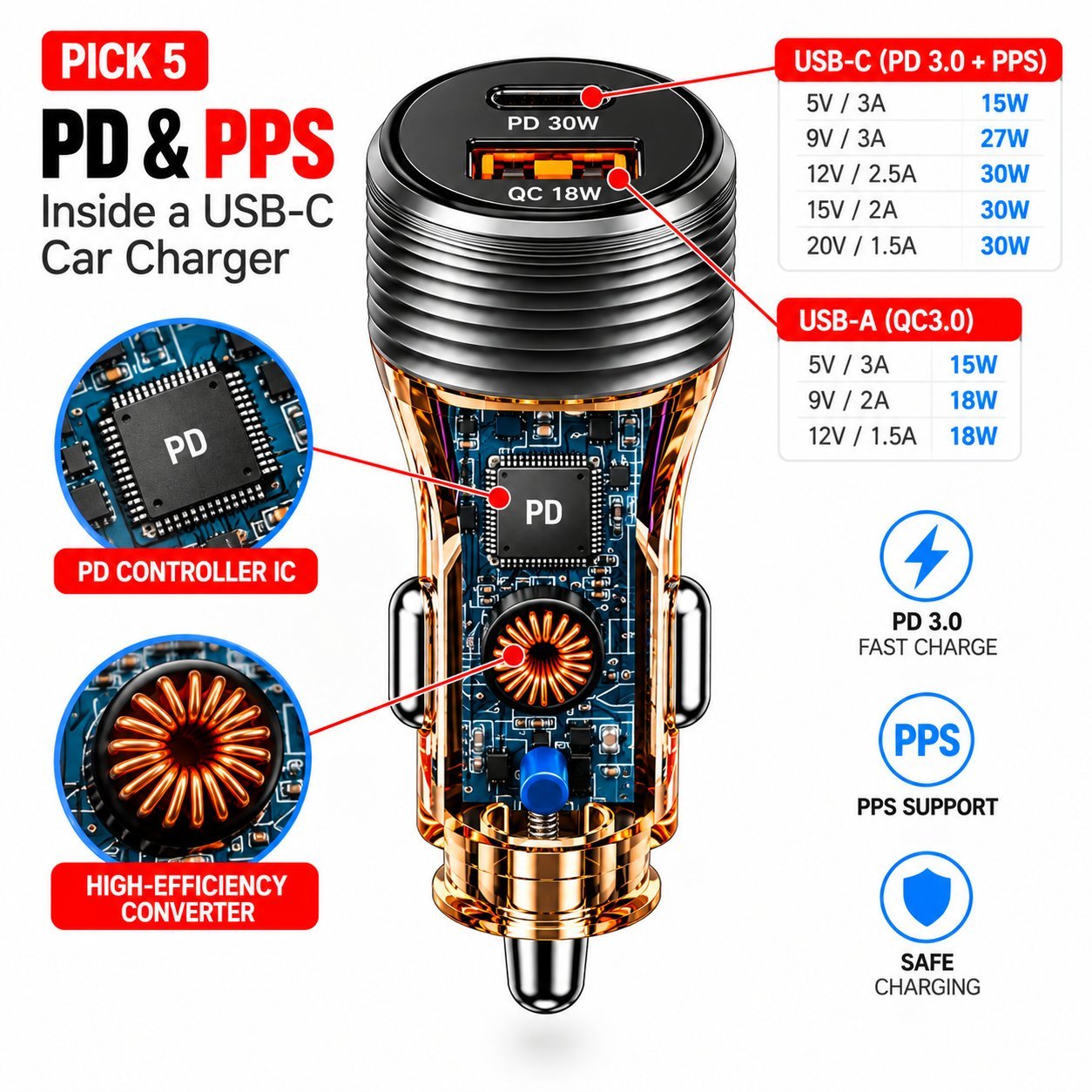
- The charging controller IC. A cheap IC outputs a flat 5V at whatever amperage the label claims, regardless of the device request. A genuine PD controller steps through voltage: 9V, 12V, 15V, and 20V options depending on what the device requests.
- Per-port PDO table. PDO stands for Power Delivery Object. Each one is a voltage and current pair the port can supply. A spec sheet that lists PDOs gives you exact delivery at each step. A spec sheet that just says “30W PD” without PDOs tells you almost nothing verifiable.
- Protocol match. iPhone 15 fast-charges at 9V/2.22A (20W). Samsung Galaxy S25-series fast-charges at up to 45W PPS. A charger without PPS (Programmable Power Supply) hits Samsung’s standard PD speed but not its peak. These are different numbers. Know which your device needs.
The Six Best USB-C Car Charger Picks
Pick 1: 40W Single USB-C (Best Overall for One Phone)
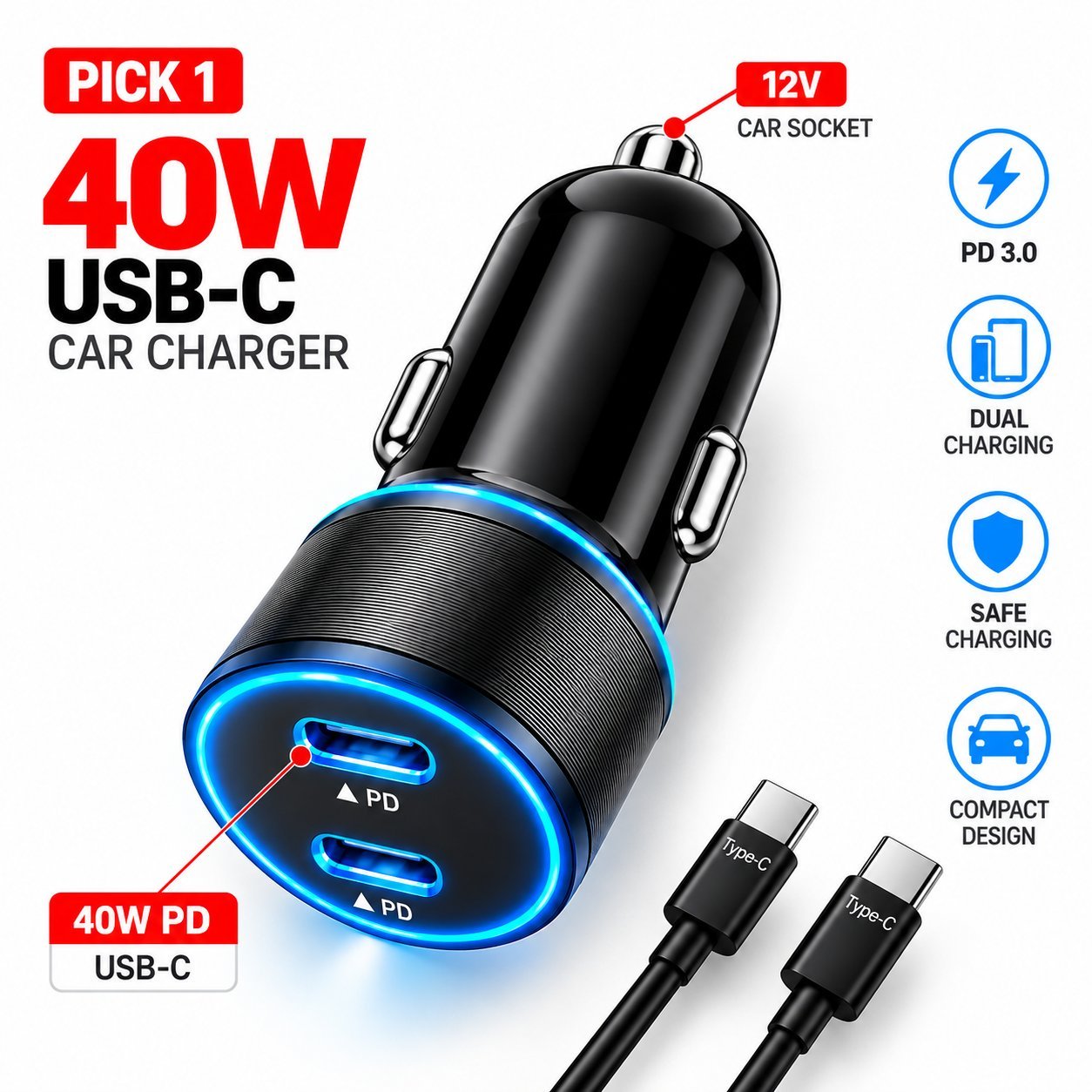
A 40W single USB-C port covers every major phone at its full rated fast-charge speed. At 9V/3A, it hits iPhone 15 Pro’s maximum input. At 9V/4.4A, it approaches Samsung Galaxy S-series peak for chargers without PPS. The power budget stays focused on one device, which keeps the charger cool in a 12V socket.
Best for: Daily drivers charging one phone at a time. Rideshare drivers charging between trips.
| Spec | Value |
|---|---|
| Output | 40W PD |
| PDO steps | 5V/3A, 9V/3A, 12V/3A, 15V/2.67A, 20V/2A |
| Certifications | CE, FCC, RoHS, E-Mark |
| Form factor | Flush mount, no protrusion |
Pick 2: 65W Dual USB-C (Best for Two Devices)
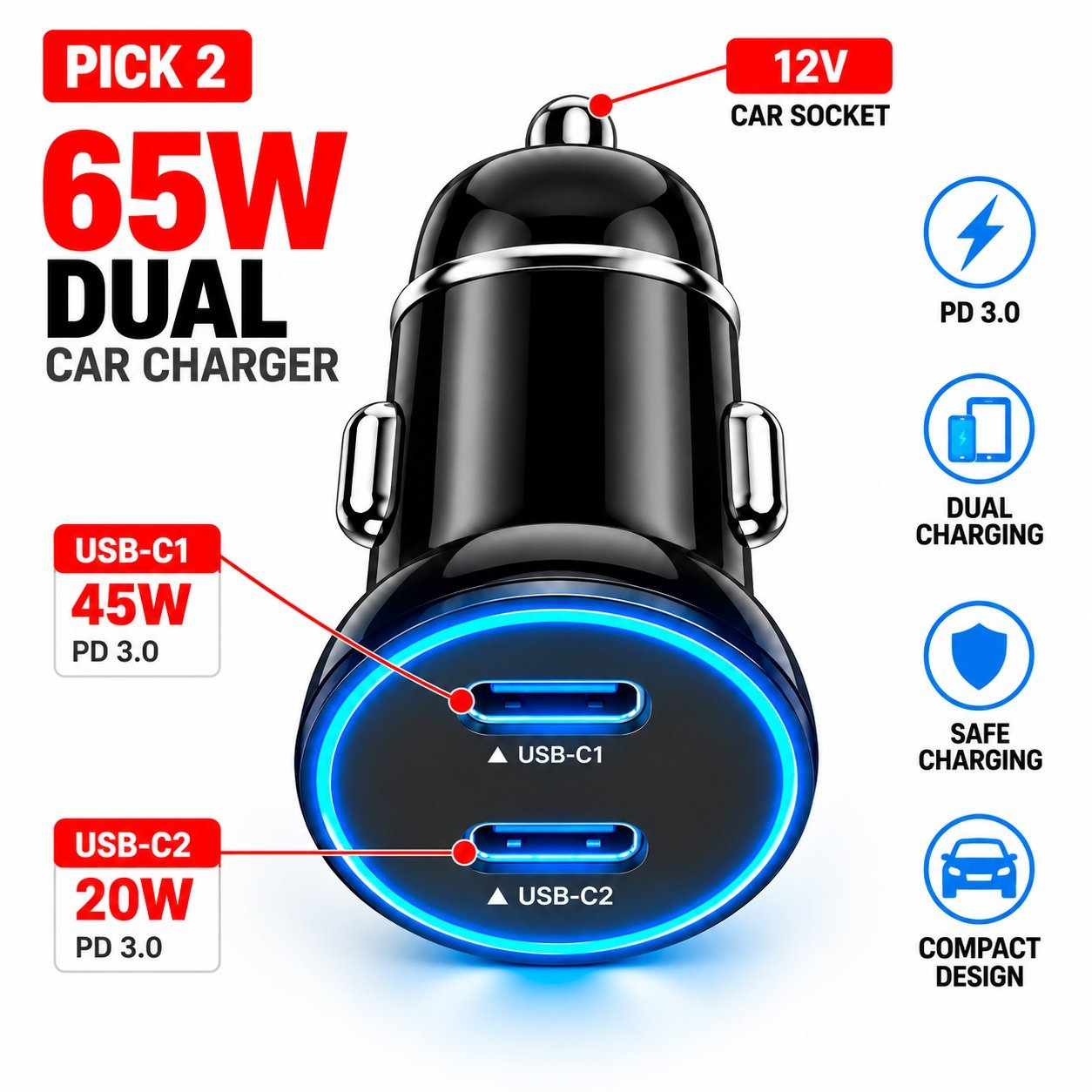
At 65W total, this charger splits power between two USB-C ports with intelligent power sharing. When one port runs alone, it gets the full 65W. When both ports are active, the split runs typically 45W and 20W or 30W and 35W, depending on device demand. It handles a phone at 20W and a tablet at 45W at the same time from one socket.
PPS support on this tier is what Samsung Galaxy S-series buyers need. Confirm your supplier’s spec sheet includes PPS PDOs, not just PD 3.0, before ordering.
Best for: Road-trip households charging phone and tablet together. Business drivers running navigation and device charging in parallel.
| Spec | Value |
|---|---|
| Output | 65W total, 45W max single port |
| Protocols | PD 3.0, PPS |
| Certifications | CE, FCC, RoHS, E-Mark |
Pick 3: 100W USB-C + USB-A (Best for Laptops)
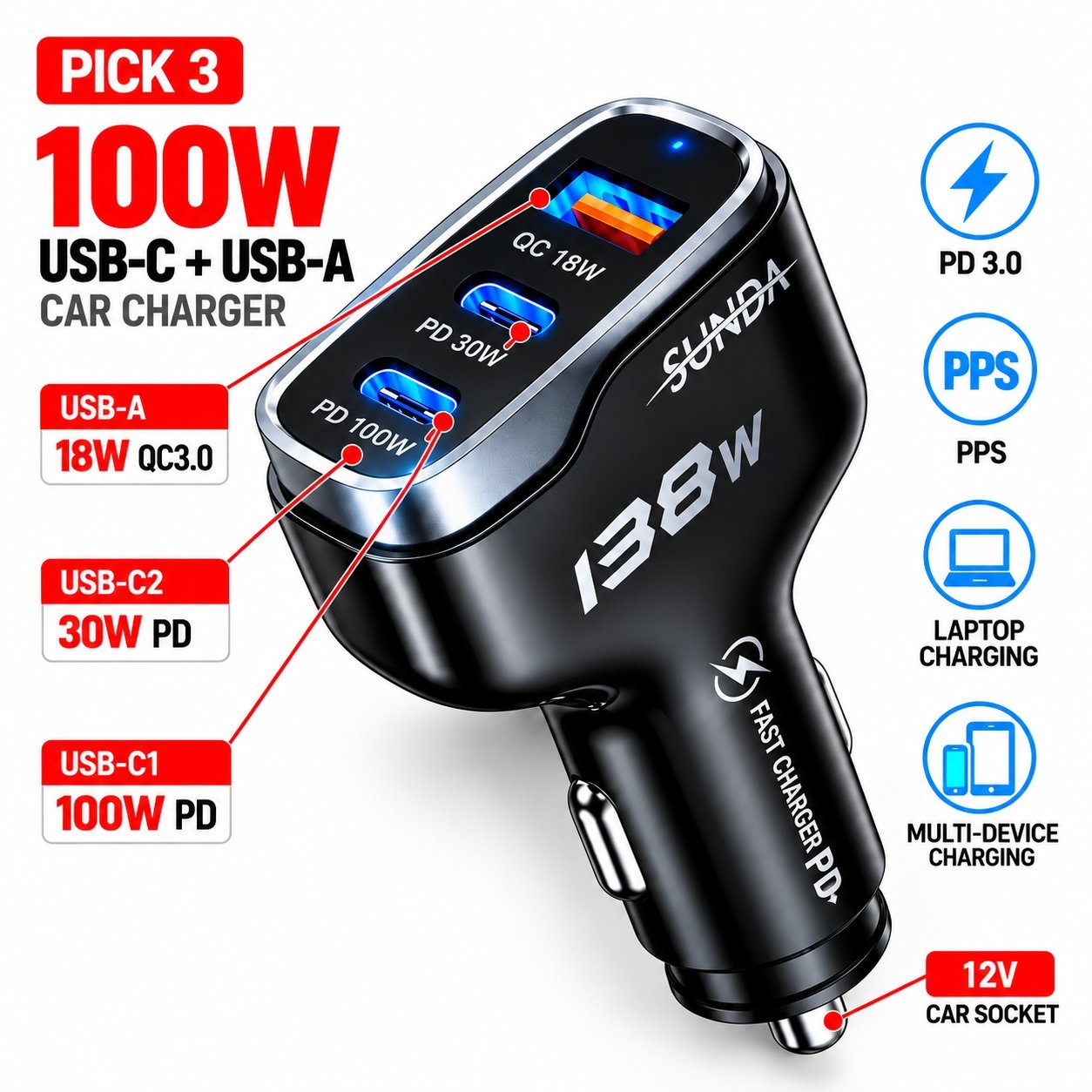
At 100W, this charger replaces a laptop power brick in your vehicle. The USB-C port delivers up to 100W single-device, enough for a MacBook Air M3 at 30W, a MacBook Pro 14-inch at 67W, or a Dell XPS 15 at 90W. The USB-A port adds 18W QC3.0 for a phone at the same time.
Fleet buyers, field sales teams, and road warriors who work from vehicles need this tier. It eliminates the choice between charging the laptop and charging the phone.
Best for: Laptop users in vehicles. Fleet procurement for work-device charging. Sales reps who present from a vehicle.
| Spec | Value |
|---|---|
| Output | 100W USB-C + 18W USB-A |
| Protocols | PD 3.0, PPS, QC3.0 |
| Certifications | CE, FCC, RoHS, E-Mark |
| Cable requirement | E-Mark cable required for 100W |
A 100W USB-C charging setup requires an E-Mark certified cable to carry 5A safely. SUNDA produces E-Mark USB-C cables for pairing with 100W charger programs. These are not the same cable that ships with a standard phone.
Pick 4: 30W Mini Flush (Best Compact)
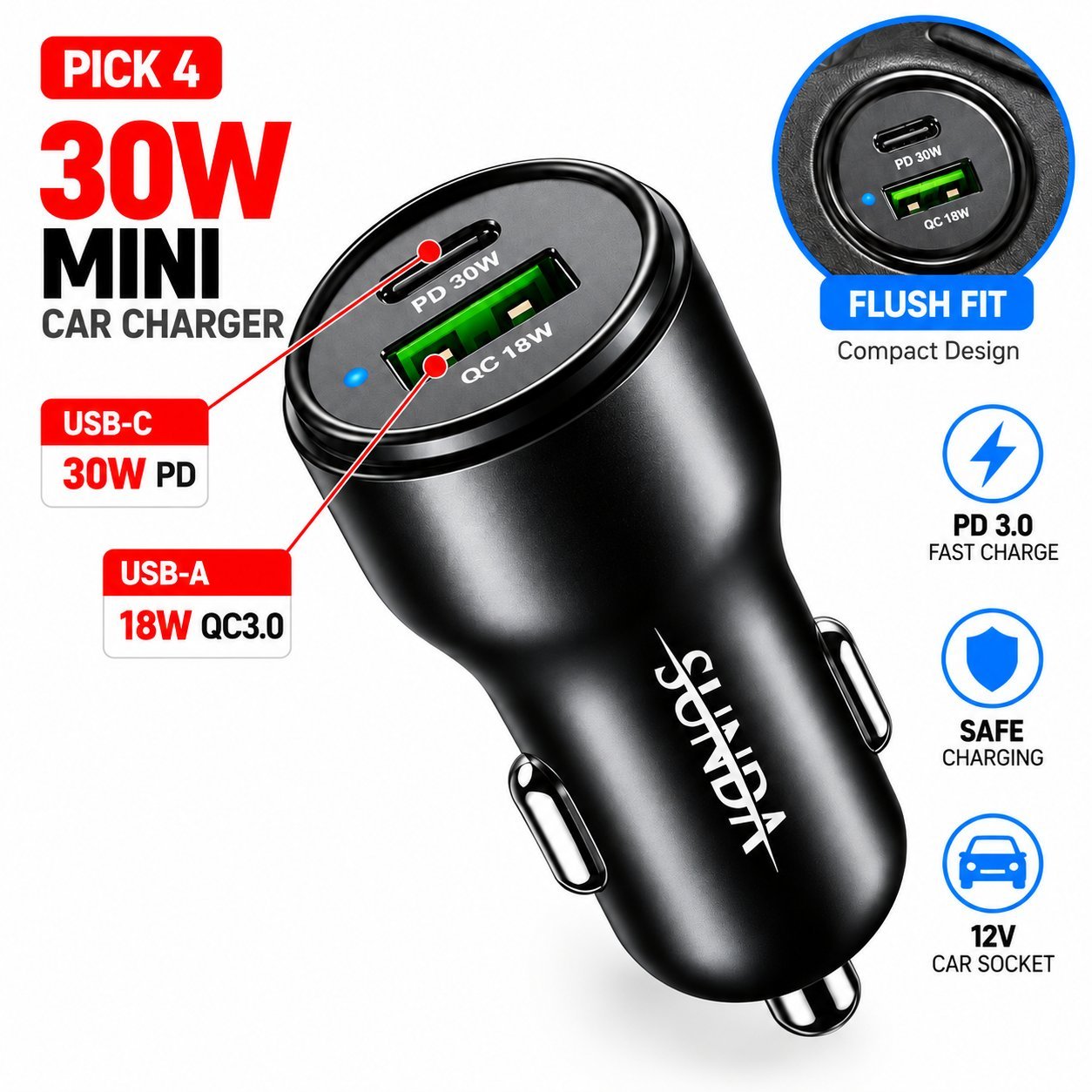
This charger sits flush with the lighter socket, with no protrusion, no cable, and no dongle. For car owners who want a permanent single-phone charger that is invisible when not in use, this is the pick. Output is 30W PD, which fast-charges any current iPhone at rated speed and handles Android phones up to their PD-standard fast-charge rate.
Best for: Users who leave the charger installed year-round. Anyone who dislikes the look of a protruding adapter in the console.
Pick 5: 20W Budget USB-C (Best Entry Level)
Apple rates iPhone 15 and all newer iPhone models at 20W maximum charge speed. A 20W PD port delivers exactly that: no wasted headroom, no budget spent on power the phone cannot use. For buyers who charge one phone per trip and do not need multi-device or laptop capability, this is the right spec at the lowest price in the USB-C car charger category.
Best for: Budget-conscious buyers. Secondary vehicle chargers. Promotional giveaways and bundled accessories.
Pick 6: Custom OEM / Private-Label Program
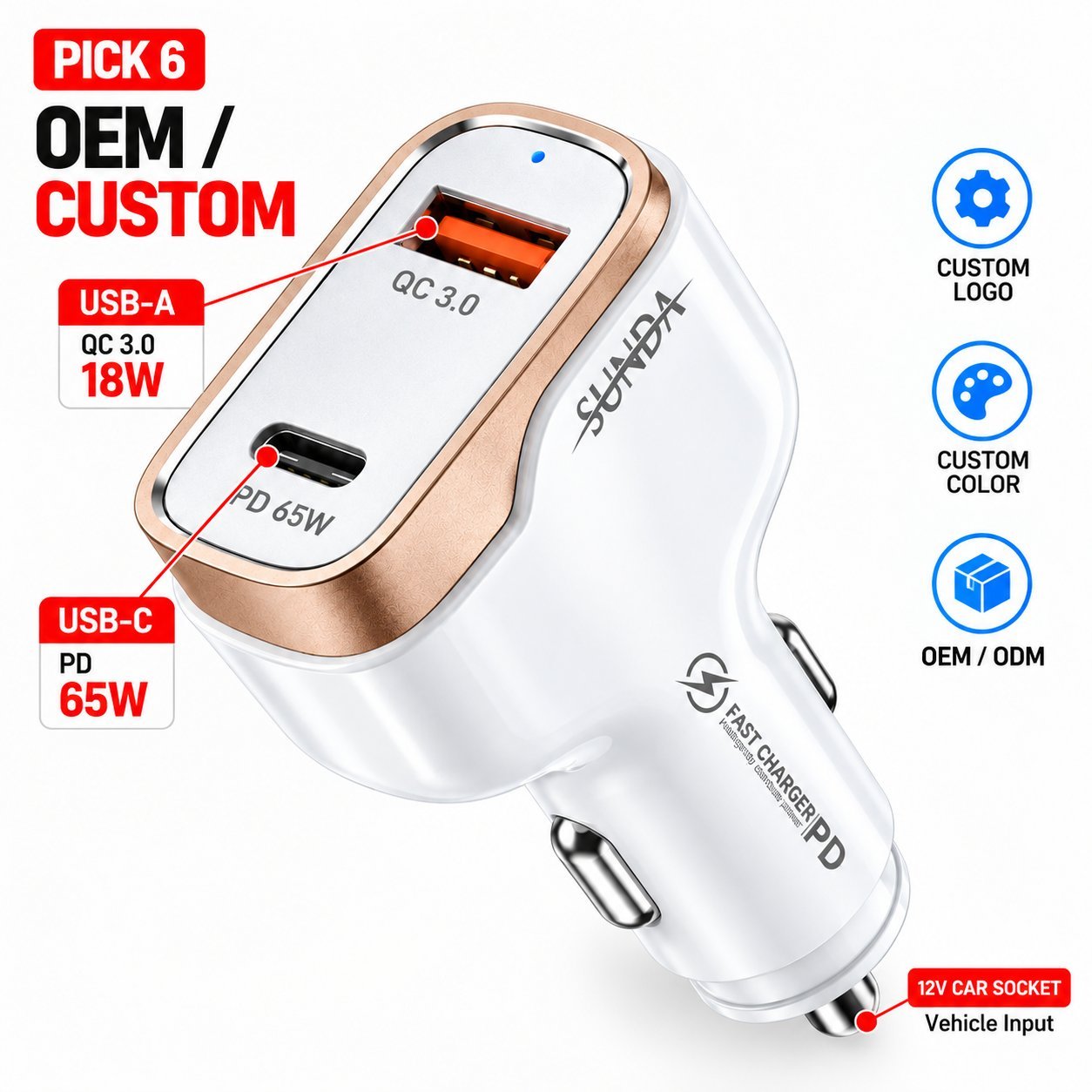
For importers, distributors, and private-label retail brands, SUNDA’s OEM program covers port count, wattage, housing color, logo, and packaging against a confirmed spec sheet. The CC53 series is the current reference platform. It runs PD 3.0 and QC3.0 in a compact form factor with E-Mark certification available. You get a production spec sheet with PDO tables before any deposit is placed.
View the CC53 series and request spec documentation before locking your next sourcing cycle.
Compatibility: iPhone, Android, and Laptops
| Device | Fast charge protocol | Recommended pick |
|---|---|---|
| iPhone 15 / 15 Pro | 20W PD (9V/2.22A) | Pick 1 (40W) or Pick 5 (20W) |
| iPhone 16 Pro Max | 30W PD (9V/3A) | Pick 1 (40W) |
| Samsung Galaxy S25 Ultra | 45W PPS | Pick 2 (65W dual, PPS required) |
| iPad Pro USB-C | 20W PD | Pick 1 or Pick 2 |
| MacBook Air M3 | 30W PD min | Pick 3 (100W) |
| MacBook Pro 14-inch | 67W PD | Pick 3 (100W) |
| Google Pixel 9 | 18W PD | Pick 1 or Pick 5 |
Samsung’s 45W fast charge requires PPS. Standard PD 3.0 without PPS charges a Galaxy S25 at around 25W, not 45W. That gap shows up on a long drive. If your charger spec sheet does not list PPS PDOs, it is not reaching Samsung’s peak.
For home charging in addition to car charging, SUNDA’s wall charger range covers the same PD 3.0 and PPS protocol tiers, useful if a buyer wants a matching charger set across home and vehicle.
Importer’s Margin Note
The USB-C car charger is the highest-volume SKU in the mobile accessory category for the second straight year. The Type-C transition is complete across all new phone models sold in 2025 and 2026. That creates a sustained replacement cycle. Buyers retiring micro-USB and older USB-A chargers represent ongoing demand, not a launch-window spike.
The wattage tier that moves best in wholesale B2B channels right now: 65W dual-port. One SKU covers multi-device households and fleet vehicles. The 40W single-port moves at the highest unit count in consumer retail.
The certification requirement that catches most new suppliers short: E-Mark on cables shipped with 100W chargers. E-Mark is mandatory for 5A USB-C cable use under EU in-vehicle device rules. SUNDA’s production line has E-Mark active on the cable SKUs bundled with 100W charger programs.
Standard production lead time is 7 to 15 working days for OEM programs. Sample lead time runs 3 to 7 days on existing tooling.
Send your wattage tiers, target market, and annual volume to the SUNDA team and you will receive a model recommendation and pricing within two business days.
Conclusion
The best USB-C car charger for 2026 is the one with a PD controller that delivers rated wattage at your device’s negotiated voltage, not a charger with a high number on the label on the label and a flat 5V output inside. For one phone, 40W PD is the right spec. For two devices, 65W with PPS covers Samsung at peak. For laptops, 100W with an E-Mark cable is what the device needs. For sourcing a private-label program, start from a confirmed PDO table and a certifications list, not packaging claims.
FAQ
What is the best USB-C car charger in 2026?
For single-phone daily use, a 40W PD single-port charger covers every current iPhone and Android flagship at full fast-charge speed. For two devices simultaneously, a 65W dual-port unit with PPS is the better choice. For laptops in the car, a 100W charger with an E-Mark cable is what you need. The right pick depends on how many devices you charge and whether any of them is a laptop.
Is 20W enough for fast charging in the car?
Yes, for iPhones. Apple rates iPhone 15 and all newer models at a 20W maximum charge rate, so a 20W PD port delivers exactly what the phone uses. For Samsung Galaxy S-series phones, 20W falls below the peak rate. A 45W PPS charger charges them noticeably faster over a 30-minute drive. For tablets and laptops, 20W is below useful fast-charge territory.
Do both ports on a dual USB-C charger deliver full power?
No. Dual-port chargers divide total wattage between ports. A 65W unit typically delivers 45W on one port and 20W on the other when both run at the same time. Some units use dynamic allocation to split 30W and 35W based on demand. Check the per-port PDO table on the spec sheet rather than the total headline output figure to know what each port actually supplies.
Can a Type-C car charger charge a laptop?
Yes, if the charger outputs 45W or higher on a single USB-C port and the laptop accepts USB-C charging. Most current ultrabooks (MacBook Air, Dell XPS, HP Spectre, Lenovo ThinkPad X1) charge at 45W to 100W over USB-C. At 100W, a car charger maintains full charge on a laptop in active use. An E-Mark cable is required for any setup running 5A (above 60W).
Are cheap USB-C car chargers safe?
The risk is in the charging controller IC. A unit without overcurrent, overvoltage, and short-circuit protection can damage a battery or overheat the socket. CE, FCC, and RoHS certification require testing for these failure modes as part of the compliance process. For any 100W setup, E-Mark certification on the cable is also required. Source from a manufacturer that provides actual certification documents by product, not just claims certification on the box.
Can I private-label USB-C car chargers?
Yes. SUNDA’s OEM program covers USB-C car chargers from 20W to 230W with custom logo, housing color, and retail packaging. Minimum order starts at 500 units per SKU. CE, FCC, RoHS, E-Mark, CCC, and UL are available depending on the target export market. Standard production lead time is 7 to 15 working days from sample approval.
Source USB-C Car Chargers for Your Brand
The full SUNDA car charger range spans 20W to 230W across single-port, dual-port, and multi-port platforms, with PD 3.0, PPS, and QC3.0 fast charging and CE, FCC, RoHS, and E-Mark certification. Private-label and OEM programs start at 500 units per SKU.
If you want per-port PDO tables, thermal test reports, or a sample run before volume, contact the SUNDA sourcing team with your target market and annual volume. OEM branding and ODM configurations are handled in-house.