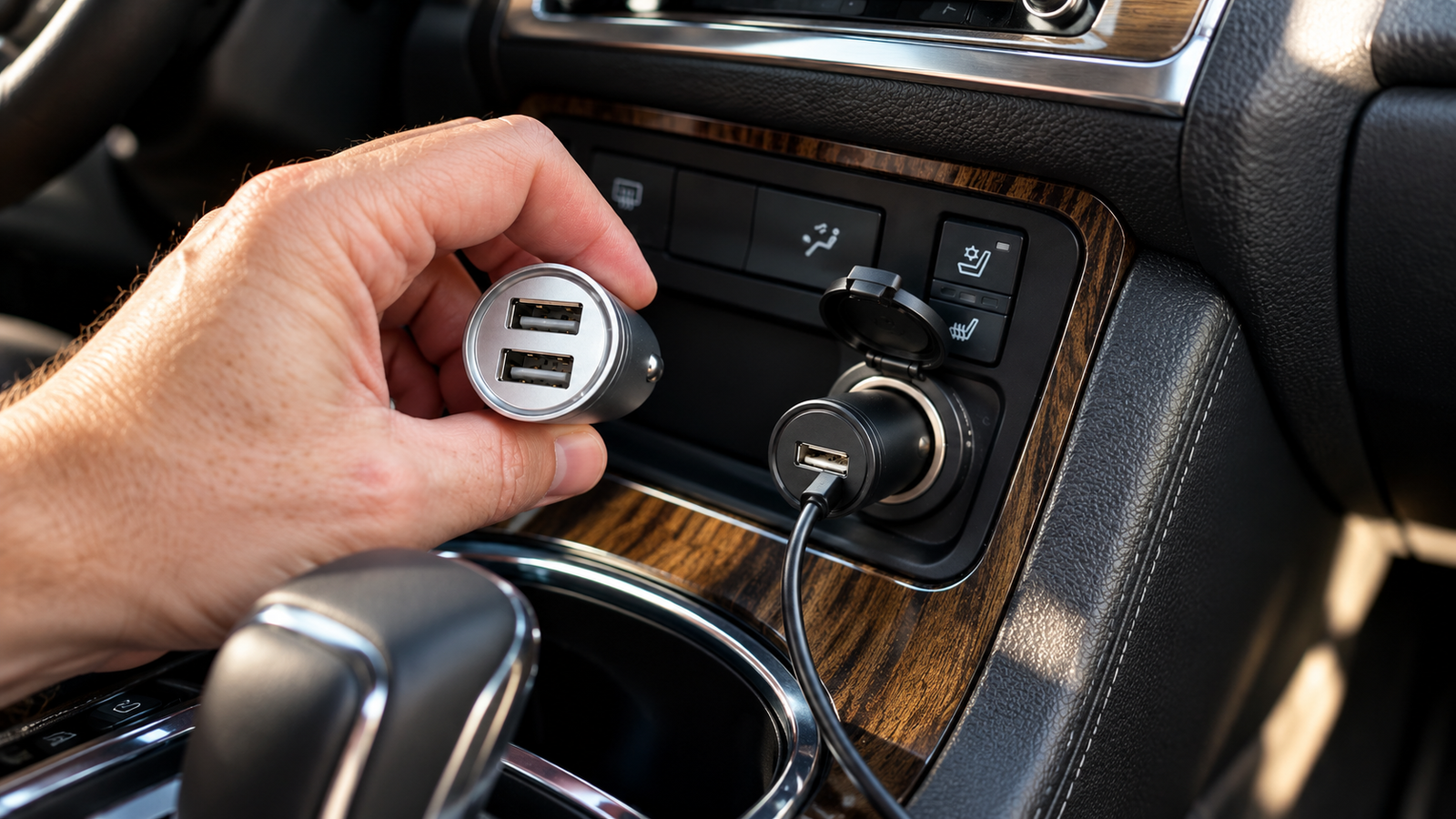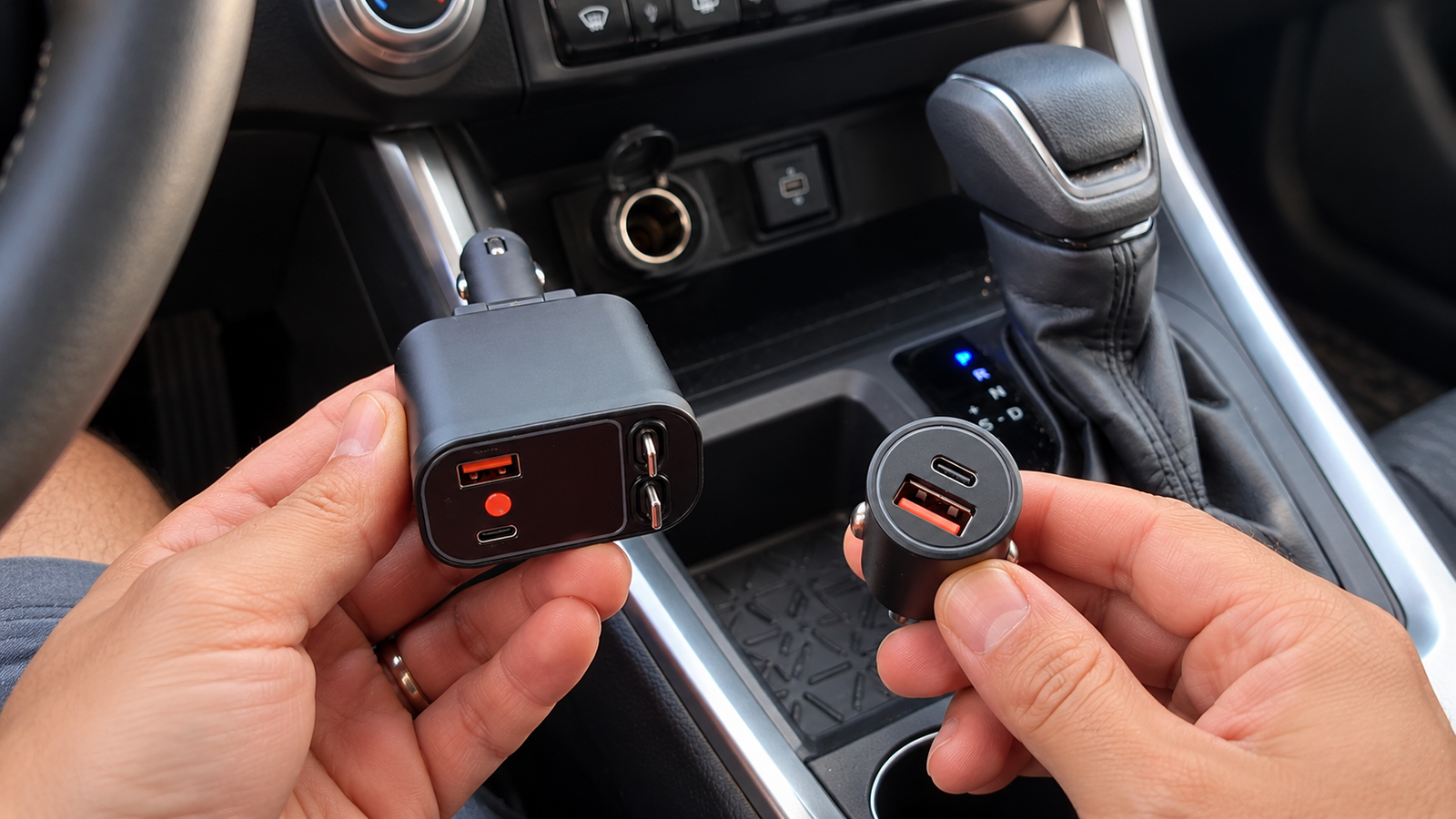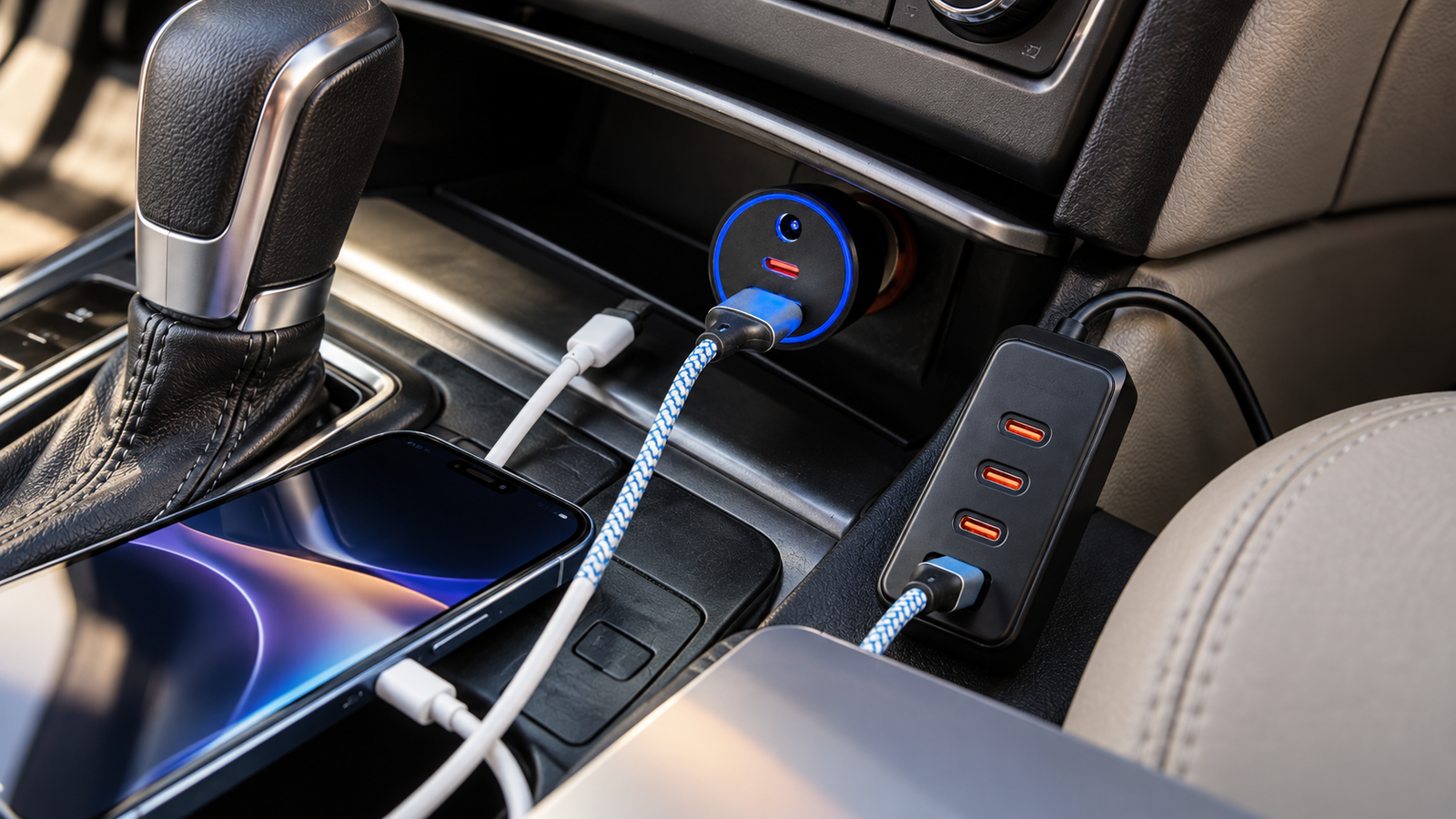
"PD" is printed on nearly every USB-C car charger sold in 2026. Ask most buyers what it means and you get "fast charging" as the full answer. That is not quite accurate. USB-C Power Delivery is a negotiation protocol. The charger and device agree on a working voltage before charging begins. Get that negotiation wrong and the unit will not fast-charge an iPhone 15, whatever the box claims.
What Is USB Power Delivery?
USB Power Delivery is an open standard managed by the USB Implementers Forum. The core function: let a charger and device agree on a voltage (5V, 9V, 15V, or 20V) and a current level, then deliver that combination over a USB-C cable.
Before PD, USB-A chargers ran at a fixed 5V. Faster charging required proprietary protocols locked to specific devices.
PD moved negotiation to the CC contact inside every USB-C connector. The charger announces available voltages and currents. The device requests what it needs. Both sides confirm, and the charger ramps to the agreed voltage in under 300 milliseconds. A 100W PD charger does not push 100W into your phone. The device draws only what its battery management system requests.
How PD Negotiation Works: The Voltage Ladder
When you plug a PD device into a PD charger, the CC line carries a short message exchange before fast charging begins.
The charger sends a Source_Capabilities message listing its available Power Data Objects (PDOs). A typical PD car charger lists 5V/3A (15W), 9V/3A (27W), and 15V/3A (45W). A high-output unit adds 20V/5A at 100W. The device picks its preferred PDO and sends a Request. The charger replies with Accept, then PS_Ready once the target voltage holds. Unplugging resets the output to 5V before the pins separate, preventing arcing at the connector.
| PDO | Voltage | Current | Power |
|---|---|---|---|
| PDO 1 | 5V | 3A | 15W |
| PDO 2 | 9V | 3A | 27W |
| PDO 3 | 15V | 3A | 45W |
| PDO 4 | 20V | 5A | 100W |
Standard Power Range caps at 100W. Extended Power Range adds 28V, 36V, and 48V for industrial use. The 12V PDO is optional in the spec and rarely included in car charger sets.
One point specific to car chargers: the automotive 12V rail sits at approximately 13.8V when the alternator runs and can sag below 6V during engine cranking on start-stop systems. Generating 5V or 9V from 13.8V is standard buck conversion. Generating 15V or 20V requires a boost stage. A unit claiming 20V output but built around a buck-only converter cannot hit that PDO under real load. Quality PD car chargers use a buck-boost topology across the full 6V to 36V automotive input range.
PPS: The Programmable Extension
PD's fixed voltage steps cover most devices. PPS (Programmable Power Supply) adds finer control on top.
PPS lets the charger and device agree on voltages in 20-millivolt steps across a 3.3V to 21V range, with current adjusting in 50-milliamp increments. Samsung's Super Fast Charging (25W on the Galaxy S24) and Super Fast Charging 2.0 (45W on the Galaxy S24 Ultra) both require PPS on the charger side. Without PPS, a Galaxy S24 Ultra falls back to around 15W rather than the 45W its charging IC supports.
PPS appears on spec sheets as "PD 3.0 with PPS." For a mixed fleet, a USB-C port without PPS leaves Samsung flagship charging speed short.
How Much Power Do Devices Actually Draw?
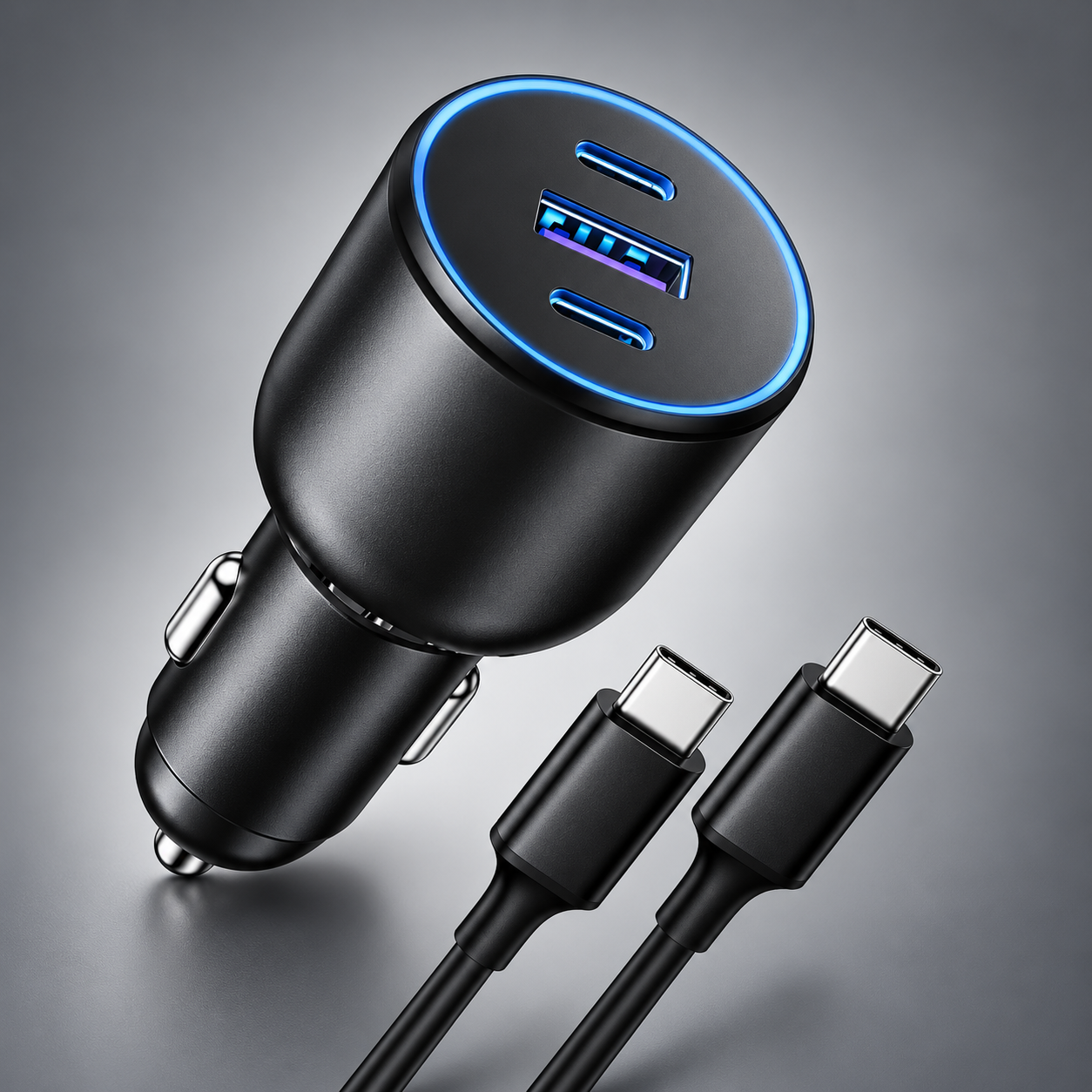
The device controls its own draw based on battery state, temperature, and what its charging circuit accepts. Knowing the peak draw of your target devices tells you which PDO the charger's USB-C port must advertise.
| Device | Peak PD Draw | Protocol |
|---|---|---|
| iPhone 15 / 15 Pro | ~27W | USB-C PD (20W minimum) |
| iPhone 15 Pro Max | ~27W | USB-C PD (20W minimum) |
| iPhone 16 / 16 Pro | ~27W | USB-C PD (20W minimum) |
| iPhone 17 / 17 Pro | ~27W | USB-C PD (20W minimum) |
| iPhone 18 / 18 Pro | ~27W | USB-C PD (20W minimum) |
| Samsung Galaxy S24 | 25W | PD 3.0 + PPS |
| Samsung Galaxy S25 | 25W | PD 3.0 + PPS |
| Samsung Galaxy S26 | 25W | PD 3.0 + PPS |
| Samsung Galaxy S24 Ultra | 45W | PD 3.0 + PPS (Super Fast 2.0) |
| iPad Pro M4 | 45W | USB-C PD |
| MacBook Air M3 | 67W | USB-C PD |
| MacBook Pro 14" | 96W | USB-C PD (E-mark cable required) |
| MacBook Pro 15" | 70W | USB-C PD (E-mark cable required) |
| MacBook Pro 16" | 140W | USB-C PD (E-mark cable required) |
Based on manufacturer specifications and independent published testing, 2025. Draw tapers as battery approaches full capacity.
Apple requires 20W or higher to trigger fast charging on iPhone 15 and later, with peaks around 27W in independent testing. The USB-C port needs to advertise at least 9V/3A to fast-charge any current iPhone.
For orders above 60W: USB-C cables carrying more than 3A above 20V must contain an E-marker chip. Without it, PD negotiation caps at 60W regardless of charger or device spec.
Inside a PD Car Charger: What the Spec Sheet Won't Tell You
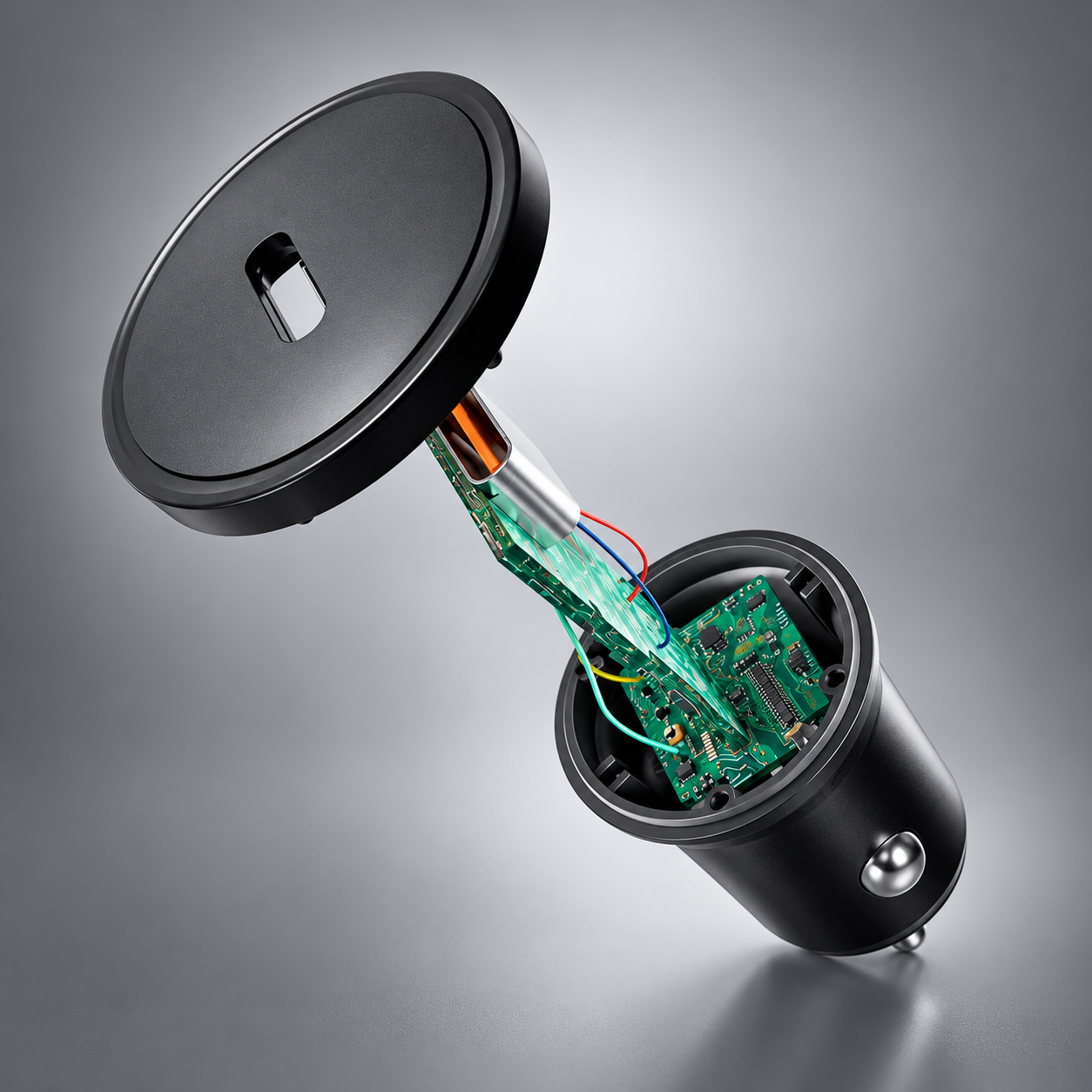
Every USB-C PD car charger has three core elements: a power conversion stage, a PD controller IC, and protection circuits. Quality differences almost always trace back to one of these three.
Conversion stage. Generating 15V or 20V from a 12V rail requires a boost stage. Cheap units use a buck-only design and claim 20V output regardless. Under load, the output drops, the PD handshake fails, and the device falls back to 5W.
PD controller IC. The controller manages CC-line negotiation and PDO advertising. Reputable IC families include Cypress (Infineon), Texas Instruments, and Maxim Integrated. A quality controller advertises only what the converter can supply.
Protection circuits. A properly built unit includes overvoltage protection (OVP), overcurrent protection (OCP), short-circuit protection (SCP), and thermal shutdown. These are required for CE and FCC certification. If a spec sheet lists those abbreviations without test documentation, ask for the report.
Spec sheet red flags for importers:
Total wattage stated with no per-port breakdown
"PD 3.0 100W" with no documented 20V PDO
CE mark that does not reference EN IEC 62368-1 in the test report
Shared port wattage with no individual maximums confirmed
PD vs. QC 3.0
| Feature | USB-C PD | QC 3.0 |
|---|---|---|
| Standard | USB-IF (open) | Qualcomm (proprietary) |
| Voltage range | 5V to 20V SPR | 3.6V to 12V |
| Connector | USB-C | USB-A or USB-C |
| iPhone support | Yes (iPhone 8 and later) | No |
| Samsung fast charging | Yes, PPS for Super Fast | Yes (select models) |
| Licensing | None | Required from Qualcomm |
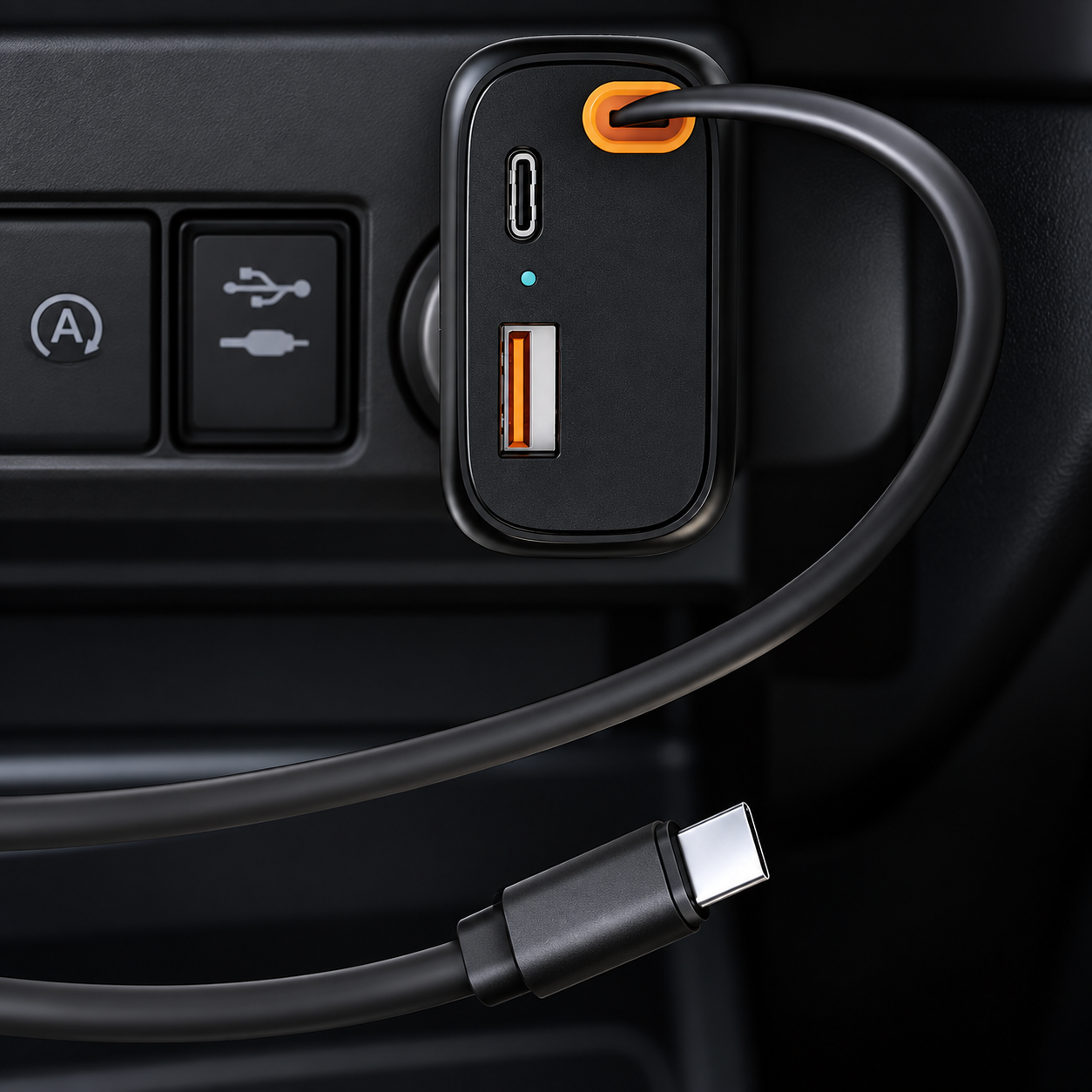
QC 3.0 uses Qualcomm's INOV algorithm in 200-millivolt steps between 3.6V and 12V. That covers compatible Android devices but has no effect on iPhones. One USB-C PD port covers iPhones, Pixels, and Galaxy S-series. QC 3.0 on USB-A covers older Android that predates USB-C.
PD Buying Checklist
For consumers:
USB-C PD port at 20W or higher for iPhone 15 fast charging
PPS support for Samsung Galaxy S23/S24 Ultra at full speed
CE, FCC, and RoHS on the same unit, not CE alone
For importers and private-label buyers:
Per-port PDO table in the spec sheet, not just total wattage
9V/3A and 15V/3A PDOs confirmed at minimum
20V/5A PDO for laptop charging
Buck-boost topology confirmed for 15V and 20V output
EN IEC 62368-1 referenced in the CE test report
The SUNDA car charger line covers 40W to 120W with per-port PD documentation and CE, FCC, and RoHS on every model. The 40W dual-port charger pairs 20W USB-C PD with a 20W USB-A port. The 90W dual-port model delivers 45W PD with PPS, covering Galaxy S24 Ultra at full speed alongside every current iPhone. The 120W four-port model adds two USB-A QC3.0 ports at 18W alongside two 60W USB-C PD ports, with UL, ETL, SAA, and CCC extending the core CE/FCC/RoHS set.
For documentation by export market, the car charger safety and certification guide covers what each standard governs.
Source PD Car Chargers With Documented Specs
If you're sourcing chargers for resale or fleet use, the PDO table, per-port wattage, and test reports separate a defensible purchase order from a spec-sheet guess.
SUNDA has manufactured car chargers since 2009, from a 2,000 sqm factory in Baoan District, Shenzhen, with CE, FCC, and RoHS across every model and select units adding UL, ETL, SAA, ISO9001, and CCC.
Contact the SUNDA sourcing team with your target market, port configuration, and annual volume. OEM branding and ODM configurations are handled in-house.
USB-C PD is a negotiation protocol. The charger and device agree on a voltage over the CC line and charge at that wattage. Quality car chargers use a buck-boost converter to reach 15V and 20V from a 12V rail. Budget units skip the boost stage and fall back to 5W under load. iPhone 15 minimum: 9V/3A. Galaxy S24 Ultra at 45W: the charger must include PPS.
FAQ
What does PD mean on a car charger?
PD stands for Power Delivery, a USB-IF protocol that lets the charger and device negotiate a working voltage (5V, 9V, 15V, or 20V) over the CC contact before charging begins. Output ranges from 15W to 100W per port depending on what both sides support. A car charger without PD outputs a fixed 5V regardless of what its label says.
Is USB-C PD the same as fast charging?
PD is a specific protocol, not a marketing category. Fast charging covers any method above the 5W USB baseline. PD covers iPhones and most Android flagships through one open standard with no proprietary licensing. QC 3.0 is Qualcomm-proprietary with no effect on iPhones. Multi-port car chargers often carry both.
Will a 65W PD car charger damage my phone?
No. The device controls its own draw through the PD handshake. A 65W charger offers 65W capability, but the phone requests only what its charging IC accepts: around 27W for an iPhone 15 or 25W to 45W for a Samsung Galaxy S24 series. A higher-rated charger provides more headroom, not more voltage.
Do I need PPS for Samsung phones?
It depends on the model. Galaxy S20 through S24 standard reach 25W on plain PD. Galaxy S23 Ultra, S24 Ultra, and several Galaxy Tab models use Samsung Super Fast Charging 2.0 at 45W, which requires PPS on the charger side. Without PPS, those devices charge at 15W or standard PD levels instead of their 45W maximum.
Can a PD car charger charge a laptop?
Yes, if the port supports the wattage the laptop needs. MacBook Air M3 draws up to 67W, covered by any 90W or 100W USB-C PD port. MacBook Pro 14" draws up to 96W. Cables above 60W need an E-marker chip to carry that current safely, so confirm charger wattage and cable rating together for laptop sourcing.
What's the difference between PD and QC 3.0 in the car?
PD is an open USB-IF standard that covers iPhones, Pixels, and most Android flagships over USB-C. QC 3.0 is Qualcomm-proprietary and works on compatible Android phones but has no effect on iPhones. A single USB-C PD port covers more device types from one connector. QC 3.0 on USB-A remains useful for older Android devices that predate USB-C.