.lsunda-article-wrap{color:#1e293b;font-family:inherit;line-height:1.72;max-width:100%;text-align:left!important}.lsunda-article-wrap *{box-sizing:border-box}.lsunda-article-wrap h2{color:#334155!important;font-family:inherit;font-weight:700;font-size:clamp(1.45rem,2.2vw,1.9rem);line-height:1.32;margin:2.55em 0 .75em;text-align:left!important}.lsunda-article-wrap h3{color:#334155!important;font-family:inherit;font-weight:700;font-size:clamp(1.12rem,1.7vw,1.35rem);line-height:1.38;margin:1.85em 0 .65em;text-align:left!important}.lsunda-article-wrap p{color:#1e293b!important;margin:0 0 1.05em;font-size:1rem;text-align:left!important}.lsunda-article-wrap a{color:#046bd2;text-decoration:none;font-weight:500}.lsunda-article-wrap a:hover{color:#045cb4;text-decoration:underline}.lsunda-list{margin:1.1em 0 1.9em;padding:0;list-style:none;display:grid;gap:.65em}.lsunda-list li{position:relative;padding:.78em 1em .78em 2.25em;border:1px solid #ECEFF3;border-radius:8px;background:#fff;text-align:left!important}.lsunda-list li::before{content:””;position:absolute;left:.95em;top:1.32em;width:.42em;height:.42em;border-radius:50%;background:#046bd2}.lsunda-imgrow{display:grid;grid-template-columns:repeat(2,minmax(0,1fr));gap:1.15em;margin:1.8em 0 2.1em;align-items:stretch}.lsunda-imgcol{min-width:0;overflow:hidden;border-radius:8px;background:#fff}.lsunda-figure{margin:0;overflow:hidden;border-radius:8px;background:#fff;height:100%}.lsunda-figure img,.lsunda-article-img{width:100%;aspect-ratio:1/1;height:100%;display:block;border-radius:8px;border:1px solid #ECEFF3;object-fit:cover;transition:transform .22s ease;transform-origin:center center}.lsunda-figure:hover img,.lsunda-article-img:hover{transform:scale(1.018)}.lsunda-tablewrap{width:100%;max-width:100%;overflow-x:auto;-webkit-overflow-scrolling:touch;margin:1.55em 0 2em;border:1px solid #D1D5DB;border-radius:8px;background:#fff}.lsunda-table{width:100%;min-width:860px;border-collapse:collapse;table-layout:auto;font-size:.95rem;color:#1e293b;background:#fff}.lsunda-table tr:first-child{background:#F0F5FA}.lsunda-table th,.lsunda-table td{text-align:left!important;padding:.85em 1em;border:1px solid #ECEFF3;vertical-align:top;line-height:1.55;overflow-wrap:anywhere}.lsunda-table th,.lsunda-table td:first-child{font-weight:700;color:#334155}.lsunda-table tr:not(:first-child):hover{background:#F9FAFB}.lsunda-faq{margin:1.15em 0 2.1em;border-top:1px solid #ECEFF3;text-align:left!important}.lsunda-faq-item{border-bottom:1px solid #ECEFF3;padding:0;margin:0;background:#fff}.lsunda-faq-q{cursor:pointer;list-style:none;color:#334155;font-weight:700;font-size:1.03rem;padding:1.05em 2.3em 1.05em .15em;position:relative;line-height:1.5;text-align:left!important}.lsunda-faq-q::-webkit-details-marker{display:none}.lsunda-faq-q::after{content:”+”;position:absolute;right:.35em;top:50%;transform:translateY(-50%);color:#046bd2;font-size:1.35rem;font-weight:500}.lsunda-faq-item[open] .lsunda-faq-q::after{content:”-“}.lsunda-faq-q:hover{color:#046bd2}.lsunda-faq-a{padding:0 .15em 1.15em;color:#1e293b;text-align:left!important}.lsunda-final-cta{margin:2.4em 0 2.2em;padding:1.45em 1.55em;border:1px solid #D1D5DB;border-left:4px solid #046bd2;border-radius:8px;background:#F9FAFB;text-align:left!important}.lsunda-final-cta h2{margin-top:0;text-align:left!important}.lsunda-cta-button{display:inline-flex;align-items:center;justify-content:center;min-height:44px;padding:.76em 1.15em;border-radius:4px;background:#046bd2;color:#fff!important;font-weight:700;line-height:1.2;text-decoration:none!important;transition:background-color .2s ease,transform .2s ease}.lsunda-cta-button:hover{background:#045cb4;color:#fff!important;transform:translateY(-1px)}.lsunda-pick{display:grid;grid-template-columns:minmax(220px,34%) minmax(0,1fr);gap:1.3em;align-items:start;margin:1.2em 0 2em}.lsunda-pick-media img{width:100%;aspect-ratio:1/1;height:auto;display:block;object-fit:cover;border:1px solid #ECEFF3;border-radius:8px}.lsunda-pick-copy h3{margin-top:0}@media(max-width:768px){.lsunda-article-wrap h2{margin-top:2.15em}.lsunda-imgrow{grid-template-columns:1fr;gap:1em}.lsunda-figure img,.lsunda-article-img{height:auto;aspect-ratio:auto;object-fit:contain}.lsunda-final-cta{padding:1.2em}.lsunda-pick{grid-template-columns:1fr}.lsunda-pick-media{max-width:520px}}@media(max-width:640px){.lsunda-table{min-width:760px;font-size:.9rem}.lsunda-table th,.lsunda-table td{padding:.7em .78em}}
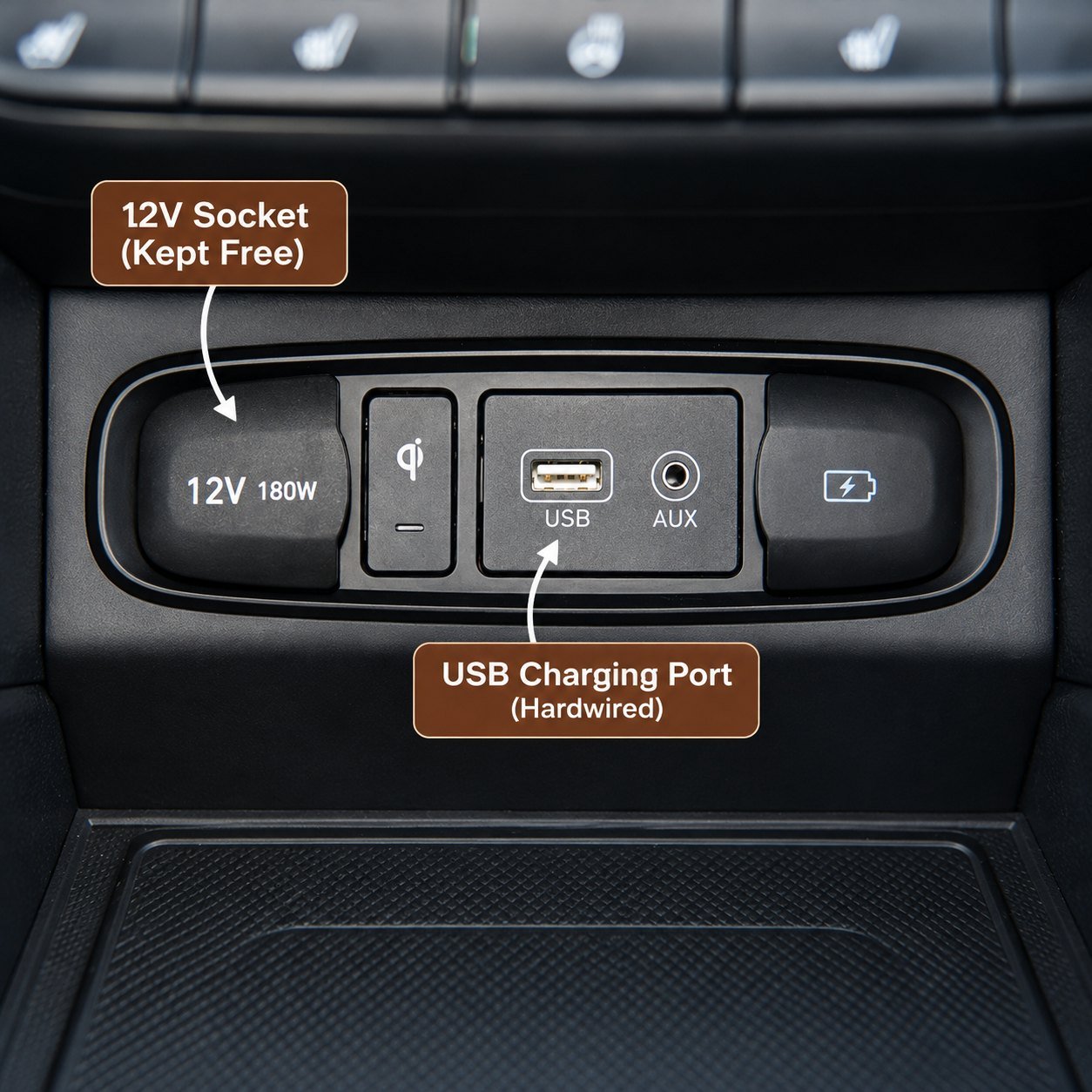
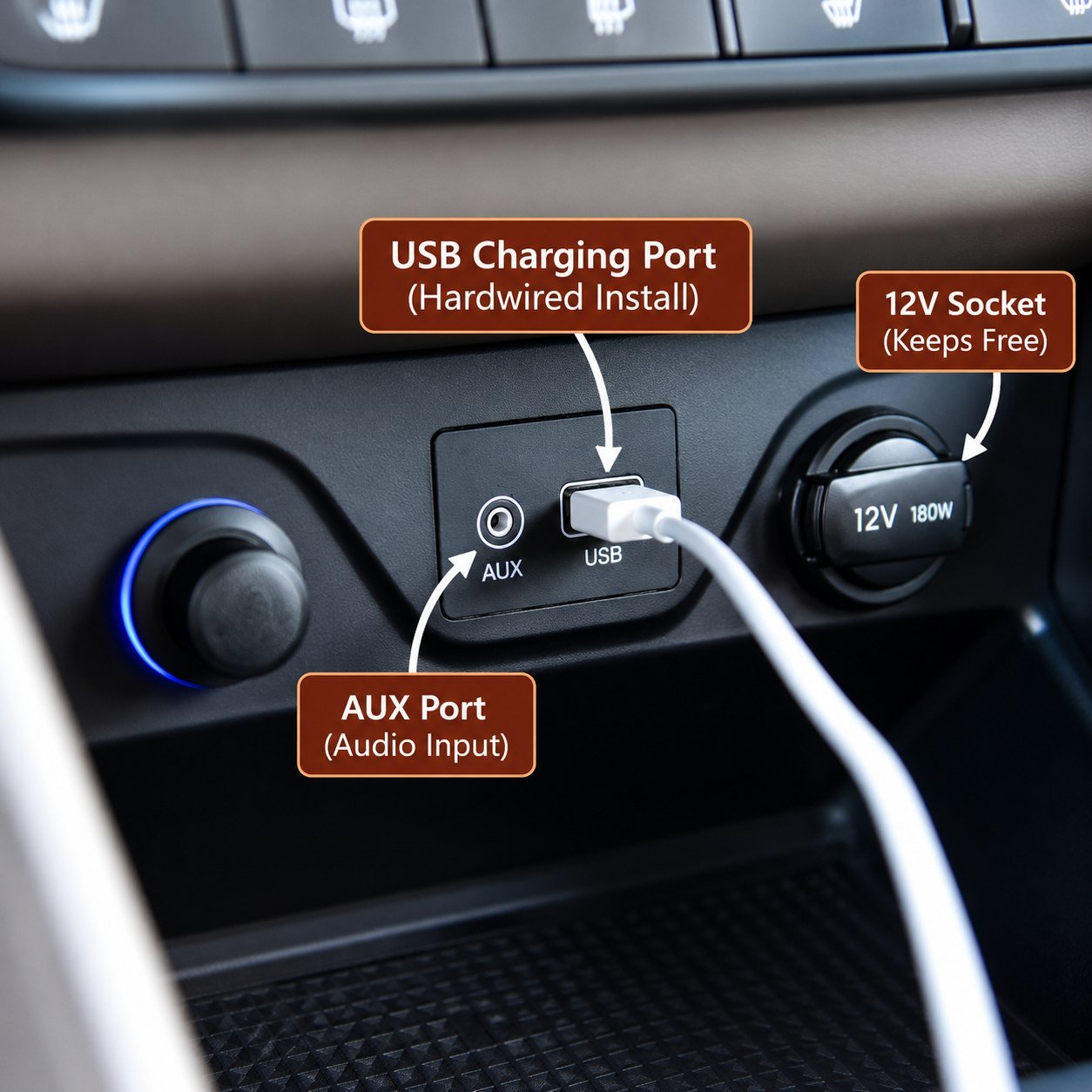
No dangling cables. No adapter sticking out of the 12V socket. The ports just appear where you want them and go live when you start the car. That is what hardwiring a USB charger gets you, and in 2026 it is the cleanest way to add fast charging to a vehicle that never had it. Hardwiring means connecting a USB module to a fused 12V source behind the dash. You pick ignition-switched power for auto-off, or constant power for always-on charging. The one rule you never break: fuse the circuit within 30 cm of the tap point.
Quick answer: Tap a fused 12V source with an add-a-circuit fuse holder, run the module’s lead to a switched or constant slot depending on whether you want auto-off, ground to bare chassis metal, and fuse the new circuit close to the tap.
Hardwire or Plug-In: Which One Makes Sense
A plug-in adapter takes two seconds and zero tools. A hardwired install takes an hour and a multimeter. The payoff is a permanent, hidden port that behaves like factory equipment.
Hardwire when you want the socket free, a clean dash, or specific ignition behavior a plug-in cannot give you. Stick with plug-in when the car is leased or you move the charger between vehicles.
| Factor | Plug-in adapter | Hardwired module |
|---|---|---|
| Install time | Seconds | 45 to 90 minutes |
| Looks | Adapter visible in socket | Fully hidden, factory look |
| Ignition behavior | Follows socket (often constant) | Your choice: switched or constant |
| Frees the 12V socket | No | Yes |
| Reversible | Fully | Leaves wiring if removed |
| Warranty risk | None | Low, if you avoid safety circuits |
What You Need Before You Touch the Fuse Box
Get the parts right first. A wrong fuse tap or an undersized wire turns a clean install into a fire risk.
Parts and tools:
- A hardwire-ready USB module (bare leads, not a socket plug)
- An add-a-circuit fuse tap sized to your fuse box (mini, standard, or low-profile mini blade)
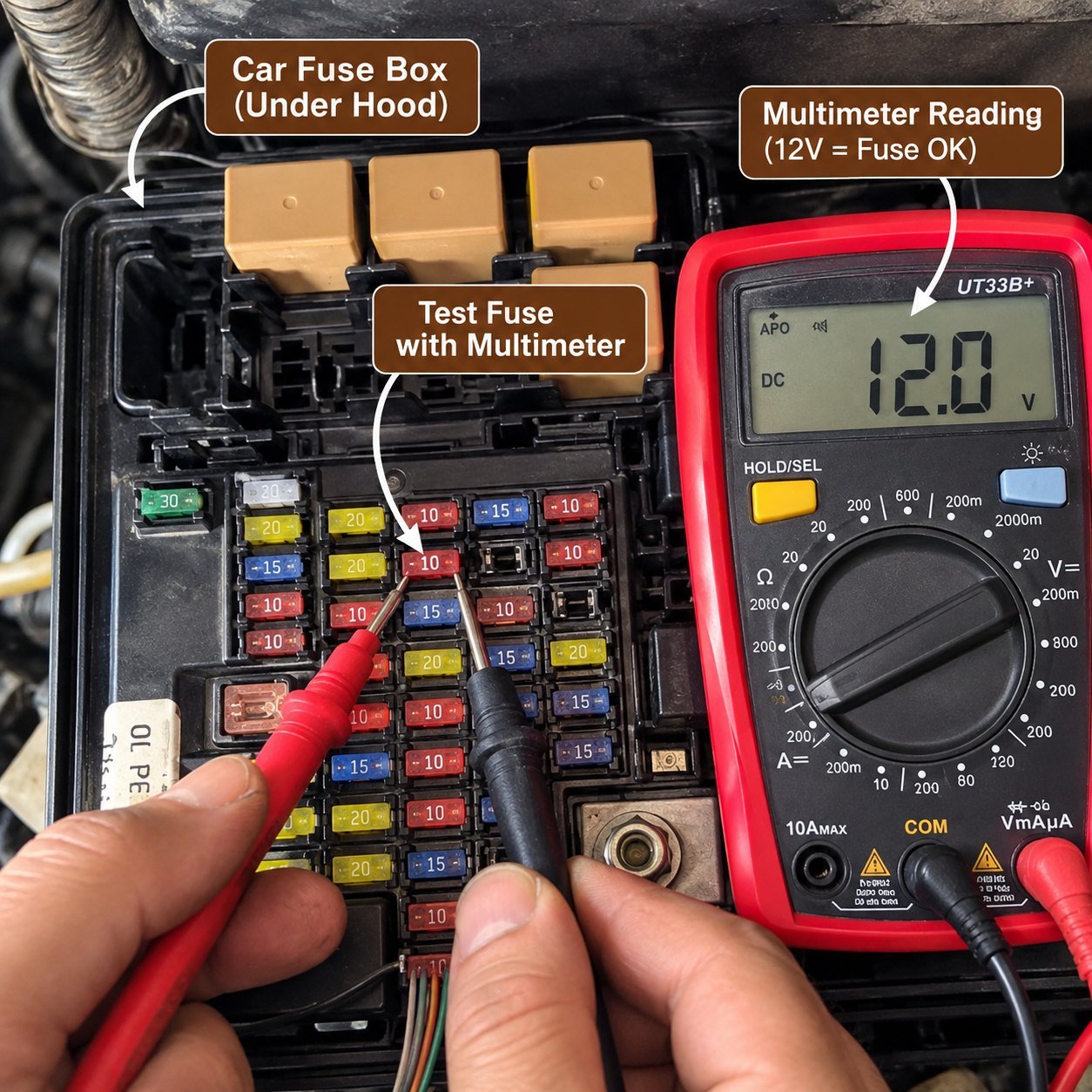
- A multimeter to find a switched power slot
- Crimp connectors and a ring terminal for the ground
- A fuse for the new circuit, rated to the wire gauge
- Trim removal tools to avoid cracking panels
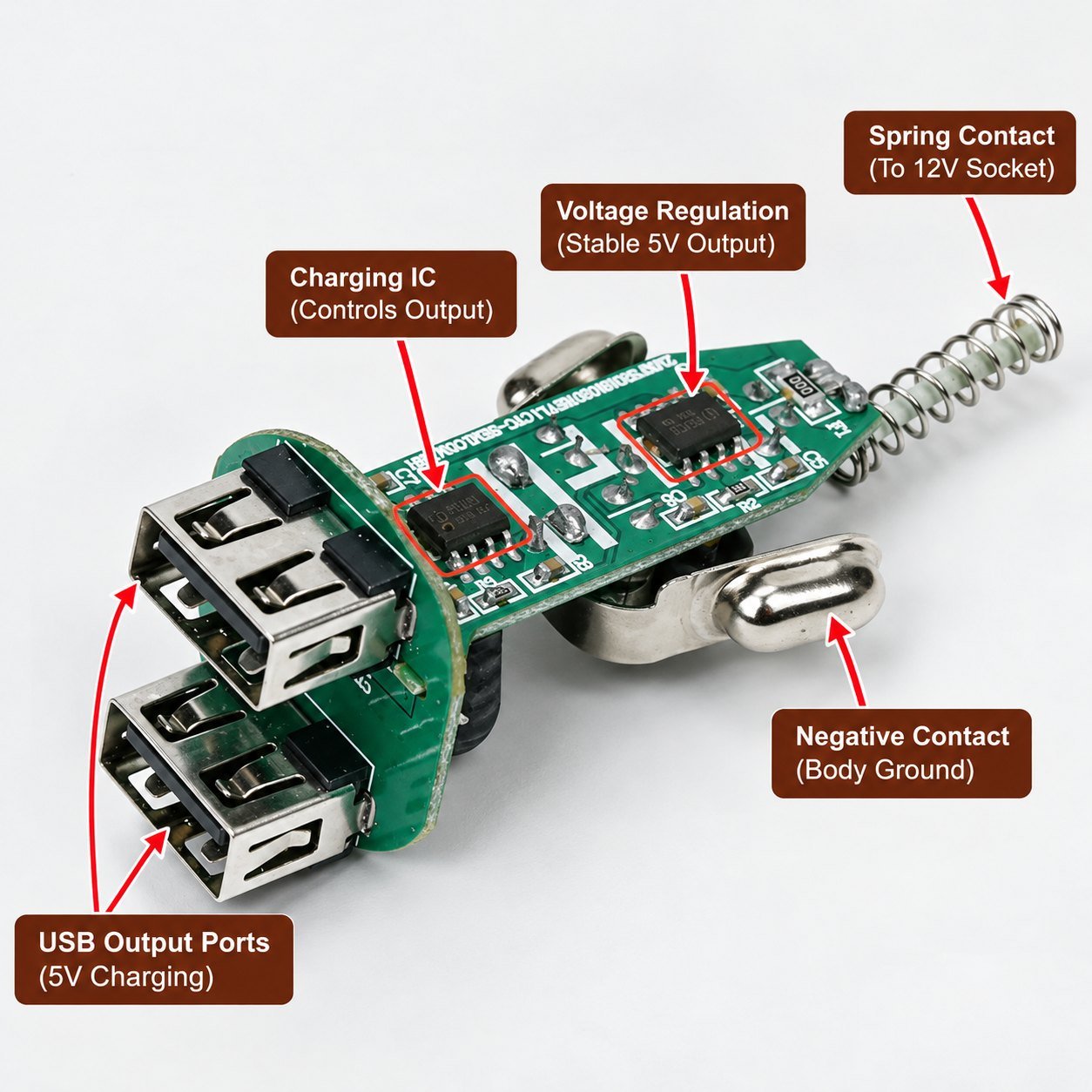
Choosing the module. The spec that separates a good hardwire module from a bad one is sleep current. A quality 12V USB-C charger hardwired into a constant circuit draws under 5mA at idle. A cheap one idles at 30mA to 50mA and will flatten a battery over a long park. Check the spec sheet for PD output, an IP rating if the module mounts in an exposed spot, and that sub-5mA standby figure. SUNDA’s car charger range lists quiescent current per model, measured on the factory bench, so you are not guessing.
Ignition-Switched Install, Step by Step
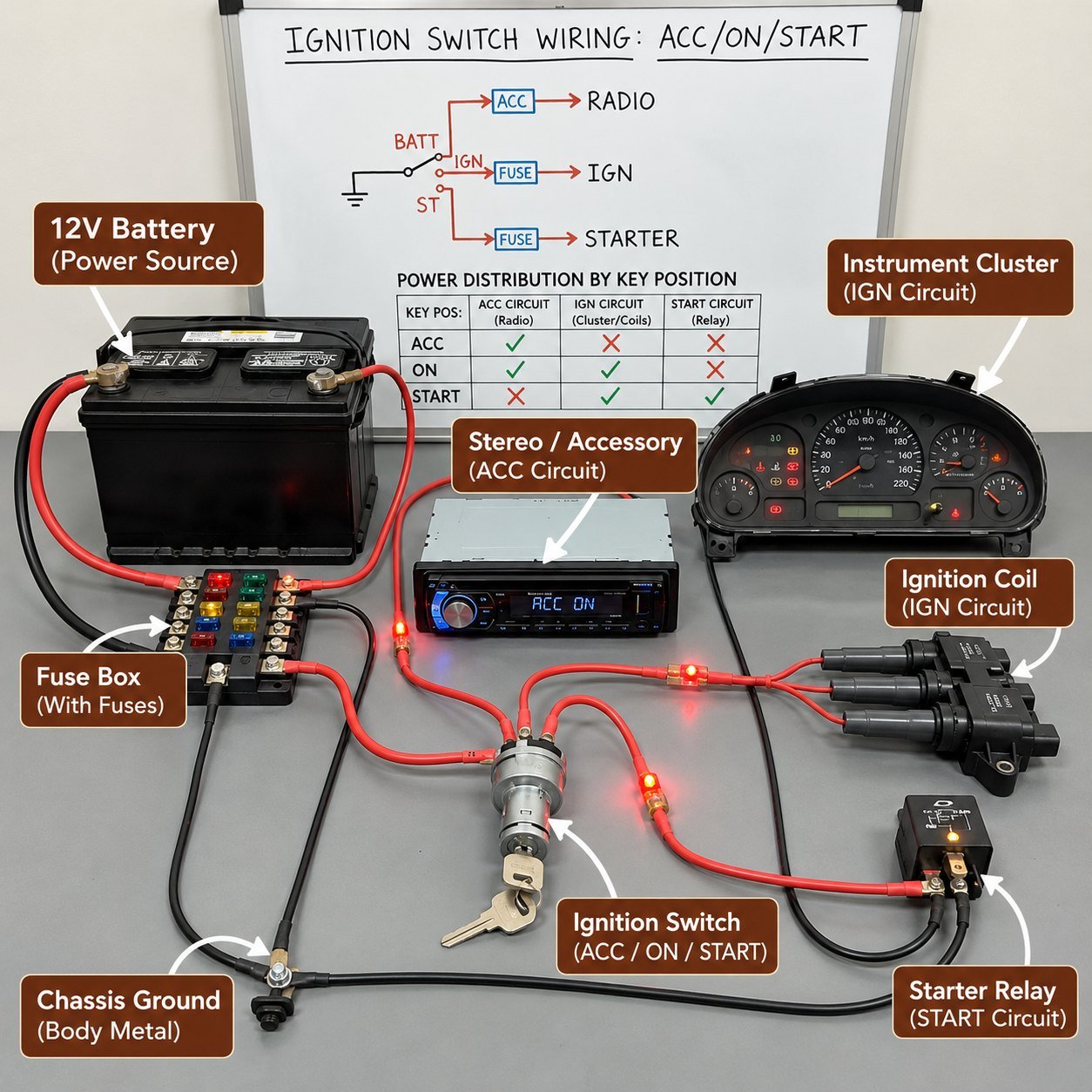
An ignition-switched install powers the ports when the key is on and cuts them when the key is out. No parked drain, no forgotten load on the battery. Here is the full sequence.
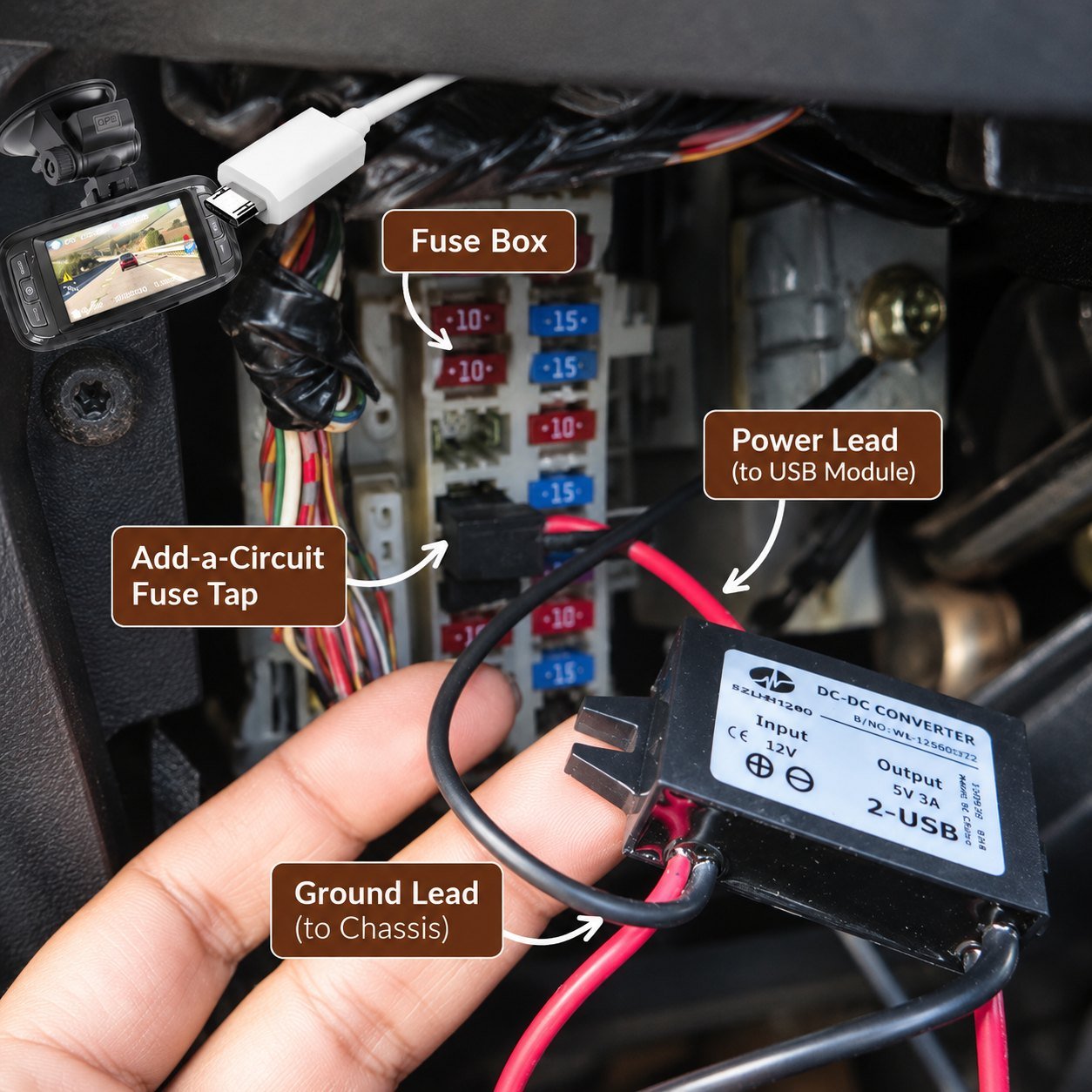
- Disconnect the battery negative terminal. Always first. This protects you and the vehicle electronics.
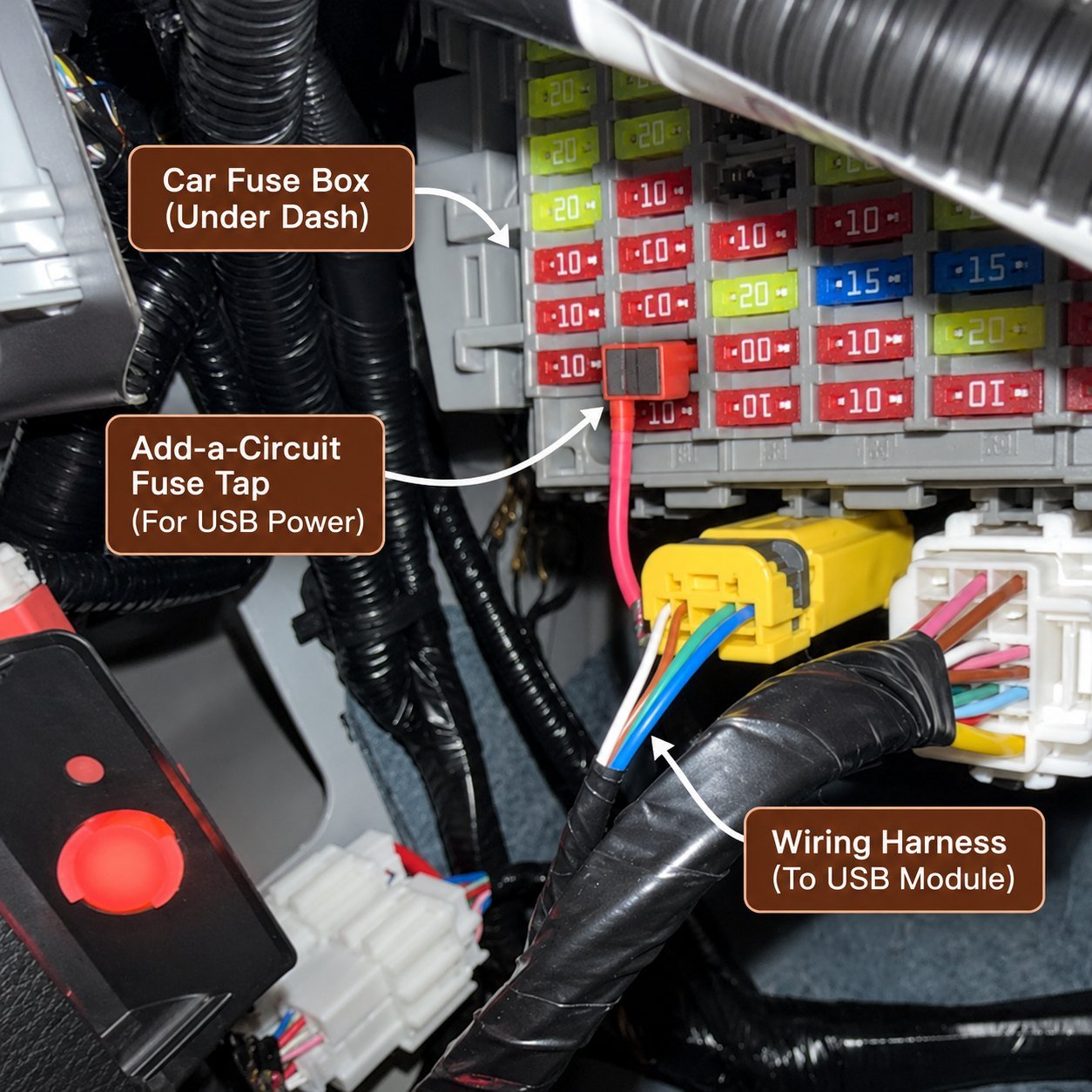
- Find the cabin fuse box. It usually sits behind the kick panel, under the dash, or behind a glovebox liner.
- Identify a switched slot. Set the multimeter to DC volts. Probe each fuse with the key in the accessory position, then with the key out. A switched slot reads around 12V with the key on and 0V with the key out.
- Check the fuse orientation. One side of the fuse is the feed, the other is the load. Note which side stays live, because the add-a-circuit tap must go in facing the right way.
- Install the add-a-circuit tap. Pull the chosen fuse. Seat it in the tap’s original slot, then fit a new fuse (matched to your module and wire) in the tap’s second slot.
- Crimp and run the power lead. Connect the module’s positive lead to the tap. Route it behind trim, away from pedals and any airbag deployment zone.
- Ground the module. Crimp a ring terminal to the ground lead and bolt it to bare chassis metal. Scrape off paint if you need to. A clean ground matters as much as the power side.
- Mount the module. Fix it where you want the ports, using the blank panel, ashtray cavity, or a drilled opening.
- Reconnect and test. Key on, ports should read live. Key out, ports should go dead. Tidy the run with loom or tape.
Warning: Never tap a slot feeding airbags, ABS, or any safety-critical system. If you are unsure which slot does what, pull the vehicle-specific fuse diagram before you start.
Constant Power vs Switched: The Battery Drain Math
Constant power keeps the ports live with the key out. You want this only for a specific reason, like running a dash cam in parking mode. For phone charging, switched power is the safer default.
Here is the math that matters. A module with a 5mA sleep current on a constant circuit draws 0.005A. Over a full day that is 0.12Ah. Across a month parked, roughly 3.6Ah. A healthy 60Ah car battery barely notices that.
The problem is a poorly designed module. One that idles at 50mA draws 1.2Ah a day, or 36Ah a month. That will leave you with a dead battery after a two-week holiday. This is exactly why sleep current is the number to check before you buy.
For a device that itself draws real power when parked, like a dash cam, add a dedicated low-voltage cutoff rather than relying on the charger alone. A full breakdown of parked-vehicle drain is worth reading before you commit to a constant-power install.
When a New Install Has No Power
Most first-time hardwire faults come down to three things. Work through them in order.
- No power at the ports. Check the add-a-circuit fuse orientation first. If the tap is seated backwards, the new fuse never gets fed. Then check the new fuse itself, and confirm the ground bolt is tight on bare metal, not on paint or a loose bracket.
- Ports work, then cut out. This is almost always a loose crimp. Re-seat and re-crimp the power connector. A marginal crimp passes the first test and fails once the car moves.
- Whine or buzz through the speakers. That is a ground loop. Move the module’s ground point closer to the head unit’s ground, or pick a module with built-in noise filtering. Cheap modules skip the filtering and let alternator noise onto the audio ground.
Installer and Fleet Supply
Workshops and fleet upfitters installing USB ports across many vehicles buy modules by the hundred, not one at a time. The spec priorities shift at that scale.
Custom cable lengths matter most. A module cut to the exact run for a specific vehicle model saves an installer minutes on every unit. SUNDA builds hardwire modules to specified lead lengths, with confirmed sub-5mA sleep current across the full production run, and the USB-C cables to match. The CC53 car charger series is the current hardwire-ready reference platform, with CE, FCC, RoHS, and E-Mark standard.
Send your vehicle models, lead-length needs, and annual volume to the SUNDA team for a quote and a sample within two business days.
Summary
Hardwiring a USB car charger is a one-hour job if you get three things right. Find a switched fuse slot with a multimeter, fuse the new circuit within 30 cm of the tap, and ground to clean chassis metal. Choose switched power for phone charging and constant power only for a dash cam or similar always-on device. Above all, buy a module with a verified sub-5mA sleep current so a constant-power install never costs you a battery.
Source Hardwire-Ready USB Modules
Send your vehicle models, lead-length needs, and annual volume to the SUNDA team for a quote and a sample within two business days.
FAQ
Is it safe to hardwire a USB charger in a car?
Yes, when you fuse the circuit correctly and avoid safety-critical slots. Fuse the new circuit within 30 cm of the power tap, match the fuse rating to the wire gauge, and never tap a fuse feeding airbags, ABS, or steering. A correctly fused and grounded hardwire install is as safe as factory wiring.
Should I use an ignition-switched or constant fuse?
Use a switched fuse for phone charging, so the ports cut off with the key and never drain the battery. Use a constant fuse only for a device that needs power while parked, like a dash cam in parking mode. Find a switched slot by probing with a multimeter, key on versus key out.
What gauge wire for a hardwired USB charger?
For the main power run, use 16 AWG stranded copper wire for runs under 10 feet at currents up to 10A. Short final module leads can use 20 AWG to 18 AWG stranded copper rated for 105°C automotive use. The rule is simple: the fuse protects the wire, so match the fuse rating to what the gauge can safely carry, never to the device wattage.
Will a hardwired charger drain my battery?
Only if the module has a high sleep current or you wire it to constant power. A module with a sub-5mA standby draw on a switched circuit draws nothing with the key out. On a constant circuit it draws about 3.6Ah a month, which a healthy battery handles easily. A module idling at 50mA is the real drain risk.
Does hardwiring void my car warranty?
A clean hardwire install that taps an accessory fuse and avoids safety circuits carries low warranty risk. Manufacturers cannot void an entire warranty over an aftermarket accessory unless that accessory caused the specific failure being claimed. Keep the install reversible and avoid cutting factory wiring to stay on the safe side.
Can I buy hardwire-ready USB modules in bulk?
Yes. SUNDA supplies hardwire-ready USB modules to installers and fleet upfitters from 500 units per SKU, with custom lead lengths, logo printing, and verified sub-5mA sleep current across the production run. CE, FCC, RoHS, E-Mark, and UL are available by target market, with 7 to 15 working days lead time from approved sample.